The pound fell to 1.3280 against the dollar, facing a double test from the UK budget and the Federal Reserve's decision.
2026-10-28 15:20:23
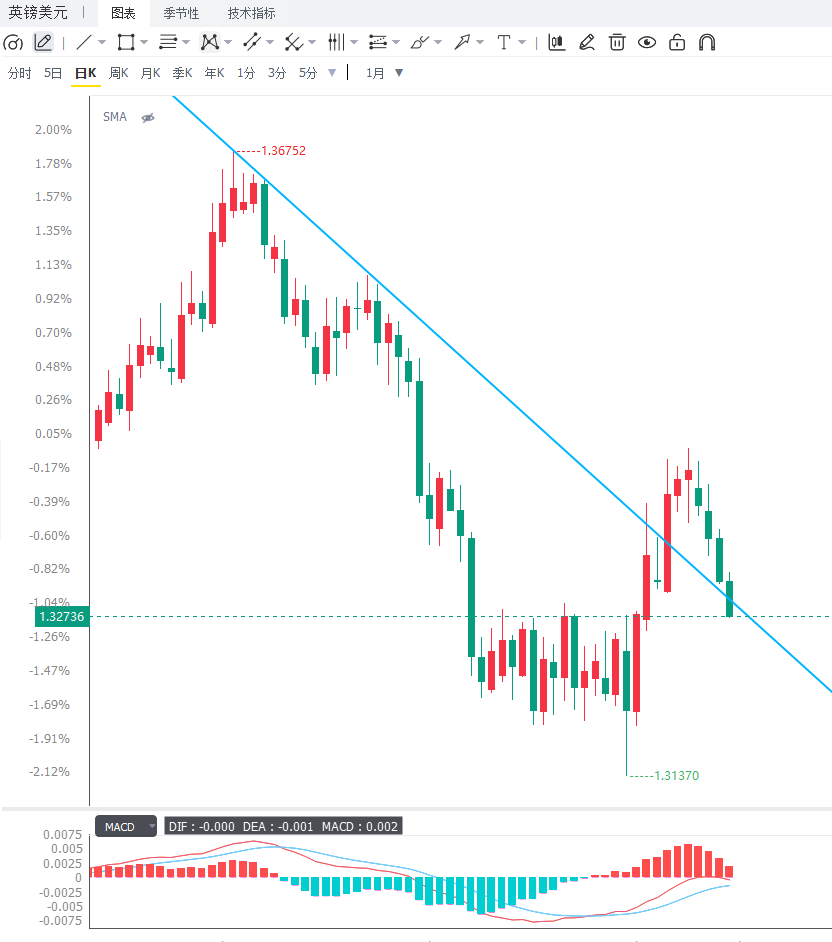
On Wednesday during Asian trading hours, the pound traded around 1.3280 against the dollar, with narrowing fluctuations. This level carries a dual significance: it is both a key psychological level since this week's rebound and a watershed between bullish and bearish sentiment amid the dual uncertainties of the budget bill and the Fed's decision. The market's decision to remain on the sidelines before these two major events are resolved reflects a typical state of "headwinds not yet dissipated, catalysts not yet arrived"—the hawkish pricing on the dollar side has not yet been disproven, and the pound lacks sufficient fundamental catalysts to reverse its decline.  From the perspective of the pound, the core contradiction lies in the conflict between fiscal credibility and policy space. Healy faces the dual demands of alleviating household cost-of-living pressures and supporting businesses, but his options are limited by high government borrowing costs and the massive tax increases implemented by his predecessor, Reeves. PGIM Global Investment Strategist Guillermo Felices points out, "It's difficult to remain unaffected in an environment of rising global bond yields, but among major developed markets, the UK looks like 'the cleanest dirty shirt.'" This highlights the current relative positioning—the UK's weakness is more relative than absolute. The Bank of Scotland further notes that "a budget that maintains fiscal credibility is at worst neutral to the pound." This means that the downside risks of the budget have already been partially priced in; what could truly trigger a significant weakening of the pound is a market reassessment of debt sustainability, rather than simply the spending figures. Furthermore, Bank of England Governing Council member Green's speech received a score of 7.4/10, exactly in line with historical averages, but he emphasized that the wage deflation process has stalled above the 2% concordance inflation level, and the risk of second-degree effects is rising. The economy has shown "remarkable resilience," and the slack in the labor market may have peaked. This combination of "resilience and sticky wages" means that the Bank of England's pace of interest rate cuts may be slower than some of its peers, thus providing some support for the pound—a key reason why the pound has not weakened in tandem with the euro. The pressure on the dollar is more direct. The October rate freeze has already been fully priced in, so the meeting itself is unlikely to provide incremental growth; the real variable lies in the expected revision of the year-end path. Any hawkish comments from Fed officials could push up the dollar and create headwinds for the currency pair. In a horizontal comparison, this divergence is widening. When the dollar's strength stems more from the relative weakness of non-dollar currencies, the pound, as a heavily weighted counterparty, naturally becomes one of the targets of pressure; however, compared to the euro's triple burden of energy costs and volatility in French fiscal and government bonds, the pound's fundamentals are slightly better, which determines its relatively moderate decline. The Bank of Scotland also expects that "a moderate loss in the pound should attract bargain hunters"—indicating that the current pullback is more of a technical correction than a trend reversal. From a cross-asset perspective, the current weakness of the pound is essentially a confluence of three factors: first, the valuation ceiling created by the persistently high interest rate differential between Europe and the US; second, the regional risk premium resulting from rising UK fiscal and government bond yields; and third, the contraction of positions ahead of the budget. It's worth noting that the same round of Middle East geopolitical developments has had inconsistent effects on different assets: it has been a pure upward driver for crude oil, a boost for gold due to easing inflation concerns, and a safe-haven support for the US dollar—while for the pound, it has indirectly suppressed it through the US dollar index channel, while being partially offset by the hawkish stance of the Bank of England. This divergence indicates that the net direction is not determined by the event itself, but by the relative strength of the forces in each transmission chain. Investors should not view the pound's single-day decline in isolation, but rather assess it within the transmission chain of "interest rate differential—fiscal policy—central bank pace—US dollar index": only when the Bank of England clearly slows its pace of interest rate cuts, or when the budget demonstrates unexpected fiscal discipline, will the pound's short-term bottom have credibility. On the daily chart, the pound/dollar pair is trading around 1.3280, with an overall bearish bias. The price is trading below the 100-day moving average of approximately 1.3390. Although there has been a slight rebound from recent lows, the overall tone remains bearish. The exchange rate is consolidating above the 20-day Bollinger Band, indicating some buying demand in the near term. The RSI (14) is around 47, below the 50 midline, suggesting that bullish momentum is still tentative, representing a typical "bearish trend, indicators needing repair" pattern. The upper resistance levels to watch are the 100-day moving average of approximately 1.3390 and the upper Bollinger Band of approximately 1.3415. If the exchange rate continues to rise, sellers may regain control here. The lower support levels to watch are first the middle Bollinger Band of approximately 1.3260, followed by the lower Bollinger Band of approximately 1.3150, which has a more substantial buffering effect. If this level is broken, the possibility of accelerated decline cannot be ruled out. On the 4-hour chart, the exchange rate is slowly moving downwards along the short-term moving average. The MACD histogram is close to the zero line, with the fast and slow lines repeatedly intertwined, indicating weak momentum. Currently, the price is fluctuating narrowly between 1.3260 and 1.3320. If it retraces to 1.3260 and finds support, there is still a chance for a short-term upward attack on 1.3330-1.3360. If it breaks below 1.32860 with significant volume, it may seek support at 1.3150.
 Editor's Summary: The core contradiction in the short-term GBP/USD exchange rate lies in the high probability of a Fed rate hike at the end of the year and the strong dollar exerting downward pressure, while the Bank of England's hawkish stance and expectations of fiscal credibility provide support. This two-way dynamic makes the exchange rate more likely to consolidate within the 1.3260-1.3360 range, awaiting the resolution of two major events to break the deadlock. Going forward, three key variables need to be monitored: first, the details of the UK budget to be released later and Healy's statements, which are the primary fiscal basis for judging whether the pound can shift from a passive to an active stance; second, the Fed's interest rate decision, policy statement, and Warsh's press conference remarks, whose statements on the year-end path will directly determine the strength of the dollar; and third, whether the exchange rate can hold 1.3260, which is the primary technical basis for judging whether the bearish momentum continues. In addition, the spillover effects of Thursday's US PCE price index and the preliminary Q3 GDP, expectations of the US-UK interest rate differential, the dollar index and US Treasury yields, and the safe-haven diversion effect of the Middle East geopolitical situation also need to be monitored simultaneously.
From the perspective of the pound, the core contradiction lies in the conflict between fiscal credibility and policy space. Healy faces the dual demands of alleviating household cost-of-living pressures and supporting businesses, but his options are limited by high government borrowing costs and the massive tax increases implemented by his predecessor, Reeves. PGIM Global Investment Strategist Guillermo Felices points out, "It's difficult to remain unaffected in an environment of rising global bond yields, but among major developed markets, the UK looks like 'the cleanest dirty shirt.'" This highlights the current relative positioning—the UK's weakness is more relative than absolute. The Bank of Scotland further notes that "a budget that maintains fiscal credibility is at worst neutral to the pound." This means that the downside risks of the budget have already been partially priced in; what could truly trigger a significant weakening of the pound is a market reassessment of debt sustainability, rather than simply the spending figures. Furthermore, Bank of England Governing Council member Green's speech received a score of 7.4/10, exactly in line with historical averages, but he emphasized that the wage deflation process has stalled above the 2% concordance inflation level, and the risk of second-degree effects is rising. The economy has shown "remarkable resilience," and the slack in the labor market may have peaked. This combination of "resilience and sticky wages" means that the Bank of England's pace of interest rate cuts may be slower than some of its peers, thus providing some support for the pound—a key reason why the pound has not weakened in tandem with the euro. The pressure on the dollar is more direct. The October rate freeze has already been fully priced in, so the meeting itself is unlikely to provide incremental growth; the real variable lies in the expected revision of the year-end path. Any hawkish comments from Fed officials could push up the dollar and create headwinds for the currency pair. In a horizontal comparison, this divergence is widening. When the dollar's strength stems more from the relative weakness of non-dollar currencies, the pound, as a heavily weighted counterparty, naturally becomes one of the targets of pressure; however, compared to the euro's triple burden of energy costs and volatility in French fiscal and government bonds, the pound's fundamentals are slightly better, which determines its relatively moderate decline. The Bank of Scotland also expects that "a moderate loss in the pound should attract bargain hunters"—indicating that the current pullback is more of a technical correction than a trend reversal. From a cross-asset perspective, the current weakness of the pound is essentially a confluence of three factors: first, the valuation ceiling created by the persistently high interest rate differential between Europe and the US; second, the regional risk premium resulting from rising UK fiscal and government bond yields; and third, the contraction of positions ahead of the budget. It's worth noting that the same round of Middle East geopolitical developments has had inconsistent effects on different assets: it has been a pure upward driver for crude oil, a boost for gold due to easing inflation concerns, and a safe-haven support for the US dollar—while for the pound, it has indirectly suppressed it through the US dollar index channel, while being partially offset by the hawkish stance of the Bank of England. This divergence indicates that the net direction is not determined by the event itself, but by the relative strength of the forces in each transmission chain. Investors should not view the pound's single-day decline in isolation, but rather assess it within the transmission chain of "interest rate differential—fiscal policy—central bank pace—US dollar index": only when the Bank of England clearly slows its pace of interest rate cuts, or when the budget demonstrates unexpected fiscal discipline, will the pound's short-term bottom have credibility. On the daily chart, the pound/dollar pair is trading around 1.3280, with an overall bearish bias. The price is trading below the 100-day moving average of approximately 1.3390. Although there has been a slight rebound from recent lows, the overall tone remains bearish. The exchange rate is consolidating above the 20-day Bollinger Band, indicating some buying demand in the near term. The RSI (14) is around 47, below the 50 midline, suggesting that bullish momentum is still tentative, representing a typical "bearish trend, indicators needing repair" pattern. The upper resistance levels to watch are the 100-day moving average of approximately 1.3390 and the upper Bollinger Band of approximately 1.3415. If the exchange rate continues to rise, sellers may regain control here. The lower support levels to watch are first the middle Bollinger Band of approximately 1.3260, followed by the lower Bollinger Band of approximately 1.3150, which has a more substantial buffering effect. If this level is broken, the possibility of accelerated decline cannot be ruled out. On the 4-hour chart, the exchange rate is slowly moving downwards along the short-term moving average. The MACD histogram is close to the zero line, with the fast and slow lines repeatedly intertwined, indicating weak momentum. Currently, the price is fluctuating narrowly between 1.3260 and 1.3320. If it retraces to 1.3260 and finds support, there is still a chance for a short-term upward attack on 1.3330-1.3360. If it breaks below 1.32860 with significant volume, it may seek support at 1.3150. Editor's Summary: The core contradiction in the short-term GBP/USD exchange rate lies in the high probability of a Fed rate hike at the end of the year and the strong dollar exerting downward pressure, while the Bank of England's hawkish stance and expectations of fiscal credibility provide support. This two-way dynamic makes the exchange rate more likely to consolidate within the 1.3260-1.3360 range, awaiting the resolution of two major events to break the deadlock. Going forward, three key variables need to be monitored: first, the details of the UK budget to be released later and Healy's statements, which are the primary fiscal basis for judging whether the pound can shift from a passive to an active stance; second, the Fed's interest rate decision, policy statement, and Warsh's press conference remarks, whose statements on the year-end path will directly determine the strength of the dollar; and third, whether the exchange rate can hold 1.3260, which is the primary technical basis for judging whether the bearish momentum continues. In addition, the spillover effects of Thursday's US PCE price index and the preliminary Q3 GDP, expectations of the US-UK interest rate differential, the dollar index and US Treasury yields, and the safe-haven diversion effect of the Middle East geopolitical situation also need to be monitored simultaneously.
- Risk Warning and Disclaimer
- The market involves risk, and trading may not be suitable for all investors. This article is for reference only and does not constitute personal investment advice, nor does it take into account certain users’ specific investment objectives, financial situation, or other needs. Any investment decisions made based on this information are at your own risk.