With signs of geopolitical easing recurring and two major election windows approaching, gold prices await a turning point.
2026-10-28 18:06:23
Recent signals of easing tensions in the Middle East and between Russia and Ukraine have led to a temporary decline in oil risk premiums. However, continued resistance forces are creating a tug-of-war between bulls and bears, bringing oil prices to a delicate turning point. Gold's current pricing is tightly anchored to oil prices and underlying geopolitical inflation expectations: as long as geopolitical conflicts persist and oil prices remain resilient, energy inflation will be difficult to alleviate, the window for global central bank easing will be further delayed, and gold prices are unlikely to experience a sustained upward trend. 
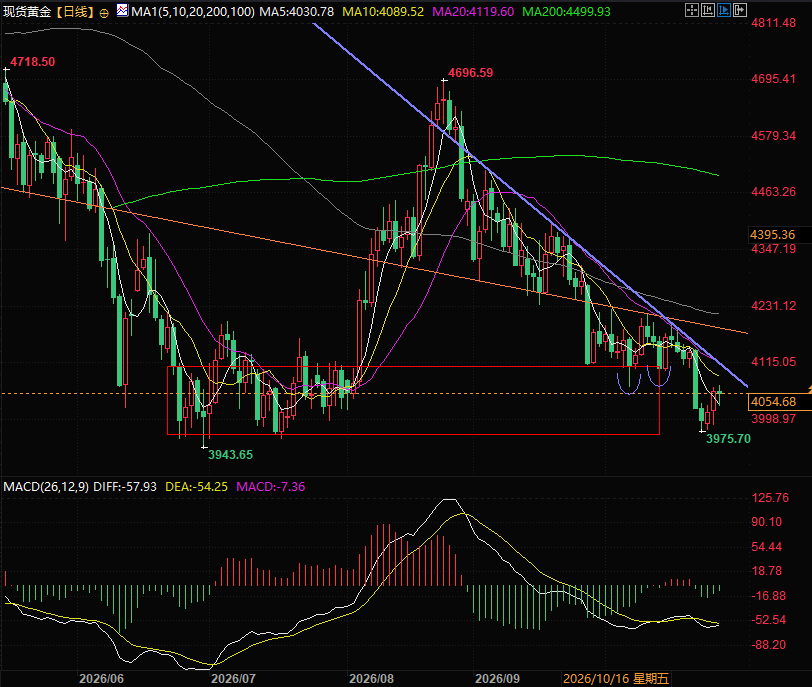 (Spot gold daily chart, source: EasyTrade) At 18:03 Beijing time, spot gold is currently trading at $4053 per ounce.
A flurry of signals indicating geopolitical easing has been released, but a de-escalation of the conflict has yet to materialize.
Recent positive developments in diplomacy have provided the market with room for speculation about a de-escalation of tensions. Qatari mediators submitted a new draft agreement to Iran on Sunday, and Iran is considering the proposal and is expected to respond this week. Iranian officials have also expressed their desire to break the stalemate, which they see as neither war nor peace, and their willingness to initiate negotiations based on their own demands to promote the implementation of a regional autonomous security framework. Regarding Russia and Ukraine, Zelenskyy communicated with the leaders of Norway and Finland, with the Nordic countries continuing to act as intermediaries, urging Russia to reduce its attacks on Ukrainian energy infrastructure and jointly preparing for the trilateral talks between the US, Russia, and Ukraine in Abu Dhabi in early November. Putin also expressed goodwill towards energy cooperation and a willingness to seek an end to the conflict and promote the lifting of sanctions. However, beneath this narrative of de-escalation, the actions of the main conflict forces have not ceased. An oil tanker struck a mine and caught fire in the Strait of Hormuz, and the Houthi rebels continued their attacks on Saudi air bases, leading to repeated security alerts in Saudi Arabia. This means that currently only the expectation of negotiations is rising, without a substantial ceasefire agreement being reached. The alternating impact of de-escalation news and attack news on the market makes it difficult to clear the risk premium in crude oil all at once. Correspondingly, inflation expectations and interest rate expectations can only ease marginally, which is insufficient to immediately open up upward space for gold.The US midterm election cycle is constraining the Federal Reserve's stance, and expectations of policy easing have already been partially priced in.
With the US midterm elections approaching, public opinion is a key factor for Trump to consider. During the election window, the Federal Reserve is likely to maintain restraint in its policy meetings, avoiding overly aggressive tightening signals to prevent exacerbating market panic and impacting asset prices. The current market benchmark is that Trump is likely to lose the House of Representatives, resulting in a "lame duck" government, making it more difficult to implement fiscal stimulus and large-scale easing policies. This policy constraint is already largely priced into gold and equity asset prices. This creates a potential trading window: as long as the election results do not significantly exceed this benchmark scenario, the pessimistic expectations surrounding gold prices could subside after the election, leading to a recovery in gold prices. The market is no longer continuously pricing in the negative impact of failed strong stimulus, and the focus is shifting back to oil prices, US Treasury real interest rates, and geopolitical situations. In addition to the US election, the Israeli election on November 4th is also a significant catalyst. Exit polls currently show that Netanyahu's camp will not secure a majority in parliament, continuing the deadlock in forming a government. If the election results indicate Netanyahu's downfall, uncertainty surrounding a hardline stance in the Middle East will decrease, market trading will likely cool down conflicts , oil price risk premiums will decline, and inflationary pressures will ease, indirectly creating room for a gold price rebound. Conversely, if the right-wing camp continues to dominate the political situation, expectations of a strike on Iran will rise again, and strong oil prices will continue to suppress expectations of interest rate cuts, limiting the upside potential for gold prices.The core logic for the future market: The turning point for gold prices awaits a substantial subsidence of geopolitical risks.
In summary, gold is currently not driven by traditional safe-haven logic, but rather by the energy inflation-real interest rate chain. Only when geopolitical risks in the Middle East and Russia-Ukraine truly subside, oil prices continue to decline, and inflationary pressures from energy sources ease, will global central banks have the conditions to restart easing and printing money to support the economy. Only then will US Treasury real interest rates decline, and gold will experience a sustained rally. In the short term, with geopolitical news fluctuating, gold prices are likely to remain in a volatile pattern. Upward triggers include: substantial progress in US-Iran and Russia-Ukraine negotiations, a significant decrease in the frequency of attacks by Houthi and other armed groups, and a continued decline in the oil price risk premium. Downward pressures remain: sudden attacks pushing up oil prices, renewed inflation expectations, and a postponement of interest rate cut expectations. Key areas to watch: substantial progress in Qatar-mediated US-Iran negotiations, the stability of navigation in the Strait of Hormuz, the November trilateral talks between the US, Russia, and Ukraine, the results of the US midterm elections, the final outcome of the Israeli elections, and the Fed's policy meeting statements. Technical Analysis: Spot gold has not yet escaped the downtrend, and the three descending candlestick patterns remain valid. Pay attention to the important resistance level around 4080, as well as the recent descending resistance line. (Spot gold daily chart, source: EasyTrade) At 18:03 Beijing time, spot gold is currently trading at $4053 per ounce.
- Risk Warning and Disclaimer
- The market involves risk, and trading may not be suitable for all investors. This article is for reference only and does not constitute personal investment advice, nor does it take into account certain users’ specific investment objectives, financial situation, or other needs. Any investment decisions made based on this information are at your own risk.