US crude oil prices fluctuated around $101. How will Iran's statement reshape the market?
2026-10-28 18:58:24
On Wednesday, October 28th, US crude oil prices hovered around $101.0 per barrel, fluctuating between approximately $99.75 and $102.24 per barrel during the day. Market sentiment was primarily influenced by reports of progress in US-Iran negotiations. News of a draft agreement brokered by Qatar initially fueled expectations of a potential deal, but subsequent statements from Iran indicated no substantial change in its core stance, and the risk of conflict in the Middle East continued to support prices. Overall, prices fluctuated within a high range, with repeated shifts in geopolitical news being the main driving factor of the day. 
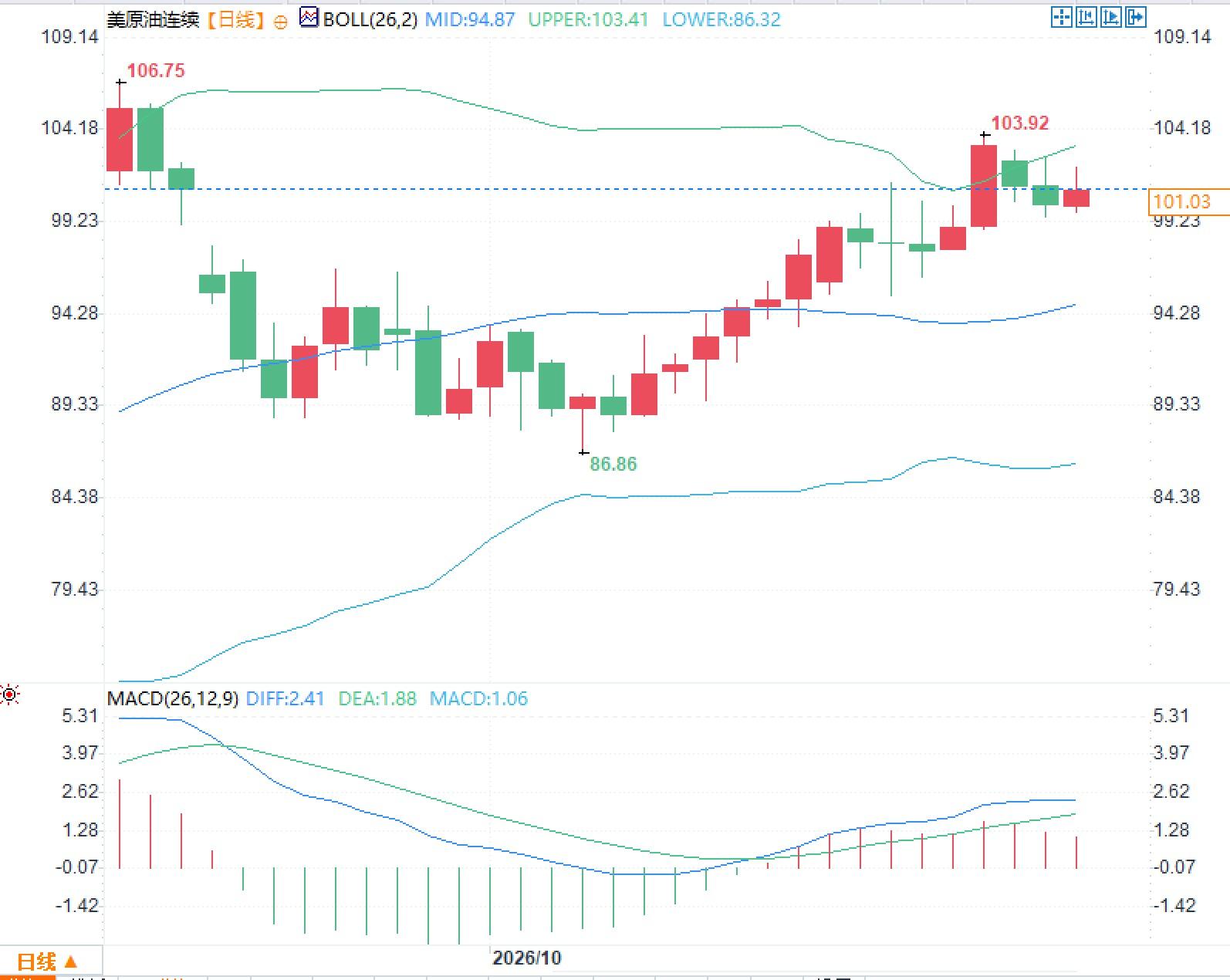 While the price is trading in the upper half of the Bollinger Bands, the MACD histogram is showing relatively limited movement, indicating that the correlation between momentum indicators and price levels still needs to be observed in conjunction with subsequent trading volume changes. The chart shows significant recent volatility, with alternating upper and lower shadows on daily candlesticks, suggesting a tug-of-war between bulls and bears near key price levels.
Short-term price reaction to negotiation news
Reports of a meeting between Iran's National Security Chief and Supreme Leader broke first, with statements emphasizing the need to safeguard Iran's interests and implement conditions to end the current deadlock. This brief news was quickly interpreted by the market as a possible opening of a negotiation window, increasing traders' expectations for some kind of agreement between the US and Iran, putting short-term pressure on US crude oil futures prices. Subsequently, news emerged that Qatari mediators had submitted a new draft proposal to Iran, setting a seven-day timetable and requiring both sides to take confidence-building steps daily. Iran was reportedly considering the proposal and expected to respond this week. This report further reinforced short-term optimism, causing prices to dip. However, a senior Iranian official subsequently clarified that Qatar had not offered any new proposals, that such ideas were unacceptable to Tehran, and that Iran's position on the nuclear issue remained unchanged. This statement quickly dampened previous optimism, and prices subsequently rebounded. From a market perspective, the back-and-forth of news caused prices to experience a short-term dip followed by a rebound, reflecting the market's high sensitivity to substantial breakthroughs, but also indicating that traders still harbor reservations about the final outcome of the negotiations.Daily technical indicators observation
Observing the daily chart, the Bollinger Band middle line for WTI crude oil is at 94.87, the upper line is at 103.41, and the lower line is at 86.32. The current price is in the area above the middle line and below the upper line. The recent candlestick touched around 103.92 before falling back, and overall it is still trading between the middle and upper lines. The MACD shows a DIFF of 2.41, a DEA of 1.88, and a MACD histogram of 1.06, with the fast line above the slow line and the histogram remaining positive. The previous high marked on the chart was around 106.75, and the recent low was around 86.86. The current price has some room to move away from both of these extreme values. While the price is trading in the upper half of the Bollinger Bands, the MACD histogram is showing relatively limited movement, indicating that the correlation between momentum indicators and price levels still needs to be observed in conjunction with subsequent trading volume changes. The chart shows significant recent volatility, with alternating upper and lower shadows on daily candlesticks, suggesting a tug-of-war between bulls and bears near key price levels.Continued support from Middle Eastern geopolitical factors
US crude oil prices remain supported by tensions in the Middle East. The conflict between Saudi Arabia and the Houthis shows no clear signs of easing, and related attacks continue to impact market assessments of regional supply stability. Simultaneously, the market is concerned about the risk of further US military action following the midterm elections. These factors collectively constitute the downside support for prices. Analysts point out that a significant price correction typically requires a substantial de-escalation of the Saudi-Houthi conflict or an unexpected breakthrough in US-Iran negotiations. Until then, geopolitical premiums are difficult to digest quickly. Recent price movements show that although hopes for negotiations briefly triggered a pullback, prices have consistently failed to break below key levels, indicating that geopolitical risk premiums are still being priced into the market. Traders assess diplomatic progress while simultaneously considering the possibility of conflict escalation, making price reactions to single positive news often short-lived.Supply and demand balance and external variable considerations
Besides geopolitical factors, the global supply and demand dynamics of crude oil also constrain prices. Current price levels have risen significantly from the year's lows, and the market remains focused on production policies of major oil-producing countries and changes in demand in major consuming regions. Changes in inventory data, refinery operating rates, and the accessibility of shipping routes can all influence traders' position adjustments in the short term. Meanwhile, the price trends of other commodities and the release of macroeconomic data from major economies may also indirectly affect US crude oil futures through risk appetite channels. The current price range already reflects a considerable degree of geopolitical uncertainty. If subsequent negotiation news continues to be inconsistent, prices may remain highly volatile within the existing range. Overall, the trading of US crude oil futures around $101/barrel reflects a dynamic balance between geopolitical support and negotiation uncertainty.Frequently Asked Questions
Question 1: What news has driven the recent price fluctuations of US crude oil? Answer: Price fluctuations have been mainly influenced by reports on the progress of negotiations between the US and Iran, including news of meetings, rumors of draft agreements, and official denials from Iran. These pieces of information have appeared alternately in a short period, leading to a price dip followed by a rebound. Question 2: Why have the negotiations failed to bring about a sustained price decline? Answer: Senior Iranian officials have clearly stated that the proposed solutions are unacceptable and that Iran's nuclear stance remains unchanged. Meanwhile, the risks of conflict in the Middle East and possible further military action continue to provide support, making the market hesitant about a substantial breakthrough.- Risk Warning and Disclaimer
- The market involves risk, and trading may not be suitable for all investors. This article is for reference only and does not constitute personal investment advice, nor does it take into account certain users’ specific investment objectives, financial situation, or other needs. Any investment decisions made based on this information are at your own risk.