The European Central Bank is expected to keep its current policy unchanged this week, with room for further tightening by 50 basis points this year.
2026-10-29 12:08:23
The euro traded in a narrow range against the dollar during Asian trading hours on Thursday (October 29), currently hovering around 1.1150, just shy of its October 14 low. The European Central Bank (ECB) is expected to keep its deposit rate unchanged at 2.50% this week. Since the rate hike at its September meeting, the inflationary backdrop has not improved—oil and gas prices have risen sharply and are now significantly higher than the levels assumed in the ECB's "adverse scenario," with the harmonized index of inflation (HICP) projected to rise above 4% in the coming months. However, with sovereign bond yields rising sharply and overall financial conditions tightening, policymakers have lessened their previous sense of urgency. This shift began with Lagarde's remarks in the European Parliament last month, where she acknowledged that a sharp rise in long-term interest rates would "slow growth and reduce transmission." Since then, the prediction of an October rate hike has been withdrawn, and rates are expected to remain unchanged this week. However, the baseline scenario still anticipates a further 50 basis point tightening, bringing the terminal rate to 3.00%. 
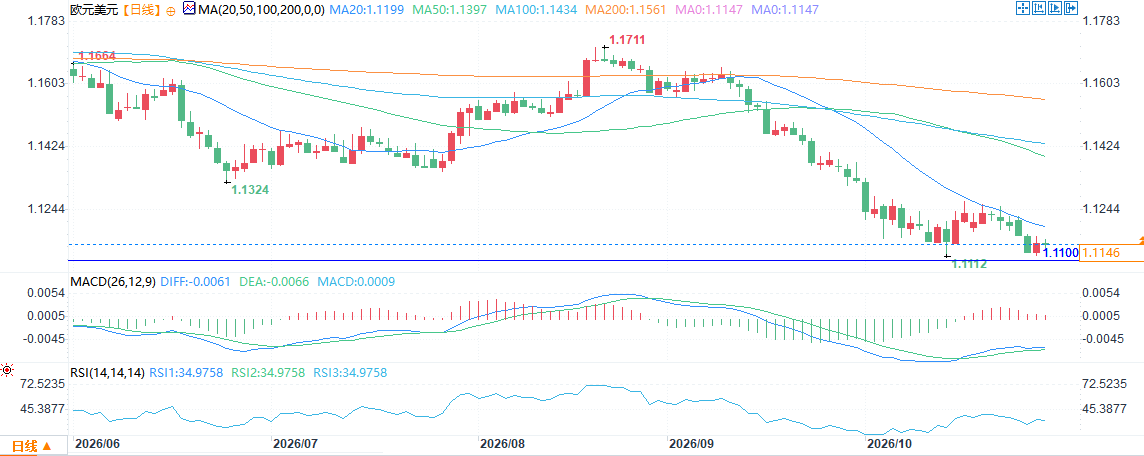 (Euro/USD daily chart, source: FX678) At 12:06 Beijing time, the euro was trading at 1.1147/48 against the US dollar.
The second-round effect remains to be seen, while domestic data is generally mild.
Regarding the effects of a second round of inflation, domestic data remains generally moderate. Last week's PMI price sub-index showed a significant acceleration in manufacturing input costs, but this has not yet translated into a broad acceleration in sales prices—in fact, service sector output prices fell in October. The ECB's consumer survey showed that households' medium- to long-term inflation expectations remained unchanged (although the one-year indicator rose slightly to 3.1%). The previously released third-quarter SAFE survey showed that companies reported increases in inflation, wage, and sales price expectations, but the ECB issued a strong warning about significant changes in the survey sample—first-time respondents provided a large proportion of the answers. Excluding this factor, while the data is unsettling for policymakers, it is far from convincing enough to demonstrate a substantial increase in the risk of a second round of inflation. The growth backdrop is also mixed. The ECB's blog post emphasized the familiar theme of "resilience." This narrative still holds true despite tightening financial conditions and rising energy prices. The preliminary October PMI reading softened, unsurprisingly led by France, but the French data only fell back to August levels, not a more worrying signal. Outside of France, the German PMI was quite constructive on the manufacturing sector, with yesterday's German Ifo survey serving as a reminder that the broader resilience narrative remains intact, and the expectations sub-index improving for the sixth consecutive month.A December rate hike seems more natural, but confidence has declined.
Therefore, the signal mix facing the Governing Council is more complex than it was a month ago. A pause now is reasonable. December appears to be the natural time for another rate hike – by then, updated forecasts will show a more unfavorable inflation picture than in September, unless energy prices reverse sharply during this period. Current oil and gas prices are already higher than the ECB's worst-case scenario assumptions. The commodities team continues to emphasize tight physical market conditions. Despite various government support measures, the overall Eurozone HICP is expected to rise above 4%. Accordingly, the baseline scenario is a further 25 basis point rate hike before the end of the year, followed by another 25 basis point hike at the next forecast meeting, for a cumulative additional tightening of 50 basis points, pushing rates into a moderately restrictive range (i.e., 3.00%, compared to the ECB's own estimate of the upper limit of the neutral rate at 2.50%). This seems reasonable in mitigating the risk of price pressure contagion. However, given the tightening financial conditions and the limited support from investigative evidence for a second-round effect, confidence in the extent of further tightening has declined compared to a month ago. Previous views argued that the ECB should proactively and preventatively tighten (with a subsequent pullback if the second-round effect remains under control), but policymakers may be beginning to feel that the window for such a move is narrowing, especially if bond market conditions deteriorate further.The Q&A session became the focus: Lagarde expects to remain flexible.
Any signals from the press conference will be closely watched. Questions about France, sovereign wealth differentials, and ECB tools are inevitable, but Lagarde is unlikely to offer any specific comments at this stage. While current market dynamics are unsettling, they appear neither disorderly nor irrational, and there is little evidence of broader financial stress or fragmentation. Therefore, statements are expected to remain general, with Lagarde likely indicating that the Governing Council is closely monitoring financial conditions while avoiding discussion of specific interest rate spreads or intervention triggers. Statements such as "the primary responsibility lies with national fiscal authorities, not central banks" are expected. On monetary policy, Lagarde has acknowledged that rising long-term interest rates will slow growth and reduce transmission more than anticipated. A continuation of this message is most likely—Lagarde acknowledged that financial conditions have tightened substantially since September, and these developments form part of the Governing Council's assessment of the appropriate policy stance. However, maintaining options will remain paramount, and it would be surprising if the President gave a strong signal that market movements directly substitute for policy action, thereby eliminating the pricing of a December rate hike. The market is currently pricing in around 20 basis points. Lagarde may also face questions about her personal future—speculation continues surrounding a possible early departure. In the absence of substantial updates, she is expected to emphasize continuity and collective decision-making by the Governing Council. Nevertheless, any uncertainty within the leadership is far from ideal as the central bank grapples with tightening financial conditions, rising energy prices, and broader macroeconomic uncertainty.Euro/Dollar unlikely to break out of range in the short term
The European Central Bank's decision to hold rates steady this week has already been fully priced in by the market, limiting its direct impact on the euro. What truly influences the euro's exchange rate against the dollar is the relative shift between the signals released at this meeting and the Federal Reserve's course of action. Currently, the euro is trading around 1.1150 against the dollar, just a step away from the low of October 14th. In terms of interest rate differentials, the Fed's rate remains at 3.75%-4.00%, 125 to 150 basis points higher than the ECB's 2.50% deposit rate. This gap has largely dominated the euro's range-bound trading since mid-September. If Lagarde explicitly considers tightening financial conditions as an "alternative" to policy action during the Q&A session, the market may further lower its pricing of a December rate hike (currently around 20 basis points), and the euro will lose a key support level. Conversely, if she only makes a general statement, leaving the option of December action open, the euro's downside potential is limited. More noteworthy is that the probability of a Fed rate hike in December has risen to about 81%. If the rate hikes in Europe and the US are ultimately equal (25 basis points each), the interest rate differential will remain unchanged, making it difficult for the euro to achieve a directional breakthrough.in conclusion
It would be reasonable for the European Central Bank to hold rates steady this week, with a 25 basis point hike in December followed by another 25 basis point hike remaining the baseline scenario. However, limited evidence of tightening financial conditions and a second-round effect has weakened confidence in further tightening compared to a month ago. Lagarde is expected to remain flexible during the Q&A session, avoiding specific commitments on interest rate differentials or policy alternatives. (Euro/USD daily chart, source: FX678) At 12:06 Beijing time, the euro was trading at 1.1147/48 against the US dollar.
- Risk Warning and Disclaimer
- The market involves risk, and trading may not be suitable for all investors. This article is for reference only and does not constitute personal investment advice, nor does it take into account certain users’ specific investment objectives, financial situation, or other needs. Any investment decisions made based on this information are at your own risk.