The expectation of a Bank of England rate hike, coupled with a decline in the US dollar, has sent the pound back to the upper limit of its trading range against the dollar, awaiting a stress test.
2026-10-30 15:18:28
The core driver of the current GBP/USD rebound is the Bank of England's "hawkish shift." The Bank of England's Monetary Policy Committee (MPC) has become the most hawkish in its communication since early 2023. The market has almost fully priced in a 25 basis point rate hike to 4.00% in November and is betting on at least three more rate hikes before July 2027. Looking at the inflation backdrop, the UK's September CPI rose 3.5% year-on-year, the highest in 11 months, while core CPI rose 2.8% year-on-year, and services inflation rose to 3.7%. Soaring energy prices (WTI returning to $104) have exacerbated the risk of a second round of inflation, with Governor Bailey warning that "the longer the energy shock lasts, the more difficult it will be to avoid a rate hike." The labor market is also relatively strong—the unemployment rate fell to 4.7% in August, the number of salaried employees unexpectedly increased by 13,000 in September, and the slowdown in wage growth has stalled, all of which provide data support for a rate hike.  From the perspective of the US dollar, the rebound of GBP/USD also benefited from the temporary weakening of the dollar. The Federal Reserve on Wednesday maintained interest rates at 3.75%-4.00% by a 10-2 vote. Chairman Warsh refused to provide forward guidance, emphasizing that "ensuring price stability is not about a fixed date on the calendar." This "hawkish pause but not commitment" rhetoric caused the two-year Treasury yield to fall and the dollar index to retreat from a two-week high. Furthermore, diplomatic contacts in the Middle East (Vice President Vance's letter to Iran and Qatar's submission of a new ceasefire draft) eased risk aversion, leading to some profit-taking on safe-haven dollar buying. However, the dollar's decline was limited—CME FedWatch showed that the probability of a Fed rate hike in December remained around 75% (down from 84.2% the previous day). The preliminary US Q3 GDP growth of 3.4% and the September core PCE growth of 3.1% reinforced the logic of maintaining high interest rates for a longer period, keeping buying interest on the dollar at lower levels, making a trend reversal in GBP/USD unlikely. In a horizontal comparison, the pound's rebound still faces structural constraints. The upcoming autumn budget from UK Chancellor of the Exchequer Healy is the biggest source of uncertainty. If the financing plan is interpreted by the market as disciplined, the pound may receive a temporary boost; conversely, if it is seen as a disguised expansion of the deficit, a jump in gilt yields could quickly translate into selling pressure on the pound. Furthermore, rising energy prices and deteriorating terms of trade will drag down economic growth, and interest rate hikes themselves will suppress demand, meaning that even if the Bank of England raises rates as expected, the upside potential for the pound may be limited. From a cross-asset perspective, the current fluctuations in GBP/USD are essentially a confluence of four factors: first, the interest rate differential support from the expectation of a November rate hike by the Bank of England; second, the floor support for the dollar from the high probability of a year-end rate hike by the Federal Reserve; third, the policy uncertainty surrounding the UK budget; and fourth, the impact of evolving Middle East geopolitical situations on safe-haven flows. On the 4-hour chart, GBP/USD is trading in the 1.3380-1.3400 range, with an overall mildly bullish bias. The exchange rate has broken through the 38.2% Fibonacci retracement level of approximately 1.3311 and stabilized above the 100-period SMA, indicating buying interest on dips in the near term. The RSI has rebounded from its lows to neutral-to-strong territory, and momentum is recovering. Resistance levels to watch are 1.3380, 1.3417, and the 1.3450 area. Support levels are initially at 1.3350, followed by 1.3311 and the 1.3280 area. A deeper pullback would test the structural support zone around 1.3256 and even 1.3199. On the daily chart, after rebounding from the low of 1.3270, the exchange rate remains below the 100-day SMA (approximately 1.3386) and the 60-day SMA (approximately 1.3409), indicating the overall trend has not yet reversed. The current rebound should be viewed as an oversold correction rather than a trend reversal.
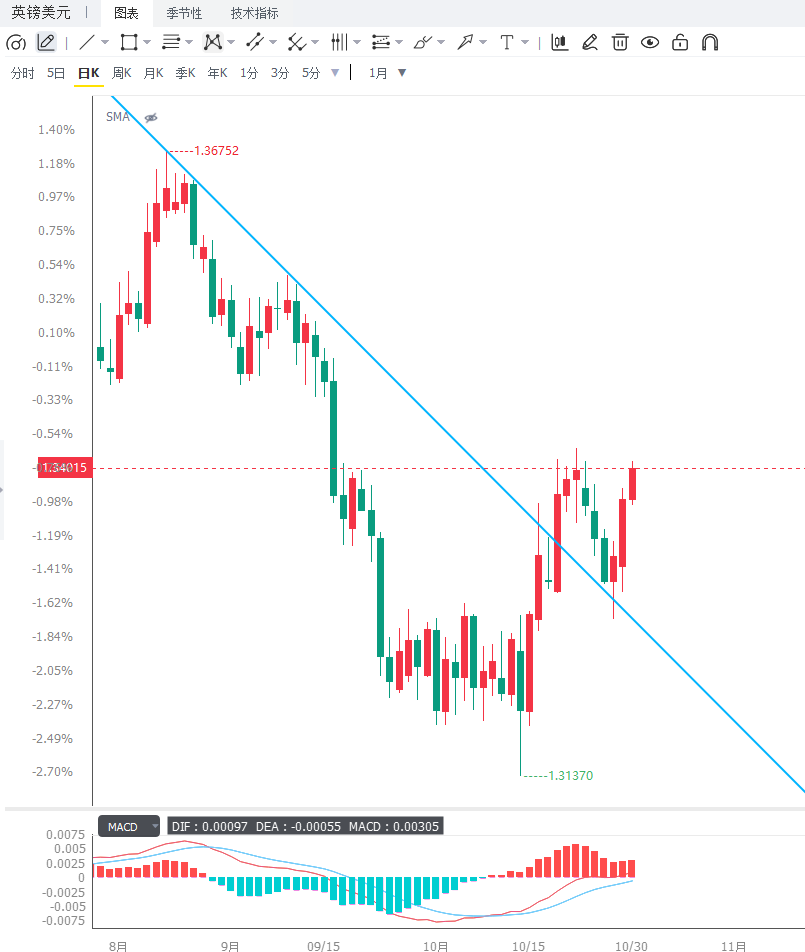 The core contradiction for GBP/USD in the short term lies in the tug-of-war between the Bank of England's expected November rate hike and the strong pressure from the US dollar, compounded by policy uncertainty surrounding the UK budget. The exchange rate is more likely to fluctuate and consolidate within the 1.3350-1.3420 range. Three key variables need to be monitored: first, the Bank of England's interest rate decision and statement on November 5th, which is the primary policy basis for determining whether the pound can shift from a passive to an active stance; second, whether GBP/USD can effectively break through and hold the 1.3380-1.3420 resistance zone, which is the primary technical basis for determining whether the short-term recovery can continue; and third, the trends of the US dollar index and US Treasury yields. If the dollar strengthens again, it will put pressure on GBP/USD. In addition, details of the UK autumn budget, US PCE data, developments in the Middle East geopolitical situation, and the UK's Q3 GDP data also need to be monitored.
From the perspective of the US dollar, the rebound of GBP/USD also benefited from the temporary weakening of the dollar. The Federal Reserve on Wednesday maintained interest rates at 3.75%-4.00% by a 10-2 vote. Chairman Warsh refused to provide forward guidance, emphasizing that "ensuring price stability is not about a fixed date on the calendar." This "hawkish pause but not commitment" rhetoric caused the two-year Treasury yield to fall and the dollar index to retreat from a two-week high. Furthermore, diplomatic contacts in the Middle East (Vice President Vance's letter to Iran and Qatar's submission of a new ceasefire draft) eased risk aversion, leading to some profit-taking on safe-haven dollar buying. However, the dollar's decline was limited—CME FedWatch showed that the probability of a Fed rate hike in December remained around 75% (down from 84.2% the previous day). The preliminary US Q3 GDP growth of 3.4% and the September core PCE growth of 3.1% reinforced the logic of maintaining high interest rates for a longer period, keeping buying interest on the dollar at lower levels, making a trend reversal in GBP/USD unlikely. In a horizontal comparison, the pound's rebound still faces structural constraints. The upcoming autumn budget from UK Chancellor of the Exchequer Healy is the biggest source of uncertainty. If the financing plan is interpreted by the market as disciplined, the pound may receive a temporary boost; conversely, if it is seen as a disguised expansion of the deficit, a jump in gilt yields could quickly translate into selling pressure on the pound. Furthermore, rising energy prices and deteriorating terms of trade will drag down economic growth, and interest rate hikes themselves will suppress demand, meaning that even if the Bank of England raises rates as expected, the upside potential for the pound may be limited. From a cross-asset perspective, the current fluctuations in GBP/USD are essentially a confluence of four factors: first, the interest rate differential support from the expectation of a November rate hike by the Bank of England; second, the floor support for the dollar from the high probability of a year-end rate hike by the Federal Reserve; third, the policy uncertainty surrounding the UK budget; and fourth, the impact of evolving Middle East geopolitical situations on safe-haven flows. On the 4-hour chart, GBP/USD is trading in the 1.3380-1.3400 range, with an overall mildly bullish bias. The exchange rate has broken through the 38.2% Fibonacci retracement level of approximately 1.3311 and stabilized above the 100-period SMA, indicating buying interest on dips in the near term. The RSI has rebounded from its lows to neutral-to-strong territory, and momentum is recovering. Resistance levels to watch are 1.3380, 1.3417, and the 1.3450 area. Support levels are initially at 1.3350, followed by 1.3311 and the 1.3280 area. A deeper pullback would test the structural support zone around 1.3256 and even 1.3199. On the daily chart, after rebounding from the low of 1.3270, the exchange rate remains below the 100-day SMA (approximately 1.3386) and the 60-day SMA (approximately 1.3409), indicating the overall trend has not yet reversed. The current rebound should be viewed as an oversold correction rather than a trend reversal. The core contradiction for GBP/USD in the short term lies in the tug-of-war between the Bank of England's expected November rate hike and the strong pressure from the US dollar, compounded by policy uncertainty surrounding the UK budget. The exchange rate is more likely to fluctuate and consolidate within the 1.3350-1.3420 range. Three key variables need to be monitored: first, the Bank of England's interest rate decision and statement on November 5th, which is the primary policy basis for determining whether the pound can shift from a passive to an active stance; second, whether GBP/USD can effectively break through and hold the 1.3380-1.3420 resistance zone, which is the primary technical basis for determining whether the short-term recovery can continue; and third, the trends of the US dollar index and US Treasury yields. If the dollar strengthens again, it will put pressure on GBP/USD. In addition, details of the UK autumn budget, US PCE data, developments in the Middle East geopolitical situation, and the UK's Q3 GDP data also need to be monitored.
- Risk Warning and Disclaimer
- The market involves risk, and trading may not be suitable for all investors. This article is for reference only and does not constitute personal investment advice, nor does it take into account certain users’ specific investment objectives, financial situation, or other needs. Any investment decisions made based on this information are at your own risk.