Easing geopolitical tensions reduced demand for safe-haven assets, causing the US dollar index to fall for the third consecutive day to around 101.70.
2026-10-30 15:56:23
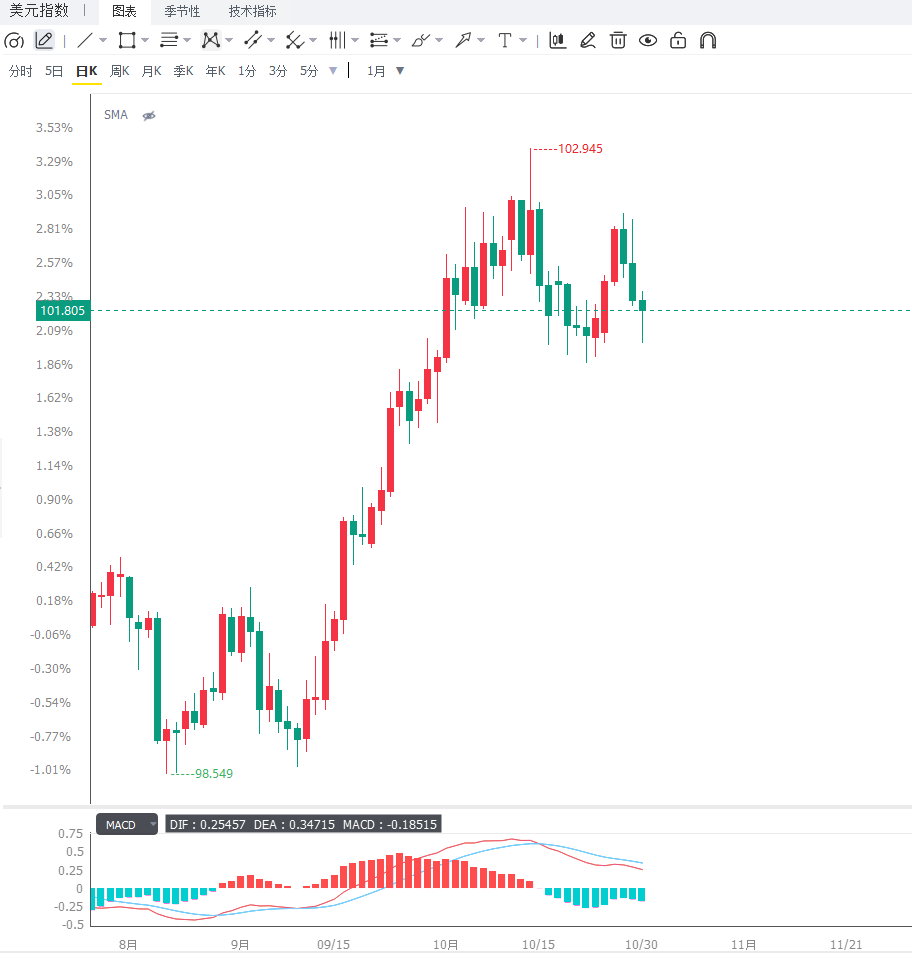
The US dollar index, which tracks six major currencies, continued its decline in Asian trading on Friday, last trading around 101.70, down about 0.3% from 102.04 at the close of the previous session, having touched a low of 101.58 during the session. The immediate trigger for the dollar's weakness was a cooling of risk aversion. US Vice President Vance has proactively contacted Rezaei, secretary of Iran's Supreme National Security Council, in an attempt to restart peace talks, and US President Trump has also confirmed his approval of this diplomatic contact. Qatar, Saudi Arabia, Turkey, and other countries have recently made numerous trips to Tehran to mediate. Although Iran remains reserved about the new proposal, the reopening of diplomatic channels has significantly eased market concerns about an escalation of the Middle East conflict. Safe-haven buying, previously driven by geopolitical risks such as the Strait of Hormuz blockade and Houthi attacks on Saudi facilities, has subsided, putting pressure on the dollar index for the third consecutive day.  Meanwhile, expectations for a December rate hike by the Federal Reserve have cooled marginally. According to the CME FedWatch tool, as of Friday, the market was pricing in a 74.9% probability of a 25 basis point rate hike in December, a significant drop from 84.2% the previous day. Easing geopolitical tensions have reduced the tail risk of oil supply disruptions, thereby lowering concerns about renewed inflation and causing some traders to loosen their bets on a year-end rate hike. However, the dollar is not without support. US economic data released on Thursday showed better-than-expected resilience: US Q3 GDP annualized growth was 3.4%, higher than the market expectation of 3.2%, and a significant acceleration from Q2's 2.2%; core PCE rose 3.1% year-on-year in September, in line with expectations, but has remained above the Fed's 2% target for the 68th consecutive month. Initial jobless claims fell to 194,000, near historical lows, indicating a still tight labor market. The combination of "high growth + high inflation" means that the Fed's necessity to maintain high interest rates has not diminished, providing fundamental support for the dollar. Even more noteworthy signals come from changes in the US Treasury yield curve. Following the Federal Reserve's decision to keep interest rates unchanged at its October meeting, the 2-year Treasury yield fell, while the 10-year and 30-year yields rose, significantly widening the 2s-10s yield spread and resulting in a noticeably steeper yield curve. Scotiabank strategists noted that this change is a "positive signal moving away from an inverted yield curve," reflecting a market reassessment of economic growth prospects and providing overall support for the US dollar. From a cross-asset perspective, the current weakness of the US dollar is more a reflection of "receding safe-haven demand" than "weakening fundamentals." If the situation in the Middle East continues to ease, the US dollar may face further pressure in the short term; however, if subsequent US economic data continues to exceed expectations, or if the Federal Reserve releases a clearer signal of interest rate hikes at its December meeting, the US dollar may still have the potential to strengthen again. On the daily chart, the US dollar index is trading above the 50-day EMA (approximately 101.21), but is constrained by the 9-day EMA (approximately 101.93), showing a neutral consolidation pattern after a high-level pullback in the short term. The RSI fell back to around 51.5 on the 14th, near the dividing line between bullish and bearish sentiment, suggesting that momentum is trending neutral and a clear directional breakout has not yet formed. The original chart analysis indicates that the upper resistance levels to watch are the 9-day EMA at 101.93 and the recent high of 102.40; a decisive break above these levels is needed to reopen upward potential. On the lower side, the first support level to watch is the 50-day EMA at 101.21. If the daily close is below this level, the bearish bias may strengthen, further testing the 100.80 and 100.50 areas. On the 4-hour chart, the US dollar index is moving down along the short-term moving averages, and the MACD histogram is close to the zero line, indicating bearish momentum but not yet accelerating. Currently, the price is oscillating narrowly between 101.55 and 101.95. If a rebound to around 101.93 is met with resistance, the bearish bias may continue; if it breaks decisively below 101.21, the risk of accelerated decline should be noted.
 Editor's Summary: The core contradiction for the US dollar index currently lies in the tug-of-war between "receding safe-haven demand" and "fundamental resilience." In the short term, progress in Middle East diplomatic negotiations and a cooling of expectations for a December rate hike are jointly suppressing the dollar, with the DXY likely to fluctuate and consolidate within the 101.20-102.00 range. However, strong US economic data and a steepening yield curve signal retain upward potential for the dollar in the medium term. Three variables need to be closely monitored going forward: first, substantial progress in the Middle East situation; if a breakthrough in diplomatic negotiations is achieved, the safe-haven premium will further diminish, and the dollar may continue to face pressure; second, next week's US October non-farm payroll data; if the job market continues to show resilience, it will re-strengthen expectations of a Fed rate hike, providing support for the dollar; and third, whether the dollar index can find effective support near 101.21 (50-day EMA), which is the primary technical basis for judging whether the short-term bearish trend has strengthened.
Meanwhile, expectations for a December rate hike by the Federal Reserve have cooled marginally. According to the CME FedWatch tool, as of Friday, the market was pricing in a 74.9% probability of a 25 basis point rate hike in December, a significant drop from 84.2% the previous day. Easing geopolitical tensions have reduced the tail risk of oil supply disruptions, thereby lowering concerns about renewed inflation and causing some traders to loosen their bets on a year-end rate hike. However, the dollar is not without support. US economic data released on Thursday showed better-than-expected resilience: US Q3 GDP annualized growth was 3.4%, higher than the market expectation of 3.2%, and a significant acceleration from Q2's 2.2%; core PCE rose 3.1% year-on-year in September, in line with expectations, but has remained above the Fed's 2% target for the 68th consecutive month. Initial jobless claims fell to 194,000, near historical lows, indicating a still tight labor market. The combination of "high growth + high inflation" means that the Fed's necessity to maintain high interest rates has not diminished, providing fundamental support for the dollar. Even more noteworthy signals come from changes in the US Treasury yield curve. Following the Federal Reserve's decision to keep interest rates unchanged at its October meeting, the 2-year Treasury yield fell, while the 10-year and 30-year yields rose, significantly widening the 2s-10s yield spread and resulting in a noticeably steeper yield curve. Scotiabank strategists noted that this change is a "positive signal moving away from an inverted yield curve," reflecting a market reassessment of economic growth prospects and providing overall support for the US dollar. From a cross-asset perspective, the current weakness of the US dollar is more a reflection of "receding safe-haven demand" than "weakening fundamentals." If the situation in the Middle East continues to ease, the US dollar may face further pressure in the short term; however, if subsequent US economic data continues to exceed expectations, or if the Federal Reserve releases a clearer signal of interest rate hikes at its December meeting, the US dollar may still have the potential to strengthen again. On the daily chart, the US dollar index is trading above the 50-day EMA (approximately 101.21), but is constrained by the 9-day EMA (approximately 101.93), showing a neutral consolidation pattern after a high-level pullback in the short term. The RSI fell back to around 51.5 on the 14th, near the dividing line between bullish and bearish sentiment, suggesting that momentum is trending neutral and a clear directional breakout has not yet formed. The original chart analysis indicates that the upper resistance levels to watch are the 9-day EMA at 101.93 and the recent high of 102.40; a decisive break above these levels is needed to reopen upward potential. On the lower side, the first support level to watch is the 50-day EMA at 101.21. If the daily close is below this level, the bearish bias may strengthen, further testing the 100.80 and 100.50 areas. On the 4-hour chart, the US dollar index is moving down along the short-term moving averages, and the MACD histogram is close to the zero line, indicating bearish momentum but not yet accelerating. Currently, the price is oscillating narrowly between 101.55 and 101.95. If a rebound to around 101.93 is met with resistance, the bearish bias may continue; if it breaks decisively below 101.21, the risk of accelerated decline should be noted. Editor's Summary: The core contradiction for the US dollar index currently lies in the tug-of-war between "receding safe-haven demand" and "fundamental resilience." In the short term, progress in Middle East diplomatic negotiations and a cooling of expectations for a December rate hike are jointly suppressing the dollar, with the DXY likely to fluctuate and consolidate within the 101.20-102.00 range. However, strong US economic data and a steepening yield curve signal retain upward potential for the dollar in the medium term. Three variables need to be closely monitored going forward: first, substantial progress in the Middle East situation; if a breakthrough in diplomatic negotiations is achieved, the safe-haven premium will further diminish, and the dollar may continue to face pressure; second, next week's US October non-farm payroll data; if the job market continues to show resilience, it will re-strengthen expectations of a Fed rate hike, providing support for the dollar; and third, whether the dollar index can find effective support near 101.21 (50-day EMA), which is the primary technical basis for judging whether the short-term bearish trend has strengthened.
- Risk Warning and Disclaimer
- The market involves risk, and trading may not be suitable for all investors. This article is for reference only and does not constitute personal investment advice, nor does it take into account certain users’ specific investment objectives, financial situation, or other needs. Any investment decisions made based on this information are at your own risk.