Expectations of a Bank of Japan interest rate hike supported the yen, causing the USD/JPY pair to fall below 157.50.
2026-10-30 16:12:24
While the Bank of Japan (BOJ) kept interest rates unchanged in its latest decision, the hawkish signals it released almost entirely met market expectations. The outlook report explicitly stated for the first time that "potential consumer price inflation is at a level broadly consistent with the 2% target" and is expected to remain around that level. This assessment is based on factors including a persistent labor shortage, a virtuous cycle between wages and prices, and medium- to long-term inflation expectations of around 2%. The BOJ also described price risks as skewed to the upside, warning that wage increases and price hikes by companies could push potential inflation above the target. The voting distribution is also noteworthy—Member Hajime Takada voted the only dissenting vote of 8 to 1 to advocate for a rate hike to 1.5%, and no members held dovish dissent supporting a rate cut, allaying pre-meeting market concerns about internal divisions. Furthermore, the BOJ announced that from January 2027, it will increase the annual ETF sales volume from approximately 330 billion yen to approximately 860 billion yen, shortening the time to complete the sale of holdings from approximately 112 years to approximately 43 years.  Regarding inflation forecasts, the Bank of Japan raised its median core CPI forecast for fiscal year 2027 to 2.6% (previously 2.4%), while maintaining its forecast at 2.5% for fiscal year 2026 and 2.0% for fiscal year 2028. Economic growth forecasts remained largely unchanged, with median real GDP growth forecasts for fiscal years 2026-2028 at 0.7%, 0.7%, and 0.8%, respectively. Governor Kazuo Ueda stated at a press conference that core CPI inflation is generally in line with the 2% price stability target and is expected to remain around that level; the medium- to long-term inflation forecast is approximately 2%. He emphasized that the Bank of Japan "will continue to raise policy interest rates" and adjust the degree of monetary easing based on developments in economic activity, prices, and the financial situation, while closely monitoring the impact of foreign exchange, AI demand, and the situation in the Middle East. Ueda also pointed out that the ultra-loose monetary policy has shown some positive effects, but is insufficient to push inflation to 2% within two years as initially expected. Overall, its FXS Speechtracker score is 7.2/10, slightly below the historical average of 7.7/10, reflecting relatively restrained wording, but the framework of "continued rate hikes" has been clearly established. The decline in USD/JPY was not solely driven by the Bank of Japan. Thursday's weaker-than-expected US tech earnings—Alphabet's stock price plummeted 12%, marking its largest single-day drop in history—triggered market concerns about the return on investment in AI, driving safe-haven demand into US Treasuries, lowering yields, and narrowing the USD/JPY interest rate differential, putting pressure on the dollar. Meanwhile, progress in Middle East diplomatic efforts weakened support for safe-haven dollar buying. US Vice President Vance has written to Iran's Supreme National Security Council Secretary Rezaei, attempting to restart peace talks, and Qatar has also submitted a new ceasefire draft. Although geopolitical risk premiums have not completely subsided, the marginal easing of safe-haven sentiment has put overall pressure on the dollar. From a cross-asset perspective, USD/JPY is currently experiencing a triple resonance of "yen policy shift + dollar safe-haven retreat + US Treasury yield decline." However, the interest rate differential between the US and Japan remains as high as 275 basis points (the Fed's policy rate ceiling of 4.00% vs. the Bank of Japan's 1.25%), and the basis for carry trade has not collapsed, which determines that the upside potential of the yen is still constrained. The market is currently pricing in an 80% probability that the Bank of Japan will raise interest rates to 1.5% in December. If this expectation is verified by subsequent data, it will provide further support for the yen. On the daily chart, the USD/JPY pair has been fluctuating at a high level in the 156-159 range since mid-September, failing to effectively break through the layered resistance zone formed by the 200-day moving average (about 158.55) and the previous high of 158.95 on October 14. After touching 157.89 during the session today, it quickly fell back and is currently trading around 157.44, with the price returning to the lower part of the range. The RSI (14) has fallen back to about 48.7, which is in the neutral zone, and the MACD is repeatedly entangled near the zero axis, with weak momentum. On the 4-hour chart, the exchange rate has retreated from a high of 157.89, breaking below short-term moving average support, and is currently consolidating between 157.30 and 157.70. The key resistance levels to watch are 157.70 (the starting point of the intraday pullback), the psychological level of 158.00, and 158.55 (the 200-day moving average). Support levels to watch are first at the psychological level of 157.00, followed by the October 23 low of 156.07 and the 156.00 area. Structurally, as long as the exchange rate continues to trade below 158.55, the daily chart suggests a continued high-level consolidation. A decisive break below 157.00 could open up potential for a pullback to the 156.07 and even 155.00 area. Conversely, if the price rebounds and stabilizes above 158.00, the bearish bias may ease, and the 158.55 resistance level could be tested again.
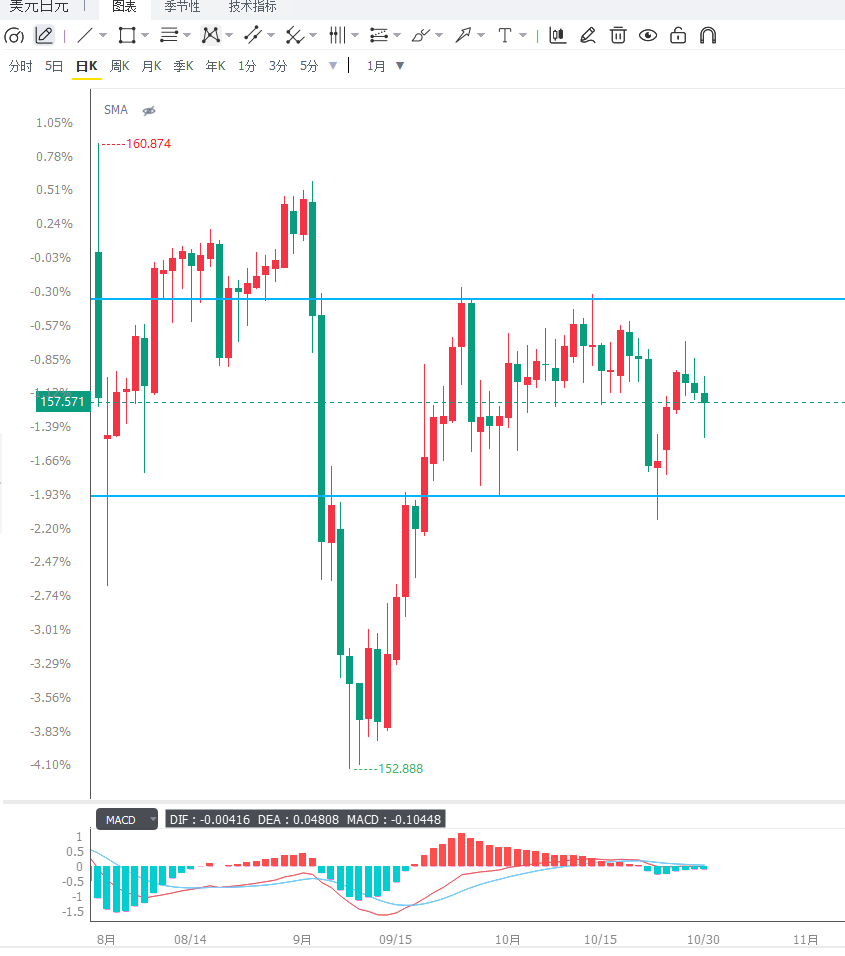 Editor's Summary : The core contradiction in the USD/JPY pair lies in the tug-of-war between the Bank of Japan's established gradual interest rate hike path and the continued high USD/JPY interest rate differential. In the short term, hawkish policy decisions and Ueda's statement of "continued rate hikes" provide support for the yen. Coupled with the decline in US Treasury yields and the retreat of the safe-haven dollar, the exchange rate is more likely to fluctuate and consolidate within the 157.00-158.00 range. Three key variables to watch going forward are: first, the Bank of Japan's December interest rate decision; if it raises rates to 1.5% as expected, the yen may strengthen further; second, next week's US October non-farm payroll data; if the job market continues to show resilience, US Treasury yields may rise again, providing support for the dollar; and third, whether USD/JPY can find effective support at the 157.00 level, which is the primary technical basis for judging whether the short-term bearish trend has strengthened.
Regarding inflation forecasts, the Bank of Japan raised its median core CPI forecast for fiscal year 2027 to 2.6% (previously 2.4%), while maintaining its forecast at 2.5% for fiscal year 2026 and 2.0% for fiscal year 2028. Economic growth forecasts remained largely unchanged, with median real GDP growth forecasts for fiscal years 2026-2028 at 0.7%, 0.7%, and 0.8%, respectively. Governor Kazuo Ueda stated at a press conference that core CPI inflation is generally in line with the 2% price stability target and is expected to remain around that level; the medium- to long-term inflation forecast is approximately 2%. He emphasized that the Bank of Japan "will continue to raise policy interest rates" and adjust the degree of monetary easing based on developments in economic activity, prices, and the financial situation, while closely monitoring the impact of foreign exchange, AI demand, and the situation in the Middle East. Ueda also pointed out that the ultra-loose monetary policy has shown some positive effects, but is insufficient to push inflation to 2% within two years as initially expected. Overall, its FXS Speechtracker score is 7.2/10, slightly below the historical average of 7.7/10, reflecting relatively restrained wording, but the framework of "continued rate hikes" has been clearly established. The decline in USD/JPY was not solely driven by the Bank of Japan. Thursday's weaker-than-expected US tech earnings—Alphabet's stock price plummeted 12%, marking its largest single-day drop in history—triggered market concerns about the return on investment in AI, driving safe-haven demand into US Treasuries, lowering yields, and narrowing the USD/JPY interest rate differential, putting pressure on the dollar. Meanwhile, progress in Middle East diplomatic efforts weakened support for safe-haven dollar buying. US Vice President Vance has written to Iran's Supreme National Security Council Secretary Rezaei, attempting to restart peace talks, and Qatar has also submitted a new ceasefire draft. Although geopolitical risk premiums have not completely subsided, the marginal easing of safe-haven sentiment has put overall pressure on the dollar. From a cross-asset perspective, USD/JPY is currently experiencing a triple resonance of "yen policy shift + dollar safe-haven retreat + US Treasury yield decline." However, the interest rate differential between the US and Japan remains as high as 275 basis points (the Fed's policy rate ceiling of 4.00% vs. the Bank of Japan's 1.25%), and the basis for carry trade has not collapsed, which determines that the upside potential of the yen is still constrained. The market is currently pricing in an 80% probability that the Bank of Japan will raise interest rates to 1.5% in December. If this expectation is verified by subsequent data, it will provide further support for the yen. On the daily chart, the USD/JPY pair has been fluctuating at a high level in the 156-159 range since mid-September, failing to effectively break through the layered resistance zone formed by the 200-day moving average (about 158.55) and the previous high of 158.95 on October 14. After touching 157.89 during the session today, it quickly fell back and is currently trading around 157.44, with the price returning to the lower part of the range. The RSI (14) has fallen back to about 48.7, which is in the neutral zone, and the MACD is repeatedly entangled near the zero axis, with weak momentum. On the 4-hour chart, the exchange rate has retreated from a high of 157.89, breaking below short-term moving average support, and is currently consolidating between 157.30 and 157.70. The key resistance levels to watch are 157.70 (the starting point of the intraday pullback), the psychological level of 158.00, and 158.55 (the 200-day moving average). Support levels to watch are first at the psychological level of 157.00, followed by the October 23 low of 156.07 and the 156.00 area. Structurally, as long as the exchange rate continues to trade below 158.55, the daily chart suggests a continued high-level consolidation. A decisive break below 157.00 could open up potential for a pullback to the 156.07 and even 155.00 area. Conversely, if the price rebounds and stabilizes above 158.00, the bearish bias may ease, and the 158.55 resistance level could be tested again. Editor's Summary : The core contradiction in the USD/JPY pair lies in the tug-of-war between the Bank of Japan's established gradual interest rate hike path and the continued high USD/JPY interest rate differential. In the short term, hawkish policy decisions and Ueda's statement of "continued rate hikes" provide support for the yen. Coupled with the decline in US Treasury yields and the retreat of the safe-haven dollar, the exchange rate is more likely to fluctuate and consolidate within the 157.00-158.00 range. Three key variables to watch going forward are: first, the Bank of Japan's December interest rate decision; if it raises rates to 1.5% as expected, the yen may strengthen further; second, next week's US October non-farm payroll data; if the job market continues to show resilience, US Treasury yields may rise again, providing support for the dollar; and third, whether USD/JPY can find effective support at the 157.00 level, which is the primary technical basis for judging whether the short-term bearish trend has strengthened.
- Risk Warning and Disclaimer
- The market involves risk, and trading may not be suitable for all investors. This article is for reference only and does not constitute personal investment advice, nor does it take into account certain users’ specific investment objectives, financial situation, or other needs. Any investment decisions made based on this information are at your own risk.