The euro fell to around 0.8350 against the pound as expectations of a Bank of England rate hike increased and the ECB held rates steady.
2026-10-30 15:58:27
The euro continued to be pressured against the pound in the European session on Friday, last trading around 0.8347, down about 0.08% on the day, with an intraday low of 0.8346. The exchange rate has been trading below the 100-day simple moving average (around 0.8540) for several consecutive trading days, maintaining a clear bearish structure. The primary factor driving the EUR/GBP weakness is the European Central Bank's policy stance. On Thursday (October 29), the ECB Governing Council unanimously decided to keep the three key interest rates unchanged: the deposit facility rate remained at 2.50%, the main refinancing rate at 2.65%, and the marginal lending rate at 2.90%. This is the first time the bank has held rates steady after two consecutive rate hikes in June and September. ECB President Lagarde acknowledged at a press conference that continued rising energy prices pose upside risks to inflation and downside risks to growth. The Eurozone's overall inflation rate rose to 3.8% in September, with the energy component increasing by 18.9% year-on-year; however, core inflation remained generally stable, and wages have not yet seen a substantial increase. The ECB has made it clear that it will adhere to the principles of data-dependent assessment and review at each meeting, and will not pre-commit to a specific interest rate path. The market reacted cautiously, with the money market currently pricing in only about a 67% probability of a December rate hike, a slight cooling from previous expectations.  Meanwhile, the policy outlook for the pound is relatively clear. The first autumn budget announced by Chancellor of the Exchequer Healy on October 28th focused on fiscal discipline, allocating £15 billion in fiscal buffer to address the "global economic storm," without significantly expanding the deficit. The gilt market reacted calmly, with the 10-year gilt yield remaining stable around 5.31%. The Office for Budget Responsibility (OBR) projects UK GDP growth of 1.2% in 2026, with inflation potentially peaking at around 3.75% in early 2027. The market widely expects the Bank of England to raise interest rates by 25 basis points to 4.00% on November 5th, breaking the 11-month interest rate freeze. ING strategists point out that the budget itself is unlikely to significantly change the Bank of England's tightening outlook, but any unexpectedly large minimum wage increase could create hawkish ripple effects through the money market. From a cross-asset perspective, the continued weakening of EUR/GBP is essentially a confluence of two main factors: first, the divergence in the pace of interest rate hikes between the ECB and the Bank of England—the ECB is choosing to wait and see due to energy shocks and growth uncertainty, while the Bank of England is more likely to act first given the resilience of employment and inflationary pressures; second, the phased recovery of the UK's fiscal credibility has provided the pound with both interest rate differential and confidence support relative to the euro. However, further upside for the pound still faces structural constraints—the erosion of UK trade terms by high energy prices, the dampening effect of interest rate hikes on demand, and the already priced-in aggressive tightening expectations in the market all suggest that the downside potential for EUR/GBP may not be unlimited. It is worth noting that Lagarde announced she will step down as ECB president on February 7, 2027, approximately nine months earlier than her original term. The selection process for her successor has begun, and this personnel change may add uncertainty to the medium-term path of Eurozone monetary policy, exerting some psychological pressure on the euro in the short term. On the daily chart, EUR/GBP is trading below the 100-day SMA (approximately 0.8540) and the Bollinger Middle Band (approximately 0.8420), indicating a clear bearish bias. The price has approached the lower Bollinger Band (approximately 0.8325), and the 14-day RSI has fallen to around 18.6, deeply entering oversold territory, suggesting that while selling pressure is heavy, a technical exhaustion may be imminent. The original chart analysis indicates that the key resistance levels to watch are the Bollinger Middle Band at 0.8420, the Bollinger Upper Band at 0.8512, and the 100-day SMA at 0.8540. The primary support level is at the lower Bollinger Band at 0.8325; a break below this level could open up further downside potential, testing the 0.8300 psychological level and even the 0.8270 area. On the 4-hour chart, the price is moving along the short-term moving averages, and the MACD histogram is close to the zero line, indicating bearish momentum but not yet accelerating. The current price is fluctuating narrowly between 0.8340 and 0.8365. If the rebound to the 0.8365-0.8380 area is met with resistance, the bearish trend may continue. If the price breaks below 0.8325, the risk of accelerated decline should be noted.
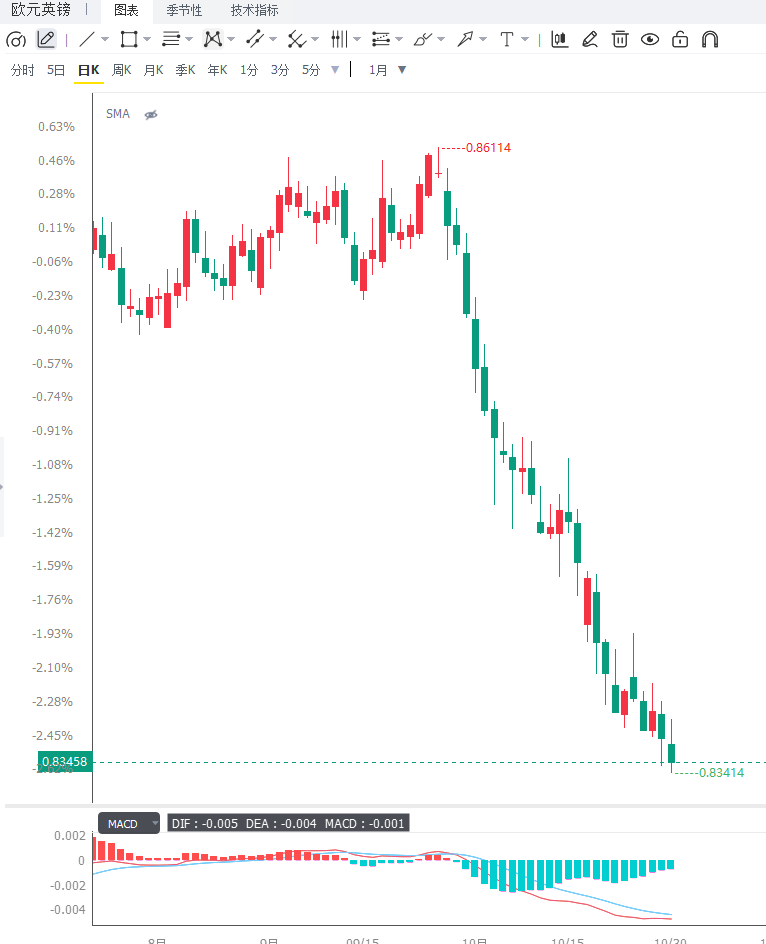 The core contradiction in the EUR/GBP exchange rate lies in the divergence in policy pace between the ECB and the Bank of England, and the support for the pound from the temporary recovery in the UK's fiscal credibility. In the short term, the exchange rate is more likely to fluctuate within the 0.8325-0.8420 range, awaiting further guidance from the Bank of England's November 5th interest rate decision and Eurozone GDP data. Three key variables need to be monitored: first, the wording of the Bank of England's November interest rate decision and statement, which is the primary policy basis for judging whether the pound can shift from a passive to an active stance; second, the preliminary Q3 GDP figures for the Eurozone and Germany released today, which, if significantly weaker than expected, could further suppress the euro; and third, whether EUR/GBP can find support near the lower Bollinger Band at 0.8325, which is the primary technical basis for judging whether an oversold rebound can occur. In addition, the evolution of the Middle East geopolitical situation, energy price trends, and the progress of the ECB's successor selection also need to be monitored.
Meanwhile, the policy outlook for the pound is relatively clear. The first autumn budget announced by Chancellor of the Exchequer Healy on October 28th focused on fiscal discipline, allocating £15 billion in fiscal buffer to address the "global economic storm," without significantly expanding the deficit. The gilt market reacted calmly, with the 10-year gilt yield remaining stable around 5.31%. The Office for Budget Responsibility (OBR) projects UK GDP growth of 1.2% in 2026, with inflation potentially peaking at around 3.75% in early 2027. The market widely expects the Bank of England to raise interest rates by 25 basis points to 4.00% on November 5th, breaking the 11-month interest rate freeze. ING strategists point out that the budget itself is unlikely to significantly change the Bank of England's tightening outlook, but any unexpectedly large minimum wage increase could create hawkish ripple effects through the money market. From a cross-asset perspective, the continued weakening of EUR/GBP is essentially a confluence of two main factors: first, the divergence in the pace of interest rate hikes between the ECB and the Bank of England—the ECB is choosing to wait and see due to energy shocks and growth uncertainty, while the Bank of England is more likely to act first given the resilience of employment and inflationary pressures; second, the phased recovery of the UK's fiscal credibility has provided the pound with both interest rate differential and confidence support relative to the euro. However, further upside for the pound still faces structural constraints—the erosion of UK trade terms by high energy prices, the dampening effect of interest rate hikes on demand, and the already priced-in aggressive tightening expectations in the market all suggest that the downside potential for EUR/GBP may not be unlimited. It is worth noting that Lagarde announced she will step down as ECB president on February 7, 2027, approximately nine months earlier than her original term. The selection process for her successor has begun, and this personnel change may add uncertainty to the medium-term path of Eurozone monetary policy, exerting some psychological pressure on the euro in the short term. On the daily chart, EUR/GBP is trading below the 100-day SMA (approximately 0.8540) and the Bollinger Middle Band (approximately 0.8420), indicating a clear bearish bias. The price has approached the lower Bollinger Band (approximately 0.8325), and the 14-day RSI has fallen to around 18.6, deeply entering oversold territory, suggesting that while selling pressure is heavy, a technical exhaustion may be imminent. The original chart analysis indicates that the key resistance levels to watch are the Bollinger Middle Band at 0.8420, the Bollinger Upper Band at 0.8512, and the 100-day SMA at 0.8540. The primary support level is at the lower Bollinger Band at 0.8325; a break below this level could open up further downside potential, testing the 0.8300 psychological level and even the 0.8270 area. On the 4-hour chart, the price is moving along the short-term moving averages, and the MACD histogram is close to the zero line, indicating bearish momentum but not yet accelerating. The current price is fluctuating narrowly between 0.8340 and 0.8365. If the rebound to the 0.8365-0.8380 area is met with resistance, the bearish trend may continue. If the price breaks below 0.8325, the risk of accelerated decline should be noted. The core contradiction in the EUR/GBP exchange rate lies in the divergence in policy pace between the ECB and the Bank of England, and the support for the pound from the temporary recovery in the UK's fiscal credibility. In the short term, the exchange rate is more likely to fluctuate within the 0.8325-0.8420 range, awaiting further guidance from the Bank of England's November 5th interest rate decision and Eurozone GDP data. Three key variables need to be monitored: first, the wording of the Bank of England's November interest rate decision and statement, which is the primary policy basis for judging whether the pound can shift from a passive to an active stance; second, the preliminary Q3 GDP figures for the Eurozone and Germany released today, which, if significantly weaker than expected, could further suppress the euro; and third, whether EUR/GBP can find support near the lower Bollinger Band at 0.8325, which is the primary technical basis for judging whether an oversold rebound can occur. In addition, the evolution of the Middle East geopolitical situation, energy price trends, and the progress of the ECB's successor selection also need to be monitored.
- Risk Warning and Disclaimer
- The market involves risk, and trading may not be suitable for all investors. This article is for reference only and does not constitute personal investment advice, nor does it take into account certain users’ specific investment objectives, financial situation, or other needs. Any investment decisions made based on this information are at your own risk.