Fire extinguished, another explosion elsewhere! Middle East, Russia, and Ukraine take turns disrupting crude oil prices.
2026-10-30 16:50:26
On Friday (October 30th) during the Asian and European sessions, international oil prices fluctuated at high levels. The recent situation in the Middle East resembled a firefighter rushing into a blaze, successfully extinguishing the flames, but a closer look revealed that fires (war) had reignited in other areas, accompanied by localized explosions. Sources revealed that Qatari mediators returned to Tehran on Friday. As part of efforts to reach a US-Iran agreement, mediation negotiations have been coordinated with the US. Following this news, oil prices quickly fell. However, the Russia-Ukraine conflict saw new developments today, and last night during the New York trading session, clashes between Saudi Arabia and the Houthi rebels escalated again, providing concrete evidence of conflict and directly supporting a rebound in oil prices. During the US election window, rumors of negotiations and military attacks alternate, suggesting continued short-term price volatility. 
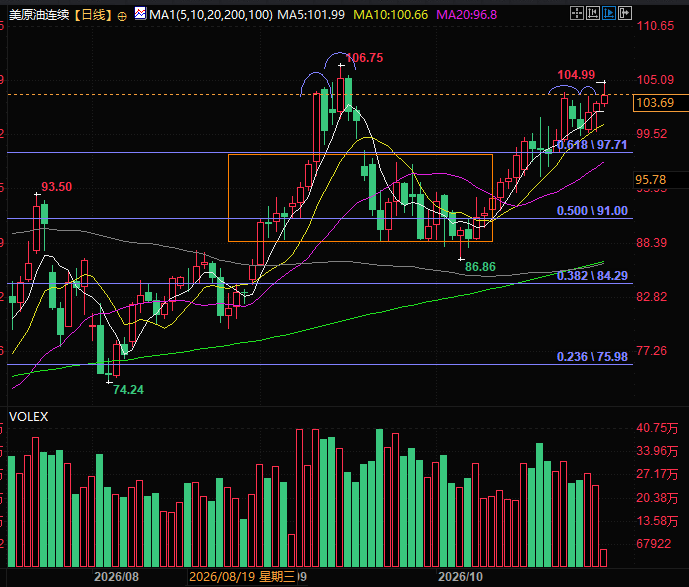 (WTI crude oil futures daily chart, source: EasyForex) WTI crude oil futures are currently trading at $103.62 per barrel.
The United States continues to pressure Iran to negotiate.
Sources familiar with the matter revealed that Qatari mediators returned to Tehran on Friday to advance US-Iran peace talks. The current mediation plan had been coordinated with the US in advance, and this diplomatic news initially caused oil prices to fall from their highs. Previously, US Vice President Vance had written to hardline representatives of Iran, proposing to initiate direct negotiations. The core of the US demands was to address the Iranian nuclear issue while acknowledging Iran's demands for economic reconstruction and sovereignty. Istanbul or Doha were considered as potential negotiation locations. Vance also conveyed the requirement that "Iran needs to send an authorized representative capable of discussing the nuclear issue." Vance's proactive contact with Rezaei reflects the Trump administration's view that Rezaei is a key figure in US-Tehran engagement and the only one capable of pushing for an internal Iranian consensus on halting the nuclear program. Meanwhile, the US military continues to deliver air defense munitions to bases in Israel, Jordan, and Qatar, and the US and Israel continue to coordinate strike plans. Expectations of the US resuming strikes against Iran after the election remain high. This is a two-pronged approach, using both carrot and stick tactics, but we believe the primary goal is to initiate peace talks while alleviating Israeli concerns.Geopolitical risks escalate between Houthi rebels and Saudi Arabia
Simultaneously with news of de-escalating tensions, the exchange of blows between Saudi Arabia and the Houthi rebels last night directly led to a rebound in oil prices after hitting a low: The Saudi-led coalition intercepted two ballistic missiles aimed at Riyadh, with explosions heard in the city and air raid sirens sent to residents' mobile phones. On the same day, the coalition also intercepted missiles aimed at Saudi Arabia's eastern province. The Houthis claimed that the Saudi-led coalition launched 116 airstrikes in various parts of Yemen in the past 24 hours, further escalating the retaliatory cycle of the conflict. Currently, Persian Gulf crude oil exports remain resilient thanks to rerouting routes and logistical adjustments, but market concerns are escalating: if subsequent attacks damage core infrastructure for production, refining, and exports, simply changing shipping routes will not be enough to fill the supply gap.Meanwhile, there has been no substantial breakthrough in the negotiations between Russia and Ukraine.
On the Russian-Ukrainian front, signals of peace talks coexist with military strikes. The Ukrainian Foreign Minister stated that Zelenskyy was willing to directly consult with Putin on sensitive issues such as territory, but the offensive on the battlefield has not ceased, with Russian forces continuing to strike Ukrainian energy and port facilities. Due to external pressure ahead of the US election, Ukraine has informally suspended attacks on Russian oil refineries. This ban is likely to remain in effect until after the election, representing a temporary tactical concession, and the risk to energy supply has not been eliminated. Overall, diplomatic advantages and new risks coexist, making it difficult to completely erase the geopolitical risk premium already priced into the market. Crude oil is expected to rise again this week, marking the fourth consecutive month of monthly gains.The simultaneous release of strategic reserves by multiple countries can only provide a temporary buffer.
To alleviate the shortage of refined oil products and suppress diesel crack spreads, Europe and the US have simultaneously launched reserve releases. Europe plans to release 42 million barrels of reserves over the next three months, half of which will be refined diesel. The diesel reserves released by France will quickly enter the spot market, with official estimates suggesting this could lower diesel retail prices by 12-18 euro cents per liter. The US is releasing the final batch of 40 million barrels of crude oil in this round of globally coordinated reserve releases, through a lease agreement with traders. Russia will continue its diesel export ban, relying on limited quotas to release diesel abroad. However, these reserves represent a marginal increase, and under the baseline scenario of a steady release, the window for buffering oil prices is only about 30-60 days. If core oil and gas facilities are attacked or damaged, the reserve's stabilizing effect will quickly become ineffective. Furthermore, the US's crude oil release is a loan, creating a rigid buying opportunity in the long term, potentially hindering future oil price support.Institutional View: Export resilience is deceptive; the risk of supply chain disruptions at the tail end cannot be ignored.
TD Securities believes the probability of Iran making substantial compromises before the US midterm elections on November 3rd is low. During the election window, rumors of negotiations and reports of skirmishes will alternate, leading to frequent market volatility. Saul Kavonic, Head of Energy Research at MST Marquee, points out that the lack of a viable diplomatic solution to the ongoing military action around the Hormuz region is causing the market to continue pricing in escalating conflict, thus keeping oil prices high. Ole Hansen, Head of Commodity Strategy at Saxo Bank, cautions that the current resilience of Persian Gulf crude oil exports is misleading. The real risk lies not in temporary obstructions, but in irreversible supply disruptions caused by infrastructure damage—the core logic behind the continued bullish bets.Trading strategy summary: Positive news is easily priced in quickly; blind optimism is not advisable.
The attacks continue to escalate, and the anticipated increase in conflict is supporting the upward trend in oil prices. The brief easing brought by the peace talks has not changed the underlying tensions. Three key themes to watch are: whether Iran can send a representative with final decision-making power to conduct substantive negotiations; whether there is new progress in the ceasefire along the Russia-Ukraine energy route; and whether the market is concerned about the deterioration of global strategic reserves. Before the November 3rd election, positive news such as diplomatic easing of geopolitical conflicts this weekend still presents short-term trading opportunities, but caution is needed regarding profit-taking. Most of the positive news generated by the election cycle is driven by short-term sentiment; if the market fails to rise despite positive news, it is a signal to exit. Diplomatic news is unlikely to reverse the current tight supply situation; chasing the rally requires strict risk control. If positive news emerges over the weekend, be wary of profit-taking and avoid excessive optimism. Technically, international oil prices did not fall sharply at the close on Thursday, temporarily alleviating the double-top risk and increasing the probability of new highs. Watch for a break above 105; if it breaks through 105, the target price is likely near the September high of 106.7. (WTI crude oil futures daily chart, source: EasyForex) WTI crude oil futures are currently trading at $103.62 per barrel.
- Risk Warning and Disclaimer
- The market involves risk, and trading may not be suitable for all investors. This article is for reference only and does not constitute personal investment advice, nor does it take into account certain users’ specific investment objectives, financial situation, or other needs. Any investment decisions made based on this information are at your own risk.