The joint statement on foreign exchange by the US and Japan "remains in effect," but why is the yen still weakening after Katayama's statement?
2026-11-02 10:12:28
On Monday (November 2nd) during Asian trading hours, the USD/JPY pair fluctuated slightly higher, currently trading around 157.80. While the exchange rate rose slightly, Tokyo's verbal warnings have materialized. Japanese Finance Minister Katayama stated on Sunday (November 1st) that the joint foreign exchange statement with the US remains in effect, and Tokyo will act on disorderly exchange rate fluctuations, retaining the possibility of intervention amidst a weakening yen. Katayama declined to comment on specific exchange rate levels, stating that she could not describe the current level as good or bad. She emphasized the importance of a stable exchange rate market and the need to avoid disorderly fluctuations. She also indicated that the situation has improved compared to earlier times, but did not elaborate. Katayama pointed out that Prime Minister Sanae Takaichi had stated that the yen's undervaluation was a problem, reminding the market that concerns about a weak yen have extended to the highest levels of government. She mentioned the joint statement with Washington, indicating that Tokyo believes its intervention options are acceptable to the US in the event of excessive volatility. 
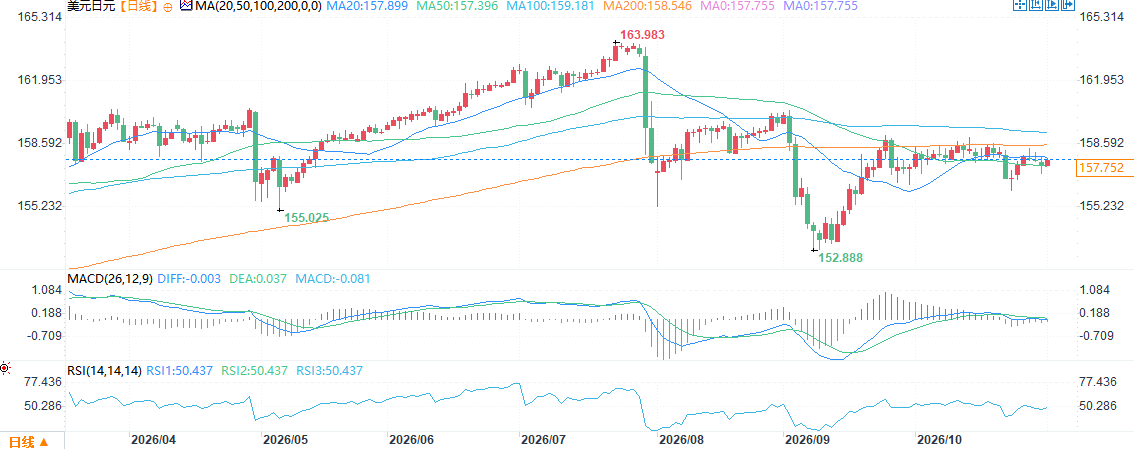 (USD/JPY daily chart, source: EasyForex) At 10:09 Beijing time, USD/JPY was trading at 157.85/86.
The measure of a stance: maintaining deterrence rather than escalating warnings.
Katayama's remarks did not escalate Japan's verbal warnings. By avoiding any judgment on the exchange rate level and pointing out that the situation had improved, she conveyed caution rather than an imminent signal of action. The current weakness of the yen indicates that the market does not perceive these comments as a strong deterrent. Refusing to assess the current level and stating that the situation has improved reads more like a wait-and-see attitude than an escalation of verbal warnings. Mentioning the joint statement with the United States reminds the market that Tokyo believes it has room to act if volatility becomes disorderly, which may make traders more cautious about significantly depressing the yen in the short term. Katayama emphasized the importance of stabilizing the exchange rate market and avoiding disorderly fluctuations, while refusing to simply define the current level as good or bad, demonstrating restraint in policy communication. She cited Prime Minister Sanae Takashi's remarks on the yen's undervaluation, indicating that the government's concerns about a weak yen have reached the highest levels, but the overall wording remained at the level of retaining the option of intervention rather than explicitly announcing action. This approach helps to maintain psychological pressure on short sellers and preserve the effectiveness of the deterrent without stimulating an overreaction in the market. Market reactions suggest that traders are more inclined to interpret such comments as routine monitoring signals rather than a precursor to immediate intervention, thus suggesting that the yen may still have room to weaken further in the short term.A weak yen and imported inflation: Manufacturing cost pressures rise for the first time in five months.
A weak yen comes at a time when Japanese companies are facing cost pressures. A manufacturing survey released Monday showed that input price inflation rose for the first time in five months, with companies attributing it to rising costs of oil, raw materials, and components. A weaker yen pushes up import costs, and Japanese manufacturers have already reported stronger input price inflation. Japan is highly dependent on energy and raw material imports, and the yen's depreciation directly translates into higher import prices denominated in local currency, further squeezing corporate profit margins. The rise in input costs in the manufacturing survey indicates renewed upstream pressure on companies, potentially forcing some manufacturers to accelerate the passing on of costs to downstream customers, thereby pushing up overall inflation expectations. Against the backdrop of global commodity prices already being influenced by geopolitical factors, a weak yen amplifies the transmission effect of imported inflation. If companies continue to face rising costs without a corresponding improvement in demand, it could impact investment and employment decisions. The market needs to pay attention to whether subsequent input price data continues to rise and whether companies alleviate pressure by raising prices. The combination of a weak yen and rising costs also presents the Bank of Japan with more constraints in balancing monetary policy, as further easing could exacerbate currency depreciation, while interest rate hikes could suppress already sluggish manufacturing demand.Fiscal Issues: Tax Revenue Forecasts and Debates on the Consumption Tax Go Hand in Hand
Katayama also discussed fiscal policy, pledging that the government will make every effort to accurately and transparently forecast tax revenue. This commitment comes amid parliamentary debates on proposals to reduce the consumption tax on food and introduce new income-related benefits for low-income workers, measures that continue to scrutinize Japan's fiscal outlook. Accurate and transparent tax forecasts help strengthen market confidence in fiscal sustainability, especially against the backdrop of concurrent spending expansion proposals. If implemented, the food consumption tax cut and low-income welfare measures could increase fiscal pressure in the short term, while also having complex impacts on inflation and consumption patterns. Katayama's emphasis on forecast accuracy is intended to address market concerns about fiscal discipline and avoid additional increases in financing costs or yen volatility due to forecast discrepancies. The parliamentary debate process itself will also influence market expectations of the policy path; progress on related proposals could further intensify concerns about fiscal spending expansion. The intertwining of fiscal and exchange rate issues makes policy communication more sensitive: on the one hand, transparent forecasts are needed to stabilize market confidence; on the other hand, a balance must be struck between supporting people's livelihoods and maintaining fiscal soundness. Subsequent tax data and the progress of parliamentary discussions will be important observation points for assessing the effectiveness of the coordination between Japan's fiscal and exchange rate policies.in conclusion
Katayama's statement maintained a deterrent stance but did not draw a red line—the joint statement remains valid, and Tokyo will take action against disorderly fluctuations, but he declined to comment on specific levels, stating that the situation has improved, conveying vigilance rather than imminent action. The yen weakened that day, indicating the market did not perceive it as a strong resistance level. For the market, the key test lies in whether the yen's weakness accelerates: Tokyo links its actions to the speed and disorder of fluctuations, rather than specific levels, therefore a sharp, rapid decline is more likely to trigger intervention than a gradual drift. A weak yen pushing up import costs, coupled with the first rise in manufacturing input price inflation in five months, constitutes another layer of pressure on policy. (USD/JPY daily chart, source: EasyForex) At 10:09 Beijing time, USD/JPY was trading at 157.85/86.- Risk Warning and Disclaimer
- The market involves risk, and trading may not be suitable for all investors. This article is for reference only and does not constitute personal investment advice, nor does it take into account certain users’ specific investment objectives, financial situation, or other needs. Any investment decisions made based on this information are at your own risk.