Strengthened expectations of a Fed rate hike are putting downward pressure on gold prices, causing gold to break below its trading range support and maintain a downward trend in the short term.
2026-11-02 09:56:25
Spot gold extended its technical rebound from Friday's close in Asian trading on Monday, last trading around $3,900 per ounce, up about 0.6% from the previous trading day's low of $3,870 per ounce, but still down more than 5% from its mid-October high of above $890 per gram (approximately $4,100 per ounce). Gold prices underwent an oversold correction after two consecutive days of sharp declines, but the rebound was noticeably weak, reflecting insufficient market buying interest.  The core driver suppressing gold prices remains the repricing of the Federal Reserve's interest rate hike path. Although the Fed kept interest rates unchanged at its October meeting, several officials released hawkish signals. Dallas Fed President Logan explicitly stated that the Fed "needs at least two more 25-basis-point rate hikes," emphasizing that skipping one meeting does not change the policy endpoint. His FXSSpeechtracker score reached 8/10, higher than the historical average of 7.7/10, and the FXS Fed Sentiment Index rose to 143.62, well above the neutral level of 100, confirming that the remarks added additional hawkish pressure to the dollar's expectations. Meanwhile, the CME FedWatch tool showed that the market's pricing in a December rate hike was approximately 72.9%, a significant increase from the previous week. The resilience of inflation data further strengthened this expectation. The combination of a 3.4% annualized GDP growth rate in the third quarter and a 3.1% year-on-year core PCE growth rate gave the US economy the characteristics of "high growth + high inflation." OCBC strategists pointed out that gold prices "failed to benefit from the decline in yields, indicating that new buying interest remains limited," even if previous liquidation pressures may be easing. The renewed weakness in the technology sector also dampened market risk appetite, raising concerns about broader deleveraging. Geopolitically, new uncertainties have emerged in the Middle East. Ukraine has resumed attacks on Russian oil refineries, ending a roughly two-week pause; Iran's Supreme Leader has also ordered senior military commanders to prepare for a new round of confrontation with the US and Israel. These factors provided a floor for gold prices, but safe-haven buying failed to generate sustained momentum amid expectations of interest rate hikes. Currently, "the decisive factor will be whether incoming economic data prompts the market to reassess the interest rate outlook, shifting expectations towards a pause in tightening or a resumption of rate cuts. Until then, although factors supporting the medium- to long-term outlook remain, gold may continue to face selling pressure." On the daily chart, spot gold is trading below all major moving averages and the 100-day moving average (approximately $4210/oz), maintaining a complete bearish structure. The price is below the Bollinger Band middle line (approximately $4085/oz), and has even broken below the lower band (approximately $3910/oz), suggesting strong downward momentum. The RSI (14) is around 32, near the edge of the oversold zone, indicating that the bearish momentum has stretched but has not yet reversed. The resistance levels to watch are $3910/oz, $4085/oz, and the dense resistance zone formed by $4210/oz and $4265/oz. A break above these levels is needed to alleviate the current bearish bias. The first support level to watch is the previous day's low of $3870/oz. A break below this level could further test the $3850/oz and even the psychological level of $3800/oz. On the 4-hour chart, gold prices rebounded from the low of $3870/oz and are currently consolidating between $3880 and $3910/oz. The RSI has risen from the oversold zone to around 40, and the MACD histogram is narrowing below the zero line, indicating a short-term technical correction. However, a rebound to around $3910/oz may encounter resistance again.
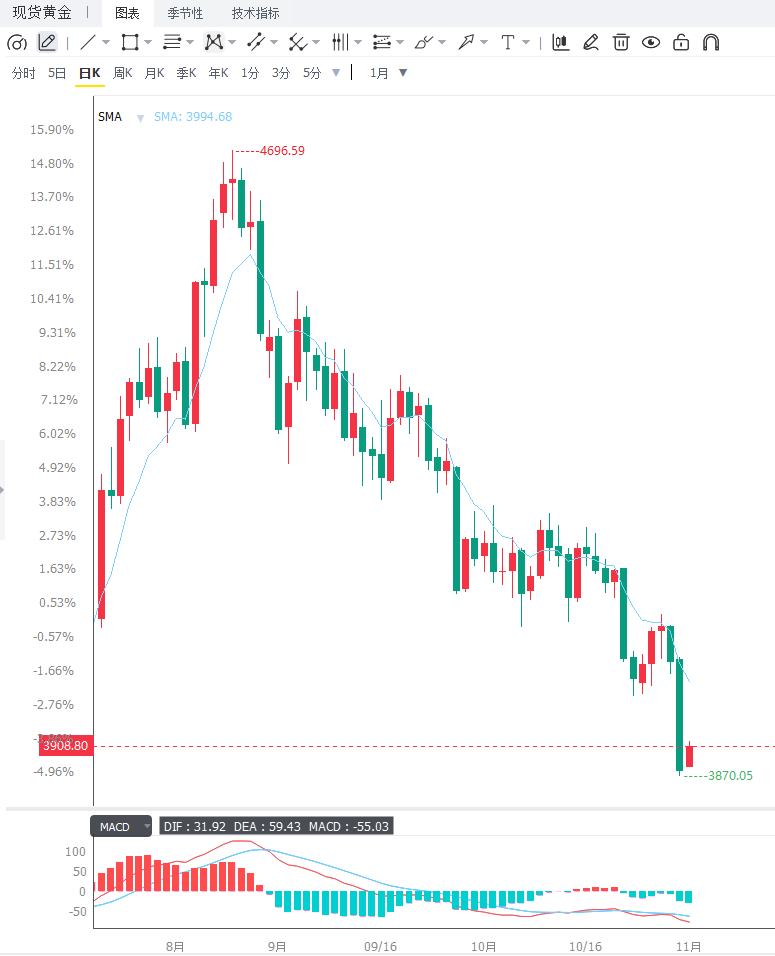 Editor's Summary: The core contradiction in the current spot gold market lies in the tug-of-war between "strengthened expectations of a Fed rate hike" and "residual geopolitical risk premium." In the short term, gold prices rebounded technically after finding initial support around $3870/oz, but with the probability of a December rate hike remaining high, the upside potential is limited, and it is more likely to consolidate within the $3870-$3910/oz range. Three variables need to be closely watched going forward: First, Friday's US Employment Cost Index (ECI) data; if wage growth continues to show resilience, it will reinforce expectations of a rate hike, further pressuring gold. Second, substantial developments in the Middle East situation; if Ukraine attacks Russian oil refineries or Iran's military preparations trigger supply disruption concerns, safe-haven buying could drive a gold price rebound. Third, whether gold prices can effectively break through $3910/oz is the primary technical indicator for judging whether the short-term bearish trend has eased.
The core driver suppressing gold prices remains the repricing of the Federal Reserve's interest rate hike path. Although the Fed kept interest rates unchanged at its October meeting, several officials released hawkish signals. Dallas Fed President Logan explicitly stated that the Fed "needs at least two more 25-basis-point rate hikes," emphasizing that skipping one meeting does not change the policy endpoint. His FXSSpeechtracker score reached 8/10, higher than the historical average of 7.7/10, and the FXS Fed Sentiment Index rose to 143.62, well above the neutral level of 100, confirming that the remarks added additional hawkish pressure to the dollar's expectations. Meanwhile, the CME FedWatch tool showed that the market's pricing in a December rate hike was approximately 72.9%, a significant increase from the previous week. The resilience of inflation data further strengthened this expectation. The combination of a 3.4% annualized GDP growth rate in the third quarter and a 3.1% year-on-year core PCE growth rate gave the US economy the characteristics of "high growth + high inflation." OCBC strategists pointed out that gold prices "failed to benefit from the decline in yields, indicating that new buying interest remains limited," even if previous liquidation pressures may be easing. The renewed weakness in the technology sector also dampened market risk appetite, raising concerns about broader deleveraging. Geopolitically, new uncertainties have emerged in the Middle East. Ukraine has resumed attacks on Russian oil refineries, ending a roughly two-week pause; Iran's Supreme Leader has also ordered senior military commanders to prepare for a new round of confrontation with the US and Israel. These factors provided a floor for gold prices, but safe-haven buying failed to generate sustained momentum amid expectations of interest rate hikes. Currently, "the decisive factor will be whether incoming economic data prompts the market to reassess the interest rate outlook, shifting expectations towards a pause in tightening or a resumption of rate cuts. Until then, although factors supporting the medium- to long-term outlook remain, gold may continue to face selling pressure." On the daily chart, spot gold is trading below all major moving averages and the 100-day moving average (approximately $4210/oz), maintaining a complete bearish structure. The price is below the Bollinger Band middle line (approximately $4085/oz), and has even broken below the lower band (approximately $3910/oz), suggesting strong downward momentum. The RSI (14) is around 32, near the edge of the oversold zone, indicating that the bearish momentum has stretched but has not yet reversed. The resistance levels to watch are $3910/oz, $4085/oz, and the dense resistance zone formed by $4210/oz and $4265/oz. A break above these levels is needed to alleviate the current bearish bias. The first support level to watch is the previous day's low of $3870/oz. A break below this level could further test the $3850/oz and even the psychological level of $3800/oz. On the 4-hour chart, gold prices rebounded from the low of $3870/oz and are currently consolidating between $3880 and $3910/oz. The RSI has risen from the oversold zone to around 40, and the MACD histogram is narrowing below the zero line, indicating a short-term technical correction. However, a rebound to around $3910/oz may encounter resistance again. Editor's Summary: The core contradiction in the current spot gold market lies in the tug-of-war between "strengthened expectations of a Fed rate hike" and "residual geopolitical risk premium." In the short term, gold prices rebounded technically after finding initial support around $3870/oz, but with the probability of a December rate hike remaining high, the upside potential is limited, and it is more likely to consolidate within the $3870-$3910/oz range. Three variables need to be closely watched going forward: First, Friday's US Employment Cost Index (ECI) data; if wage growth continues to show resilience, it will reinforce expectations of a rate hike, further pressuring gold. Second, substantial developments in the Middle East situation; if Ukraine attacks Russian oil refineries or Iran's military preparations trigger supply disruption concerns, safe-haven buying could drive a gold price rebound. Third, whether gold prices can effectively break through $3910/oz is the primary technical indicator for judging whether the short-term bearish trend has eased.- Risk Warning and Disclaimer
- The market involves risk, and trading may not be suitable for all investors. This article is for reference only and does not constitute personal investment advice, nor does it take into account certain users’ specific investment objectives, financial situation, or other needs. Any investment decisions made based on this information are at your own risk.