Why is the dollar index failing to rise despite three Federal Reserve officials calling for continued interest rate hikes?
2026-11-02 10:58:25
Three Federal Reserve officials advocated for further interest rate hikes last Friday (October 30) to combat high inflation. This was the first time Fed officials publicly articulated their policy stance since the latest monetary policy meeting decided to hold rates steady. Dallas Fed President Logan stated that the current level of price pressures and the duration for which inflation has remained above the 2% target are "unacceptable," and indicated that the Fed still needs to continue its efforts. In prepared remarks for an event at Davidson College, Logan said, "Given the current economic outlook, I still believe the Federal Open Market Committee needs to raise interest rates at least twice more, 25 basis points each time." She added that after these rate hikes, "I think we can pause to review the economic and financial situation and determine whether further action is needed." Logan is a voting member of the FOMC this year, and at this week's meeting, she and other policymakers unanimously supported keeping the target range for the interest rate unchanged at 3.75%-4.00%. She explained that keeping rates unchanged was due to increased market volatility and also to allow the public time to adjust to the environment of higher borrowing costs. 
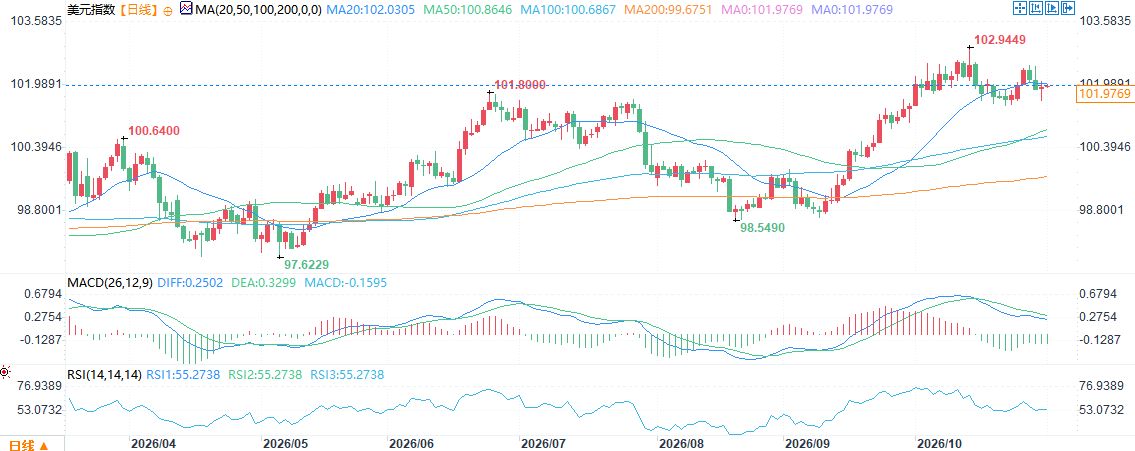 (US Dollar Index Daily Chart, Source: FX678) At 10:56 Beijing time, the US Dollar Index was at 101.98.
Logan: At least twice, 25 basis points each time, after which the review can be paused.
Logan's statement was the most specific of the three officials. She outlined a quantitative path of "at least two 25-basis-point hikes each" and specified the conditions for a pause—a review of the economic and financial situation after these hikes. This statement both criticized the current policy stance and provided an operational framework for future actions. Her explanation for keeping interest rates unchanged this week—increased market volatility and the need for the public to adjust to higher borrowing costs—indicated that this pause was a consideration of pace rather than a change in direction.Musalaim: Monetary policy remains accommodative; the sooner the better.
St. Louis Fed President Mossaleem, who does not have a vote this year, also advocated for interest rate hikes in another speech. In prepared remarks for a Shadow Open Market Committee event, Mossaleem stated, "Monetary policy needs to be tightened further, and sooner rather than later." He added, "Early, gradual adjustments are generally less shocking than larger, more abrupt actions later." He stated that inflation remains too high relative to the 2% target; without Fed action, inflation is unlikely to fall. He pointed out that the current monetary policy stance is insufficient to push inflation down. Mossaleem stated, "I believe monetary policy and financial conditions remain accommodative, but financial conditions have recently tightened somewhat." His core logic is: policy remains accommodative, and there is no spontaneous impetus for inflation to fall; therefore, sooner rather than later, gradual adjustments are better than being forced into large-scale actions later.Barkin: The direction is clear; the key lies in the pace.
Richmond Fed President Barkin stated in a radio interview, "Inflation is high, demand is robust, and unemployment is relatively low. Therefore, the next step for interest rates is quite clear." Barkin added, "However, the key is the pace of rate hikes… We have already signaled a gradual pace of increases. A gradual pace is reasonable as long as we are not significantly behind the curve, because we need time to observe and understand how things develop." Compared to Logan and Musalaim, Barkin's statement focused more on the pace than the magnitude, but his judgment on the direction was equally clear.Background and Market: The quiet period ends, December becomes the next observation window.
The Federal Reserve's so-called "blackout period," which restricts officials' public speaking before FOMC meetings, has ended. Two Fed officials voted against raising rates at the meeting, but unlike recent practice, Cleveland Fed President Hammarck and Fed Governor Cook did not formally explain their reasons for voting in favor of the rate hike on Friday. The Fed raised rates in September to push persistently high inflation back to its 2% target. Officials have generally hinted that the rate hike cycle is not over, and traders and investors are viewing the December meeting as the next potential point of action. Following the FOMC meeting, Fed Chairman Warsh was asked at a press conference why the Fed did not raise rates at this week's meeting if it considered inflation too high. Warsh said, "I am encouraged by the progress we have made in reducing inflation in a short period of time." Warsh added, "But if the core of your question is that we haven't met our goals and haven't achieved price stability, then you're right. However, we are working on it." Warsh has consistently declined to provide guidance on the interest rate outlook and has not revealed what action the Fed might take at its December 8-9 policy meeting. Futures markets have cooled their expectations for a December rate hike, but market participants still believe the Federal Reserve is more likely to raise short-term borrowing costs than to keep rates unchanged. Notably, U.S. stocks fell sharply on Friday, with developments in the artificial intelligence sector dampening investor sentiment, and the Nasdaq index dropping to a three-month low. If the market's concerns about a slowdown in AI-related activity materialize, the pressure on the Fed to raise rates may ease—officials have been pointing out for some time that overheated technology investment is driving up inflation, and a slowdown in activity in this sector could help alleviate price pressures and reduce the need for further rate hikes.Officials stated that the market provided bottom support, but this was insufficient to drive a breakout.
Logan outlined a quantitative easing path of "at least two 25-basis-point increases each," Musalaim advocated for "acting as soon as possible," and Barkin stated that the direction was "quite clear"—the three agreed that inflation remained high and policy was not yet in place, providing new support for expectations of a December rate hike. CME FedWatch showed a 75% probability of a December rate hike, a slight decrease from previous highs but still at a relatively high level. This means the interest rate advantage of dollar assets is unlikely to reverse in the short term, forming a bottom support for the dollar index. However, this support is insufficient to drive the index higher . On Monday (November 2nd) during the Asian session, the dollar index remained volatile, currently trading around 101.98, almost unchanged for the day. There are three reasons: First, officials' statements are a form of expectation management rather than policy implementation. Non-farm payroll and ISM data are still pending release before the December 8-9 meeting, and the market needs data verification rather than pricing based solely on speeches. Second, the futures market's expectation of a December rate hike actually cooled after the officials' speeches, indicating that the market still has reservations about the certainty of the policy path. Third, the waning of safe-haven demand—due to continued diplomatic contact between the US and Iran—is weakening another layer of support for the dollar. With these two forces offsetting each other, the dollar index is more likely to remain in the 101.50 to 102.20 range, with officials' statements providing lower-level support rather than upward momentum. A true directional breakout requires clearer signals from the data stream before the December meeting, or new variables in the geopolitical situation.in conclusion
Three Federal Reserve officials collectively called for continued interest rate hikes last Friday, marking their first public statement since the Fed held rates steady this week. Logan outlined a quantitative easing path of "at least two 25-basis-point increases each," Musalaim advocated for swift action and maintained a relatively accommodative policy stance, while Barkin emphasized a clear direction and the key was a gradual pace. Their consensus was that inflation remained too high and policy was not yet in place; their differences lay only in the pace and magnitude. Futures market expectations for a December rate hike have cooled somewhat but still lean towards a rate hike, making the December 8-9 meeting the next key observation window. A slowdown in AI investment could indirectly weaken the necessity of rate hikes by easing price pressures, constituting a contrarian variable in the policy path. (US Dollar Index Daily Chart, Source: FX678) At 10:56 Beijing time, the US Dollar Index was at 101.98.
- Risk Warning and Disclaimer
- The market involves risk, and trading may not be suitable for all investors. This article is for reference only and does not constitute personal investment advice, nor does it take into account certain users’ specific investment objectives, financial situation, or other needs. Any investment decisions made based on this information are at your own risk.