Interpreting the Bank of Japan's Outlook Report: The Constraints on Private Consumption Trends Due to Accelerated Population Decline
2026-11-02 17:58:26
On Monday, November 2nd, the Bank of Japan released its full-quarter economic and price outlook report, explicitly stating that continued population decline makes it difficult for overall private consumption to achieve strong growth. The report emphasized that from a demographic perspective, even weak overall consumption data does not necessarily equate to a deterioration in household demand itself. Currently, the USD/JPY exchange rate is trading above 157, the Bank of Japan's policy rate remains at 1.25%, and Japan's core CPI rose to 2.1% year-on-year in September, while the core index excluding fresh food and energy reached 2.4%. The market is focused on the Bank of Japan's next policy decision on December 18th and the third-quarter GDP data released on November 16th. 
Structural constraints on overall consumption due to population decline
Data from Japan's Ministry of Internal Affairs and Communications shows that the population is projected to decline by 2.5% in 2025 compared to five years prior, falling to approximately 122.97 million. This decline is the fastest recorded since 1920, roughly three times the rate of decline in 2020. The report points out that the rate of population decline accelerated around 2020, and this structural factor has historically limited the growth potential of overall private consumption. Private consumption accounts for about half of Japan's economy and is one of the core variables in policy evaluation. While overall consumption levels remain lower than pre-pandemic levels, the total economic output has reached a record high. This discrepancy largely stems from a shrinking population base rather than simply a contraction in demand. The report argues that simply observing overall consumption data may overestimate the extent of demand weakness and that demographic factors must be considered in conjunction with this analysis.The divergence between per capita consumption and overall consumption
The Bank of Japan's estimates show that per capita consumption at the beginning of this year was about 4% higher than in 2015, while overall consumption remained almost flat. This divergence indicates that per capita consumption remains resilient, while the lackluster overall data reflects more the mechanical effect of a declining population. Categories such as non-durable goods, which are directly affected by the number of consumers, are more susceptible to population constraints. Meanwhile, improved employment and income conditions, wage growth, and some asset effects are supporting consumption, but rising prices and weather factors are also putting temporary pressure on it. The report therefore advises that policy decisions should distinguish between weakness caused by deteriorating household demand and overall growth constraints caused purely by demographic factors to avoid misjudging the consumption situation.Consumption and Inflation Considerations in Policy Evaluation
The Bank of Japan stated in its report that underlying inflation is broadly in line with its 2% target, with upside risks remaining. Interest rate adjustments will help alleviate price pressures and support consumption. The current policy rate is 1.25%, having been raised in September and then unchanged at the end of October. The report also noted that private consumption is expected to remain largely flat in fiscal year 2026, influenced by energy prices and weather, but supported to some extent by improved incomes and government measures. From 2027 onwards, the income-expenditure cycle is expected to gradually strengthen. Demographic factors make it difficult for overall consumption to experience strong upward momentum, which is an important background factor when assessing demand strength. While there are differing market expectations for the policy path in December, the report itself does not provide specific timing guidance, focusing instead on differentiating the different drivers behind consumption data.USD/JPY Market Technical Analysis
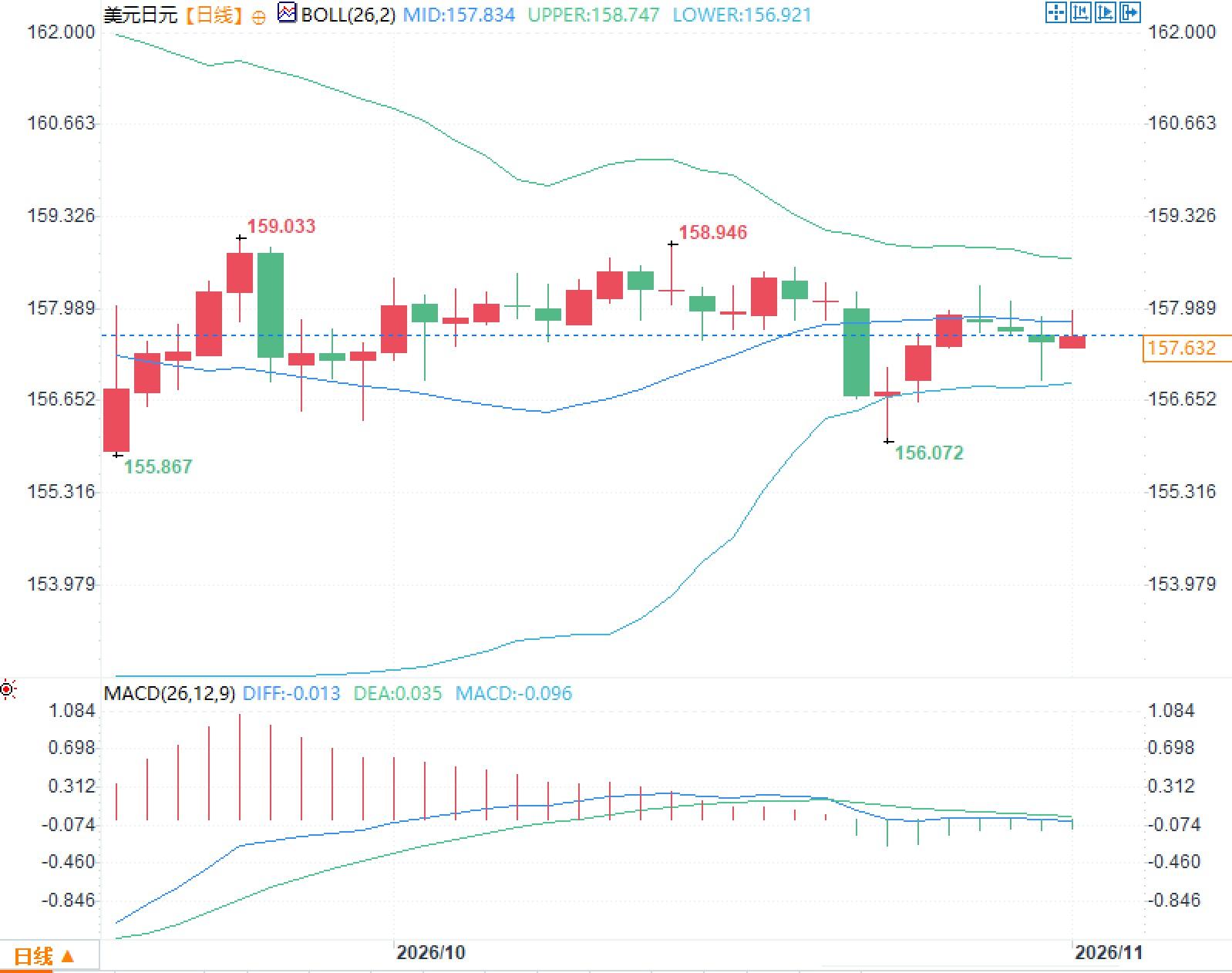
The current USD/JPY exchange rate is around 157.70. The daily Bollinger Bands show the middle band at 157.834, the upper band at 158.747, and the lower band at 156.921, with the price trading near the middle band. The MACD indicator shows the DIFF at -0.013, the DEA at 0.035, and the histogram at -0.096. The price is fluctuating within a recent range, and the Bollinger Band width reflects relatively limited volatility. These technical characteristics describe the current price position relative to moving averages and the trading range, as well as the state of momentum indicators. The exchange rate level, along with the Bank of Japan's policy rate, inflation data, and changes in population and consumption patterns, constitute the fundamental background that the market is focused on.Frequently Asked Questions
Question 1: Why does Japan's declining population limit overall consumption growth? Answer: Japan's population has been declining at an accelerated pace since around 2020, and is projected to decrease by 2.5% by 2025 compared to five years ago. This shrinks the overall consumption base, making it difficult for overall data to show strong growth even if per capita consumption remains resilient. Question 2: Why is there a divergence between per capita consumption and overall consumption in Japan? Answer: At the beginning of this year, per capita consumption was about 4% higher than in 2015, while overall consumption remained almost flat, indicating that demand itself has not deteriorated significantly. The overall lackluster performance is mainly due to the mechanical effect of the declining population, rather than a general weakening of household spending intentions. Question 3: What is the significance of this analysis for the Bank of Japan's policy assessment? Answer: The report suggests the need to distinguish between deteriorating demand and demographic factors, avoiding the direct interpretation of weak overall consumption as insufficient household demand, thus allowing for a more accurate assessment of the economic situation and inflationary environment.- Risk Warning and Disclaimer
- The market involves risk, and trading may not be suitable for all investors. This article is for reference only and does not constitute personal investment advice, nor does it take into account certain users’ specific investment objectives, financial situation, or other needs. Any investment decisions made based on this information are at your own risk.