The pound tested a key area after UK manufacturing data was confirmed. How will the market price this ahead of the Bank of England meeting?
2026-11-02 19:08:25
On Monday, November 2nd, the pound maintained a modest gain against the dollar, but retreated from its two-week high reached earlier in the day, currently trading around 1.3400. UK October manufacturing activity data confirmed accelerated expansion, adding another dimension to watch for the Bank of England's monetary policy meeting this Thursday. Meanwhile, uncertainty ahead of the US midterm elections and changes in risk sentiment due to falling oil prices combined to exert mild pressure on the dollar. Market focus is on whether the Bank of England will raise interest rates by 25 basis points to 4%, and the divergence in its subsequent path. 
 Across markets, the decline in oil prices and a slight improvement in risk sentiment interacted with the relative resilience of the pound, while uncertainty surrounding the US election limited further gains for the dollar. Traders are focused on this week's Bank of England meeting statement, US ISM data, and the potential impact of the election results on interest rate paths and political risk premiums. The overall market logic remains centered on policy divergences and data validation.
UK manufacturing activity confirms accelerated expansion.
The UK's final manufacturing purchasing managers' index (PMI) for October came in at 52.8, unchanged from the preliminary reading and up from 51.9 in September, marking its highest level in five months. The output sub-index rose to 53.6, a significant improvement from the previous reading of 51.5, representing the fastest expansion in 25 months; new orders also saw their strongest growth in months. The data, covering October 12-27, shows that manufacturing activity momentum strengthened at the start of the fourth quarter, encompassing multiple sub-sectors of consumer goods, intermediate goods, and investment goods. Meanwhile, input cost inflation accelerated, supplier lead times lengthened to their largest extent in nearly four years, and the employment index remained flat after six consecutive months of expansion. These details suggest that the rebound in activity has not fully translated into job creation, with cost pressures and supply chain tensions continuing to constrain growth. In previous Bank of England meeting minutes, most members focused on the persistence of energy price shocks, and the current manufacturing data provides additional insight into assessing demand resilience.Pricing and committee disagreements ahead of the Bank of England meeting
The Bank of England's current interest rate remains at 3.75%, and the market widely expects a 25 basis point increase to 4% at its November 5th meeting, which would likely be the first rate hike since August 2023. Market forecasts and economist surveys indicate a high probability of an increase, with some institutions predicting further adjustments after November, but the overall path remains uncertain. At the September meeting, the committee kept the rate unchanged by a 6-3 majority, with the three members already leaning towards an increase. Bank of England Governor Bailey recently stated at an event in Bangkok that the second round of inflation effects observed so far are "quite mild," with businesses focusing more on cost reduction and facing difficulties in passing on higher energy prices. He also noted that more evidence is needed to determine the persistence of the shock. The UK's Consumer Price Index (CPI) rose to 3.5% year-on-year in September, accelerating from 3.1% in August. The Bank of England had previously warned that inflation could slightly exceed 4% in the first quarter of 2027. Disagreements remain within the committee regarding the necessity of further tightening, with Bailey tending to downplay some inflationary pressures in previous months, increasing the value of the meeting statement and forward guidance.Uncertainty surrounding the US midterm elections is exerting mild pressure on the dollar.
The US midterm elections will be held on November 3rd. Market forecasts indicate a high level of expectation that the Democrats will control both the House and Senate, putting some downward pressure on the US dollar. Commentators believe that such an outcome may limit fiscal expansion, but the impact on the dollar will be more of a short-term fluctuation than a fundamental change, with interest rate differentials and other fundamental factors still providing support. The US October ISM Manufacturing Purchasing Managers' Index will be released today during the North American session. Market expectations are for moderate expansion, with the price component showing some easing at high levels. If these data meet expectations, they may provide some bottom support for the dollar. The decline in oil prices has led to a moderate increase in risk appetite across markets. Brent crude oil has fallen due to expectations of progress in diplomatic negotiations, reducing some safe-haven demand and indirectly affecting the relative performance of the dollar.Observations on Technological Forms and Cross-Market Interactions
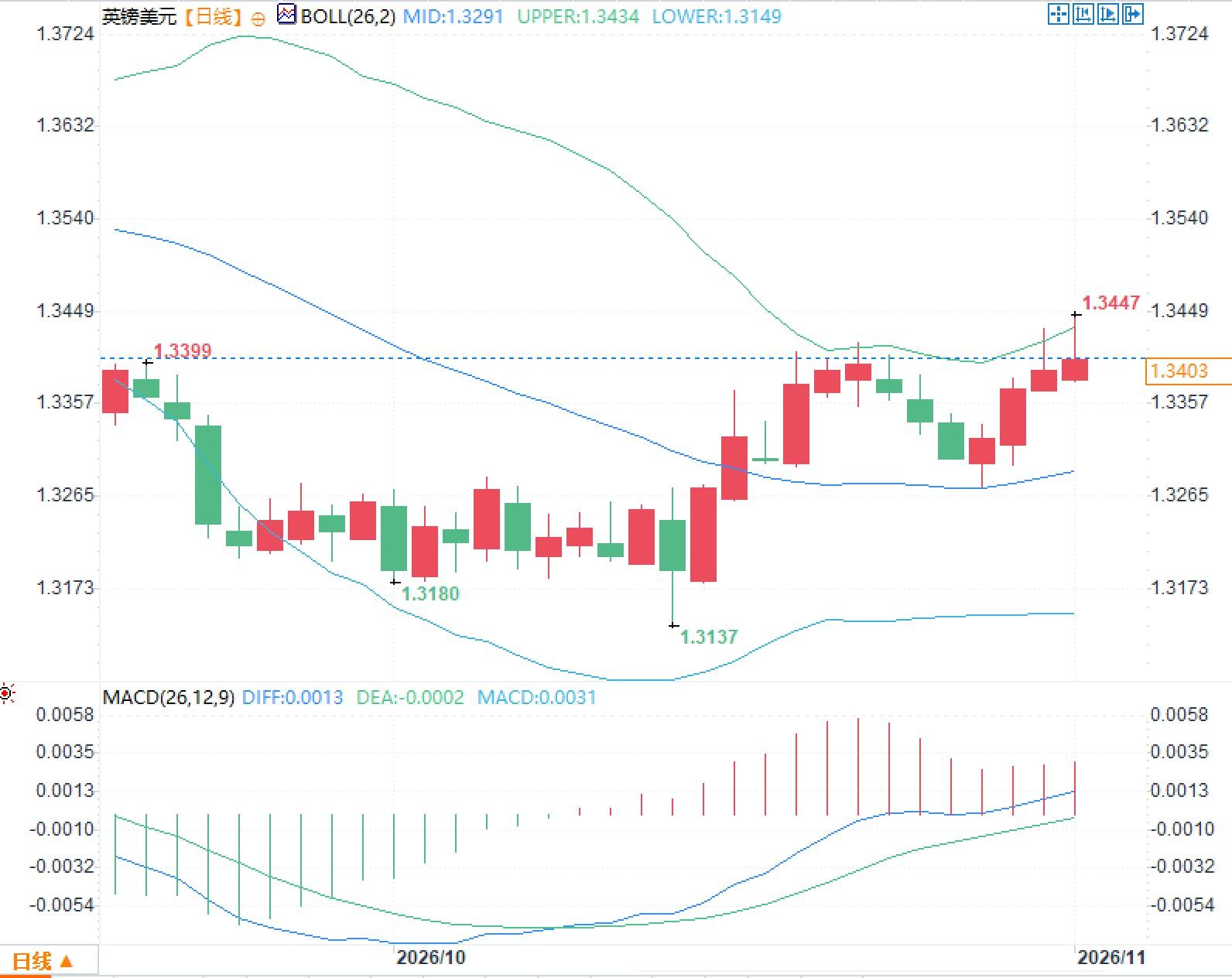
From the daily chart, the GBP/USD pair has recently been trading above the middle Bollinger Band and close to the upper band. The MACD indicator shows that the DIFF and histogram are in positive territory, reflecting a slight improvement in short-term momentum. However, the trading range is still constrained by the support formed by the previous low. Across markets, the decline in oil prices and a slight improvement in risk sentiment interacted with the relative resilience of the pound, while uncertainty surrounding the US election limited further gains for the dollar. Traders are focused on this week's Bank of England meeting statement, US ISM data, and the potential impact of the election results on interest rate paths and political risk premiums. The overall market logic remains centered on policy divergences and data validation.Frequently Asked Questions
Question 1: Why is the UK's October Manufacturing Purchasing Managers' Index (PMI) considered an important reference for the Bank of England's meeting? Answer: The index rose to 52.8, confirming faster output expansion and indicating resilient demand in the manufacturing sector. This is related to the Bank of England's assessment of inflation persistence, providing the Committee with real-time evidence of activity to determine whether further policy adjustments are needed in the context of the energy shock. Question 2: How have Bailey's recent comments on the effects of the second round of inflation affected the market's understanding of the interest rate path? Answer: He pointed out that the current effects are quite mild and businesses are focused on cost reduction. This reflects the Committee's cautious attitude towards the persistence of the shock. Therefore, while pricing in an upward adjustment in November, the market remains divided on expectations for multiple subsequent rate hikes, rather than being completely locked in.- Risk Warning and Disclaimer
- The market involves risk, and trading may not be suitable for all investors. This article is for reference only and does not constitute personal investment advice, nor does it take into account certain users’ specific investment objectives, financial situation, or other needs. Any investment decisions made based on this information are at your own risk.