AI computing power triggers sell-off; gold price rebound falls short of expectations as geopolitical easing measures ease.
2026-11-02 18:00:26
On Monday (November 2nd) during the Asian and European sessions, spot gold rebounded but has since retreated, recovering only 0.5%, after a sharp drop of over 3.5% in the previous trading day. Last Friday, persistent concerns about the business model of AI computing power triggered a liquidity sell-off in US stocks, putting downward pressure on gold prices; however, the weekend's US-Iran negotiations released signs of easing tensions, leading to a temporary recovery. Meanwhile, against the backdrop of major central banks globally pausing interest rate hikes, Friday's non-farm payroll data and inflation resilience will be key indicators to watch. Finally, the US midterm elections and potential escalation risks in the Middle East will collectively constitute the core variables driving gold prices going forward. 
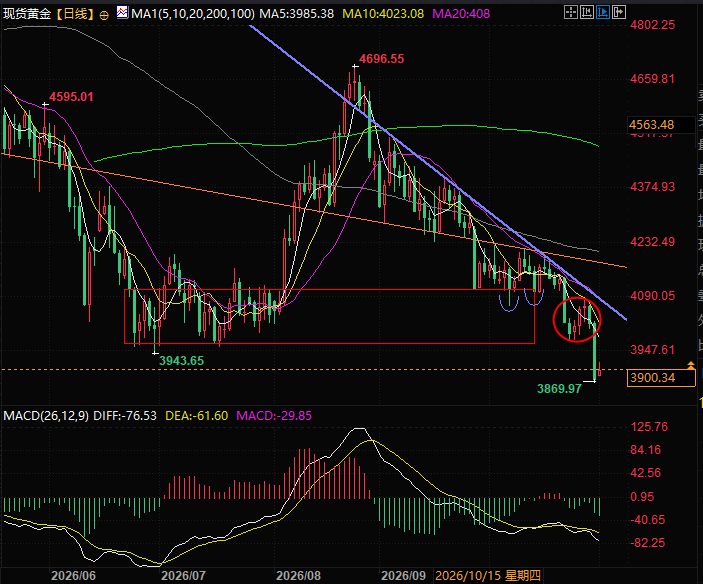 (Spot gold daily chart, source: EasyTrade) At 17:58 Beijing time, spot gold is currently trading at $3898 per ounce.
The collapse of the computing power business model and the resulting liquidity crunch dragged down gold prices, leading to a sell-off.
On the previous trading day, US stocks fell sharply, and gold failed to escape its traditional safe-haven appeal, instead encountering liquidity selling pressure and weakening. The direct driver of this round of gold price correction comes from the repricing of business model risks in the US AI computing power sector: the market has begun to trade on concerns that the completion of US AI computing power centers is not progressing as expected. Bernstein's latest research report has further fueled market concerns about the creditworthiness of AI computing power clouds. The report includes an in-depth conversation with data center legal expert Jeffrey Moerdler, making a far-reaching judgment: the underlying contradictions in the lease structure will drive a number of AI computing power cloud companies to bankruptcy within 1-3 years. Computing power companies need to sign long-term data center leases with real estate developers for up to 15 years, locking in rigid rental obligations for a long period; however, the order cycle for computing power leasing to downstream AI customers is extremely short, ranging from a few days or weeks, with most contracts lasting only a few months, and even the best quality orders lasting only 1-3 years. Once downstream customers stop renewing their contracts, the revenue source for computing power service providers will directly dry up, but the lease debts of more than ten years will not disappear. The risk quickly spread to the US technology sector, and computing power-related stocks collectively came under pressure. In a market downturn of risky assets, funds did not flow into gold as a safe haven. Instead, a typical liquidity squeeze occurred: institutions chose to sell their gold positions to obtain cash in order to make up for floating losses in their technology holdings and replenish margin. Gold prices were suppressed by liquidity logic, and its safe-haven attribute temporarily gave way.The Middle East saw signs of easing tensions over the weekend, and falling oil prices led to a temporary rebound in gold prices.
The weekend's easing of tensions between the US and Iran provided a boost to gold prices in early trading on Monday. The indirect negotiations between the two countries entered their third day, with Iran reducing its previously proposed seven-day action plan to two days, demonstrating goodwill. Meanwhile, China's active participation in mediation and promoting peace talks provided crucial support for de-escalating the situation. The market quickly traded on the downward pressure on energy inflation expectations, leading to a decline in international oil prices. Concerns about supply disruptions from the Strait of Hormuz eased, and geopolitical risk premiums contracted rapidly, providing a temporary rebound for gold prices. However, the rebound was weak, and bullish sentiment remained insufficient.Global central banks have collectively paused interest rate hikes; inflation and non-farm payrolls remain the core of pricing.
At the macro interest rate level, the Federal Reserve, the European Central Bank, and the Bank of Japan have recently paused their rate hikes, temporarily halting the tightening cycle. Theoretically, this should provide support for gold, a non-interest-bearing asset. However, pausing rate hikes does not mean the tightening risk has been completely eliminated; inflation resilience remains the core variable hanging over the market. The current policy stance of central banks is a "wait-and-see pause." If subsequent inflation data rebounds, it will reignite market expectations of restarting rate hikes, pushing up real interest rates and continuously suppressing gold prices. The US non-farm payroll report to be released this Friday is a key indicator of interest rate expectations: overheated employment will strengthen concerns about a wage-inflation spiral, leaving the Federal Reserve with the option of further rate hikes; a significant weakening of employment will solidify expectations that interest rates have peaked, which is beneficial for gold. Before interest rate expectations clearly shift, it will be difficult for gold to break out of its own trend.The ongoing midterm elections continue to suppress bullish sentiment, harboring the tail risk of an escalation in the Middle East.
The looming shadow of the US midterm elections continues to limit the extent of gold price rebounds. This election will determine the tone for US AI industry policy; if the Democrats win the House, computing power regulation and fiscal incentive rules will be reassessed, further amplifying the uncertainty of technology capital expenditures. The market is also wary of another geopolitical path: if the Republicans suffer a major defeat and Trump becomes a "lame duck president," his domestic agenda will be constrained by the Democratic Congress, with many bills only able to be blocked by veto power. Without domestic policy leverage, there is a possibility of a shift to a hardline Middle East stance and using military action to solidify the MAGA narrative. This geopolitical black swan expectation continues to hang over the market, a significant reason for the recent lackluster gold price rebound.Follow-up observation: Awaiting bottoming signals, with three main lines for verification.
At this juncture, gold is entering a critical observation window. The watershed moment lies in whether it can form a bottom structure where negative factors have been fully priced in and prices haven't fallen further. In the short term, multiple factors are intertwined: on one hand, the continued escalation of credit risk in cloud computing companies and the suppression from liquidity fluctuations in the US stock market; on the other hand, the fading geopolitical premium brought about by the easing of US-Iran negotiations, coupled with the approaching midterm election results, means that black swan opportunities remain. Finally, close attention should be paid to US inflation data, Friday's non-farm payroll report, and the midterm election results to verify the interest rate path and congressional landscape, and to assess the options available for Trump's subsequent domestic and Middle East policies. Technically: As previously emphasized, the descending three-method pattern on the daily candlestick chart has proven effective, with gold prices hitting new lows. Currently, gold prices are forming a new descending three-method bearish pattern, with distant support around 3600, which is also the 0.500 Fibonacci retracement level. A near-term reversal requires gold prices to rise above 3950; otherwise, any upward movement is likely a rebound, with further lows possible. (Spot gold daily chart, source: EasyTrade) At 17:58 Beijing time, spot gold is currently trading at $3898 per ounce.
- Risk Warning and Disclaimer
- The market involves risk, and trading may not be suitable for all investors. This article is for reference only and does not constitute personal investment advice, nor does it take into account certain users’ specific investment objectives, financial situation, or other needs. Any investment decisions made based on this information are at your own risk.