With contracting growth and rising debt, will France become a stumbling block to the Eurozone's recovery?
2026-11-03 08:22:25
On Tuesday (November 3), the euro traded slightly higher against the US dollar during Asian trading hours, currently hovering around 1.1195. This slight increase reflects market digestion of the latest data: Eurozone growth slowed in the third quarter, the French economy contracted, and debt pressures increased, with fundamentals not supporting a strong rebound. Newly released data shows that Eurozone GDP grew by 0.4% quarter-on-quarter in the third quarter, slower than the 0.6% growth in the second quarter; the French economy unexpectedly contracted by 0.1%, with public debt approaching 120% of GDP, and the deficit ratio projected to reach 5.4% by 2026; the 10-year French bond yield rose above 5.14%, and the Franco-German interest rate spread widened to its widest in 15 years; Fitch downgraded France's rating outlook to negative, with debt concerns becoming an additional source of vulnerability for the Eurozone recovery. The Eurozone economy is losing momentum, and France's unexpected contraction has exacerbated market concerns about the sustainability of the regional recovery. The 21-nation currency union's third-quarter GDP grew by 0.4% quarter-on-quarter, slower than the 0.6% growth in the previous three months. But the latest data reveals significant differences among member states, with France struggling to maintain growth amid mounting fiscal and political pressures. The French economy contracted by 0.1% between July and September, missing expectations and highlighting the challenges facing the eurozone's second-largest economy. This decline comes at a time when the government is struggling to control its budget deficit, public debt is nearing 120% of GDP, and investors are demanding higher returns on French sovereign bonds. As credit rating agencies' concerns about the country's fiscal trajectory intensify, France's predicament may extend beyond its domestic economy—higher government borrowing costs, weaker investor confidence, and limited fiscal flexibility could add headwinds to the wider eurozone at a time when growth is already moderate and inflationary pressures are mounting again. 
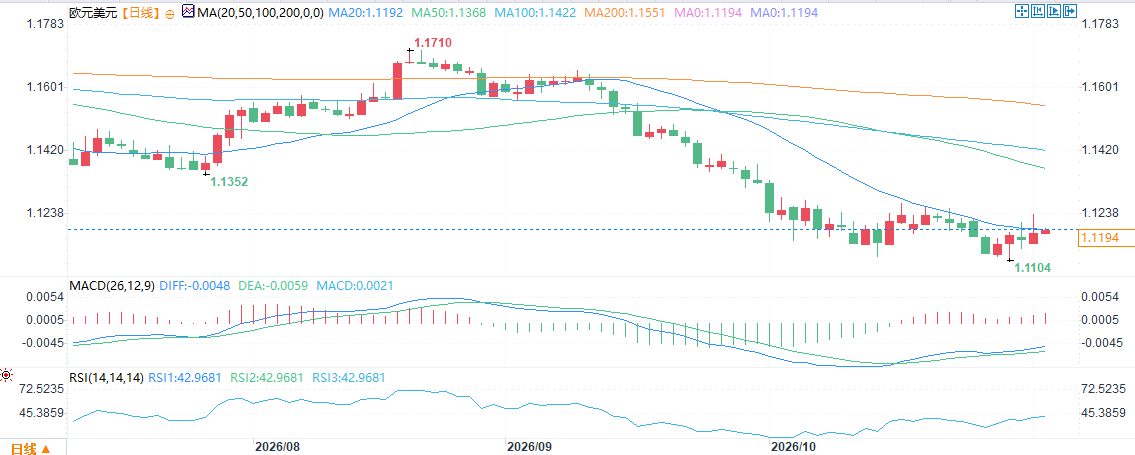 (Euro/USD daily chart, source: FX678) At 8:17 Beijing time, the euro was trading at 1.1194/95 against the US dollar.
Growth diverged: France contracted, Germany saw slight growth, and the Eurozone grew by only 0.2% excluding Ireland.
The eurozone's 0.4% quarter-on-quarter expansion in the third quarter was stronger than economists' expectations of 0.2%, but the overall figure masks a less convincing picture of underlying performance. Growth slowed from 0.6% in the second quarter, while several of the region's largest economies continued to struggle. France recorded a 0.1% contraction, after stagnating in the previous quarter; Germany, the eurozone's largest economy, grew by only 0.2%, while Italy's GDP remained flat; Spain performed relatively strongly, growing by 0.6%, supported by domestic demand and employment; Ireland recorded an unusual 5.5% expansion, but its GDP figures are particularly volatile due to the large presence of multinational corporations. In fact, according to estimates from prominent institutions, excluding Ireland, the eurozone's economic growth in the third quarter was only 0.2%—providing a more cautious picture of the region's underlying momentum and highlighting the limited contribution of several major economies. France's performance is particularly worrying due to its importance to the monetary union. Weak economic activity could constrain tax revenue and complicate efforts to reduce the public deficit, especially if unemployment rises or household consumption deteriorates. This will leave governments with less room to maneuver in supporting economic activity while simultaneously reassuring financial markets about the sustainability of public finances. The broader economic environment is also becoming more challenging. Higher energy prices linked to the Middle East conflict are pushing up production and transportation costs, putting pressure on household purchasing power and corporate profit margins. The International Monetary Fund warns that high energy costs and weak consumer confidence remain risks to the eurozone's outlook. The European Central Bank also acknowledged that the balance of risks is deteriorating—keeping its three key interest rates unchanged on October 29—but warned that rising energy prices could simultaneously push up inflation and weaken economic activity, emphasizing that tighter financing conditions and potential disruptions to global financial markets could further suppress demand.Fiscal and Political Issues: A 5.4% deficit and a divided parliament increase the political difficulty of austerity measures.
France's economic woes are unfolding against an increasingly dire fiscal backdrop. Public debt is nearing 120% of GDP, and the government projects a budget deficit of 5.4% of GDP in 2026, significantly higher than the EU's reference threshold of 3%. Controlling public finances is becoming increasingly difficult due to political fragmentation and resistance to spending cuts. Since the snap parliamentary elections in 2024, France has been hampered by a divided legislature, making it harder for successive governments to garner support for fiscal reforms. Prime Minister Sébastien Lecornu is seeking to advance the 2027 budget, aiming to reduce the deficit to 5% of GDP. The government's proposed adjustments include approximately €54 billion in spending cuts, but opposition parties have challenged several measures, raising questions about the feasibility of implementing necessary savings. Social tensions add another layer of uncertainty. Widespread demonstrations against the cost of living, public services, and education funding emerged in October, with some protests escalating into riots and clashes with police. The resulting losses have also imposed additional economic costs on businesses and local governments. These developments demonstrate the political difficulty of implementing austerity measures when household finances are already under pressure.Market pricing: French bond yields break 5.14%, Franco-German interest rate spread widens to 15 years.
Financial markets have reacted to the deteriorating fiscal and political outlook for France. In October, the yield on 10-year French government bonds rose above 5.14%, the highest since 2002. The spread between French and German 10-year bond yields also widened to its widest in 15 years, reflecting the additional risk premium investors demand for holding French debt. Credit rating developments have reinforced these concerns. Fitch had previously downgraded France's rating and revised its outlook from stable to negative on October 30, while affirming its long-term rating at A+. The agency cited weaker economic growth, higher borrowing costs, a deteriorating fiscal situation, and political fragmentation as obstacles to stabilizing public debt, projecting that France's debt-to-GDP ratio will rise from 115.7% in 2025 to approximately 124% in 2028. Moody's, on the other hand, maintained France's Aa3 rating on October 23, but retained a negative outlook, assuming the government will successfully pass the 2027 deficit reduction budget and that financing pressures and social tensions will ease. While these decisions do not foreshadow an imminent sovereign debt crisis, they highlight a deterioration in investor confidence. Higher yields increase the cost of rolling over maturing debt and borrowing new money, potentially diverting a larger share of public resources to interest payments.Spillover Risks: Financing Cost Transmission and the ECB's Dilemma
The impact of rising borrowing costs in France transcends national borders due to the country's size and its close financial and economic ties with other Eurozone members. Rising sovereign yields can affect the broader economy through several channels: higher government financing costs reduce resources available for public investment and other spending priorities; sovereign bond yields affect broader market financing conditions, potentially making corporate borrowing, mortgages, and other forms of credit more expensive. This creates the risk that financial pressures will reinforce economic weakness—economic activity could deteriorate further if businesses postpone investment due to higher financing costs and households reduce spending due to tighter credit conditions; weaker growth, in turn, makes it more difficult for France to generate the tax revenue needed to reduce its deficit. There are also potential spillovers to other highly indebted Eurozone economies. The continued rise in the risk premium investors demand for French debt could prompt markets to reassess sovereign risk in other regions, particularly those with high debt levels or limited fiscal flexibility. While this doesn't automatically translate into higher borrowing costs across the region, it could increase sensitivity to political and budgetary developments. For the European Central Bank, this situation creates a difficult policy environment. Maintaining interest rates at a sufficiently restrictive level to curb inflation could exacerbate financing pressures; while easing monetary policy to support growth risks reinforcing price increases. The energy shock makes this trade-off particularly difficult, as it threatens to both weaken economic activity and drive up inflation.French debt risk premium constitutes a ceiling constraint on the euro.
There is a clear transmission chain between France's fiscal and political predicament and the euro's exchange rate against the US dollar. The 10-year French bond yield rising above 5.14% and the Franco-German interest rate spread widening to its widest in 15 years indicate that the risk premium required by investors to hold French debt is systematically increasing. This premium suppresses the euro through two channels: first, the widening sovereign wealth fund spread weakens the euro's attractiveness as a reserve and allocation currency, with funds tending to flow from peripheral Eurozone assets to core safe-haven assets such as the US dollar and German bonds; second, as the Eurozone's second-largest economy, the uncertainty surrounding France's fiscal trajectory is interpreted by the market as a governance risk for the entire monetary union, thus embedding a "fragmentation premium" in euro pricing. However, this suppression is not one-way. The short-term direction of the euro against the US dollar is still mainly driven by the divergence in monetary policy between the US and Europe—the probability of a Fed rate hike in December is about 75%, while the ECB is holding rates steady, creating an interest rate differential favorable to the US dollar, which constitutes the main reason for the euro's decline. The French factor has raised the bar for a euro rebound: even if the dollar corrects due to waning safe-haven demand or weaker data, the risk premium on French bonds will limit the euro's upside, making it more vulnerable to selling pressure during rebounds. In short, France's fiscal predicament doesn't determine the euro's direction, but it does constrain its upper limit—any euro-dollar rebound is more likely a correction than a trend reversal until the Franco-German interest rate differential narrows substantially.in conclusion
France's economy unexpectedly contracted by 0.1% in the third quarter, with public debt nearing 120% of GDP and a projected deficit ratio of 5.4% by 2026. The 10-year French bond yield rose above 5.14%, and the Franco-German interest rate spread widened to its largest in 15 years. Fitch downgraded its outlook to negative—the combined fiscal and political pressures are making France an additional source of vulnerability for the Eurozone recovery. The spillover channels are clear: higher sovereign yields push up financing costs for businesses and households, financial pressures could reinforce economic weakness, and weaker growth, in turn, weakens the ability to reduce the deficit. For the European Central Bank, the stagflationary trade-off under the energy shock has narrowed its policy space. Whether France can stabilize its public finances without further weakening growth will be a crucial factor in shaping investor confidence and the regional economic outlook for 2027. (Euro/USD daily chart, source: FX678) At 8:17 Beijing time, the euro was trading at 1.1194/95 against the US dollar.
- Risk Warning and Disclaimer
- The market involves risk, and trading may not be suitable for all investors. This article is for reference only and does not constitute personal investment advice, nor does it take into account certain users’ specific investment objectives, financial situation, or other needs. Any investment decisions made based on this information are at your own risk.