The US dollar index fluctuated narrowly ahead of the midterm elections, with safe-haven buying offsetting the decline in US Treasury yields.
2026-11-03 14:20:28
The US dollar index traded in a narrow range during Asian trading hours on Tuesday (November 3), currently hovering around 101.75. Overnight, the dollar index fell to around 101.41, a new low since early October. Traders' cautious stance ahead of the midterm elections limited the dollar's decline. High energy prices related to the Iran conflict are increasing political pressure on President Trump and the Republican Party. Meanwhile, market forecasts currently reflect a roughly 74% probability of Democrats winning the Senate, highlighting the high political stakes involved in this election. 
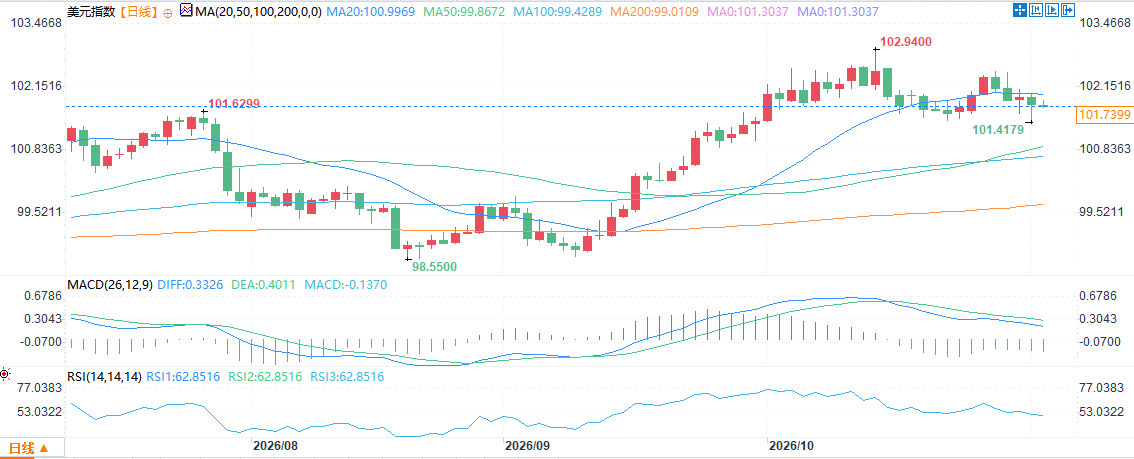 (US Dollar Index Daily Chart, Source: EasyTrade) At 14:17 Beijing time, the US Dollar Index was at 101.73/74.
Safe-haven buying: The strike on Qeshm Island provides support
The dollar continues to be supported by safe-haven demand stemming from escalating military hostilities. The US reportedly launched an attack on Iran's Qeshm Island on Monday, the latest in a series of covert, limited strikes by Washington in recent weeks. These military actions come shortly after Trump downplayed the possibility of a full-scale return to conflict with Iran after the election. For markets, the coexistence of limited strikes and diplomatic engagement provides the dollar with dual support from a safe-haven premium and policy uncertainty.Elections and Interest Rates: Uncertainty Supports the Dollar, Rate Hike Expectations Remain High
Besides the election, market participants are closely watching the U.S. jobs report to be released later this week. This data is expected to provide new insights into the health of the labor market and help shape expectations for future monetary policy decisions. The Federal Reserve maintains a hawkish stance, with the CME FedWatch tool currently pricing in a 73% probability of a December rate hike, after holding rates steady at the October meeting. High energy prices continue to support inflation concerns, which is the core reason for the persistently high rate hike expectations.Two-way pressures on the US dollar: Policy patience and AI concerns suppress US Treasury yields.
According to strategists at well-known institutions, the dollar and short-term Treasury yields lost some momentum last week as Federal Reserve Chairman Warsh maintained a "patient tone" amid stalled inflation progress, leading to a decline in both the dollar and short-term Treasury yields. They added that "concerns about a slowdown in AI investment exacerbated this trend, casting doubt on the U.S. growth outlook and dampening expectations of a Fed rate hike," reinforcing the softer tone of the dollar and front-end yields. This was offset by safe-haven buying—the former suppressing the dollar's upward movement, while the latter provided downside support—which is why the dollar index fell further.Employment data: Non-farm payrolls and unemployment rate will be the next tests.
Some institutional strategists view Friday's October non-farm payroll report as a key test of the US labor market narrative, noting that the market consensus expects "non-farm payrolls to increase by 65,000, compared to 29,000 in September, consistent with the assessment that labor demand is stabilizing." The institution points out that "the unemployment rate is expected to remain at 4.2%, 0.1 percentage points higher than the FOMC's 2026 forecast of 4.1%," highlighting a slightly softer stance than the Fed's long-term view. Wage dynamics are also under scrutiny: "Average hourly earnings are expected to rise 0.3% month-over-month, compared to 0.1% in September; the year-over-year increase is expected to slow to 2.9%, compared to 3.0% in September"—this combination suggests that despite stronger monthly increases, pressure on lower-income earners is moderately easing.in conclusion
The US dollar index traded around 101.75 ahead of the midterm elections, supported by two factors: safe-haven flows triggered by the covert US military strike on Iran's Qeshm Island, and election uncertainty itself. Forecasting markets indicated a roughly 74% probability of a Democratic Senate victory, raising political stakes. Regarding interest rates, high energy prices maintained inflation concerns, with a roughly 73% probability of a December rate hike; however, Warsh's patient policy stance and concerns about slowing AI investment depressed yields, offsetting safe-haven buying and causing the dollar index to fluctuate within its recent range. This week's non-farm payrolls report—expected to show an increase of 65,000, with the unemployment rate remaining at 4.2% and average hourly earnings rising 0.3% month-on-month—will be the next key variable in testing the labor market and the path of interest rate hikes. (US Dollar Index Daily Chart, Source: EasyTrade) At 14:17 Beijing time, the US Dollar Index was at 101.73/74.
- Risk Warning and Disclaimer
- The market involves risk, and trading may not be suitable for all investors. This article is for reference only and does not constitute personal investment advice, nor does it take into account certain users’ specific investment objectives, financial situation, or other needs. Any investment decisions made based on this information are at your own risk.