Switzerland's core inflation is locked at 0.5%: What does it mean that the USD/CHF exchange rate is approaching the lower Bollinger Band?
2026-11-03 17:32:25
On Tuesday, November 3rd, the Swiss Federal Statistical Office released the October Consumer Price Index (CPI) data. Overall annual inflation rose to 1.5%, higher than the market expectation of 1.3% and the previous reading of 1.0%. Month-on-month inflation increased by 0.2%, reaching 101.7 points (100 in December 2025). Core annual inflation remained unchanged at 0.5%. During the same period, the USD/CHF exchange rate fluctuated between 0.8150 and 0.8180. Energy prices were the main factor driving the overall inflation rebound. The Swiss National Bank has repeatedly emphasized the temporary nature of these pressures, and the policy interest rate remains at 0%. 
Structural breakdown of Swiss October inflation data
Headline inflation jumped to 1.5% in October from 1.0% in September, exceeding expectations. The 0.2% month-on-month increase was mainly driven by rising prices for heating oil, gasoline, and diesel, with increases also seen in footwear and hospital outpatient services. Meanwhile, prices for local clinic services, international package tours, and hotels declined. Energy contributions boosted the overall reading, but core inflation remained stable at 0.5%, indicating that price pressures beyond food and energy have not spread significantly. Data from the Swiss Federal Statistical Office shows that the index rose to 101.7 from 101.5 in September, with energy-related price changes being the main driver. This structure is similar to the recent inflation path in many European countries, where energy cost transmission remains the dominant variable rather than broad demand-pull. The stability of the core reading provides a key reference for assessing secondary effects; currently, there are no clear signs of widespread cost passing by businesses.Swiss National Bank's assessment framework and policy space
In its September monetary policy assessment, the Swiss National Bank (SNB) noted that rising energy prices were the primary driver of the inflation rebound, with limited evidence of a second-order effect. Conditional inflation forecasts indicate that inflation is likely to continue rising moderately in the short term due to energy factors, before declining in 2027, remaining within a price stability range of 0% to 2% throughout the forecast period. The policy rate has remained at 0% since the previous assessment, with the central bank emphasizing that current monetary conditions are sufficient to support price stability and economic growth. October data did not change this narrative: overall inflation, near 1.5%, remains below the upper limit, and core inflation remains low. The SNB previously stated that further assessment would be necessary if energy prices remain high and broader cost transmission occurs, but there is no need to adjust its stance at present. Market pricing in the policy path continues to revolve around the expectation of unchanged interest rates, and the willingness to intervene in the foreign exchange market remains within the framework of intervention only when necessary.Price Structure and Indicator Characteristics of USD/CHF
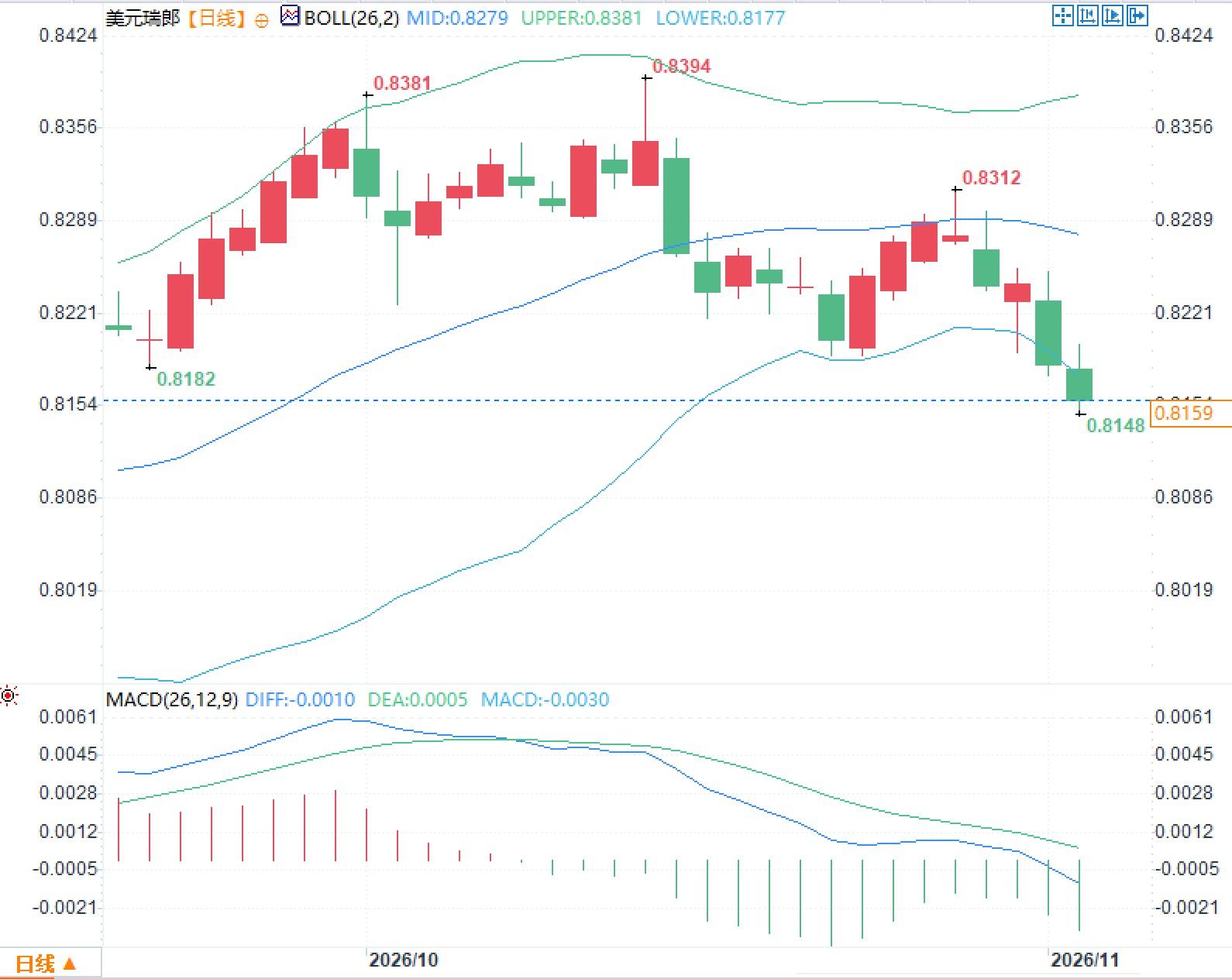
The USD/CHF daily chart shows that the price retreated after reaching a high of around 0.8394 in mid-October and has recently been fluctuating around 0.8150. The Bollinger Bands have a middle band at 0.8279, an upper band at 0.8381, and a lower band at 0.8177; the current price is near the lower band. The MACD indicator shows the DIFF at -0.0010, the DEA at +0.0005, and the histogram at -0.0030, indicating negative momentum. Throughout October, the price gradually shifted downwards from above 0.83 to the current range, with volatility not showing extreme amplification before or after data releases. The Swiss franc exchange rate is correlated with inflation data, global energy prices, and relative interest rate expectations; the price structure shows short-term fluctuations concentrated within the 0.8140 to 0.8240 range.The Implications of Data for Exchange Rates and Policy Expectations
The overall inflation reading of 1.5% was higher than expected, but core inflation remained stable at 0.5%, allowing the Swiss National Bank (SNB) to maintain a wait-and-see approach. The dominant role of energy prices is consistent with the SNB's previous statements, and has not triggered widespread concerns about a second-side effect. The USD/CHF pair remained around 0.8150 to 0.8180 after the data release, without significant one-sided fluctuations. Market focus has shifted to whether energy prices will remain high and whether there will be cost transmission to a wider range of goods and services in the coming months. The SNB's conditional forecasts continue to place inflation within a price stability range, and the data supports its stance of maintaining the policy rate at 0%. In terms of exchange rates, the relative strength of the Swiss franc continues to be influenced by global energy prices, relative growth expectations, and the SNB's willingness to conduct foreign exchange operations. Overall, the data reinforces the assessment of energy-driven inflation and core stability, and the urgency for policy adjustments has not increased significantly.Frequently Asked Questions
Question 1: Does the rise in overall inflation to 1.5% in October change the Swiss National Bank's (SNB) basic assessment? Answer: The rebound in the overall figure mainly came from energy prices, while core inflation remained unchanged at 0.5%, consistent with the SNB's previous statements regarding energy dominance and limited secondary effects. Currently, this does not constitute a direct basis for policy adjustments. Question 2: What does stable core inflation mean for the subsequent policy path? Answer: Stable core inflation indicates that non-energy price pressures have not spread significantly. The SNB can continue to observe the persistence of energy costs, and the framework of maintaining the policy interest rate at 0% still has room for assessment.- Risk Warning and Disclaimer
- The market involves risk, and trading may not be suitable for all investors. This article is for reference only and does not constitute personal investment advice, nor does it take into account certain users’ specific investment objectives, financial situation, or other needs. Any investment decisions made based on this information are at your own risk.