The attack on Qeshm Island disrupted negotiation expectations, weakened physical demand, and oil prices are stuck at a key level.
2026-11-03 16:18:25
On Tuesday (November 3), international oil prices rebounded during the Asian and European sessions, with WTI crude oil rising as much as 2.2% intraday and currently trading around 97.5, up 1.67%. On Monday evening, oil prices plummeted by 7% following news of Iranian Supreme Leader Mojtba Khamenei authorizing the Iranian government and progress in peace talks. However, the US military's continued small-scale strikes on Iran's Qeshm Island while negotiating increased uncertainty in the negotiations, driving a price rebound. The good news is the recovery in exports from Middle Eastern oil-producing countries, and institutions and companies predict a simultaneous cooling in global crude oil and natural gas demand, reducing some supply pressure. The bad news is internal divisions within the White House, making the market highly susceptible to short-term fluctuations from unexpected news, and the overall trend remains undecided. 
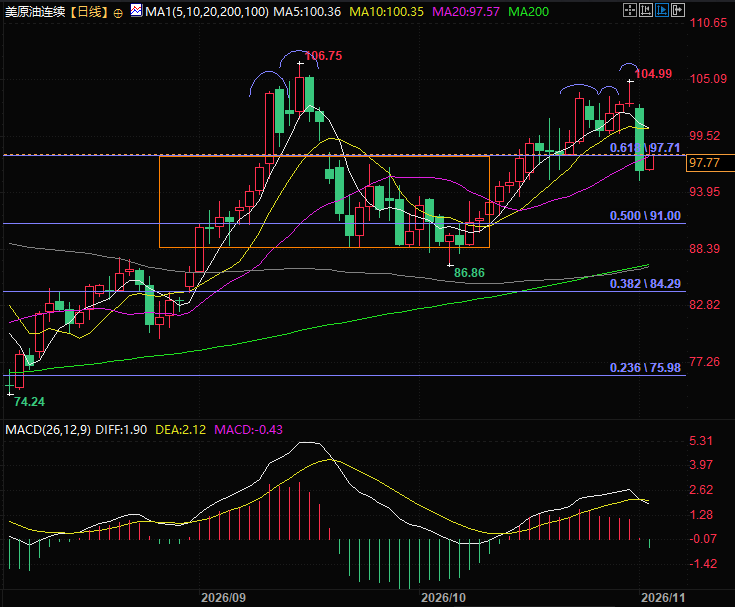 (WTI crude oil futures daily chart, source: EasyTrade) At 16:16 Beijing time, WTI crude oil futures are currently trading at $97.78 per barrel.
Oil prices rebounded after a sharp drop due to geopolitical factors, and risk premiums were replenished again.
The ongoing tug-of-war between the US and Iran continues to roil international crude oil prices, with geopolitical risk premiums and physical supply data interacting to cause wild price fluctuations. After a 7% drop in the previous trading day, international crude oil prices rebounded rapidly during the session, stimulated by news of the US strike on Iran's Qeshm Island. According to anonymous US officials, the US military recently launched a strike on Iran's Qeshm Island, the latest in a series of undisclosed, limited military actions by Washington against Iran in recent weeks. The US characterized the action as a defensive strike aimed at preventing Iran from attacking merchant ships in the Strait of Hormuz, and deliberately kept the operation low-key to avoid signaling a large-scale war. Trump publicly stated that the US had won the conflict with Iran and that the two sides had not engaged in large-scale combat for months, but the news of the secret strike shattered the market's previous optimistic expectations for diplomatic easing.Diplomatic signals are mixed: the window for negotiation still exists, but Iran's hardline bottom line is clear.
Market sentiment had previously leaned towards a negotiated reconciliation. Iran's Supreme Leader authorized the government to conduct negotiations, and Qatari mediators held multiple rounds of talks with Iranian officials in Tehran. Both the US and Iran were reviewing new proposals from the mediators. However, senior Iranian officials simultaneously released a strong signal, stating that a ceasefire agreement was still far off and that Iran would retaliate forcefully should it suffer an attack. Iranian Foreign Minister Araqchi also stated that Iran hoped to promote a new regional security framework led by regional countries, excluding external military forces, while also extending goodwill to the Gulf Cooperation Council countries and acknowledging the mediating role of Qatar and Oman. This mixed diplomatic news made it difficult for the trading market to form a unified expectation regarding the outcome of the negotiations. KCM Trade analyst Tim Waterer pointed out that news of the US attack reintroduced a risk premium into oil prices. Just as the market had begun pricing in a diplomatic reconciliation path, news of continued military action quickly reversed market sentiment. However, some institutions remain rational. Phillip Nova analyst Priyanka Sachdeva believes that geopolitical news alone is unlikely to drive oil prices to continue rising. Only concrete evidence of damage to crude oil supply and key energy infrastructure will trigger a new round of sustained price increases.The White House's Three-Pronged Approach: Three Policy Directions to Determine the Future Course of the Conflict
From within the Trump administration, three distinct policy paths exist, further amplifying the uncertainty of the situation. **Pushing for a Negotiation Agreement:** Vice President Vance and White House Special Envoy Witkov advocate for resolving the issue through an agreement, believing that restarting war may not improve the situation; most Gulf states support this position. **Resuming Military Strikes:** Israeli Prime Minister Netanyahu and Defense Minister Hegses advocate for resuming military action, deeming Iran untrustworthy and an agreement unlikely to be implemented or fulfilled, arguing that military means should be used to achieve the objectives. **Maintaining the Status Quo:** Treasury Secretary Bessant, CIA Director Ratcliffe, and Secretary of State Rubio favor a "no war, no agreement" approach, relying on long-term economic attrition to force concessions from Iran, even potentially inciting internal turmoil. These three paths, mutually restraining each other, lead to numerous divergent outcomes, representing the biggest source of uncertainty in oil trading.Crude oil physical market: Middle East exports are recovering, but the weakening spot market structure is limiting upside potential.
On the physical supply and demand front, signals have emerged in the market that don't quite align with geopolitical anxieties. Data shows that Middle Eastern crude oil supply has shown signs of exceeding demand for the first time since July. Saudi Arabia, the UAE, Iraq, and Kuwait's total crude oil exports increased by 10% month-on-month, with daily exports slightly exceeding 15 million barrels, essentially returning to pre-war export levels; Iranian crude oil exports remain almost stagnant. The regional benchmark Dubai crude oil futures market shows a near-month discount structure, with the November contract trading at a discount of approximately $2 per barrel to the December contract, reflecting a relatively loose supply in the spot market. June Goh, senior oil market analyst at Sparta Commodities, points out that the current situation is merely a gradual recovery in supply, and the large-scale crude oil surplus and massive tanker shipments seen at the end of June have not reappeared. Meanwhile, on the demand side, the CEO of Vitol Energy Group stated that oil demand will take a year to recover to 2025 levels. This is because geopolitical issues have increased shipping and trade costs, high oil prices have suppressed aviation, freight, and chemical fuel consumption, and the slow recovery of global supply chains and consumer confidence have contributed to the decline in crude oil demand.Natural gas spillover impact: IEA warns of record-breaking annual drop in global LNG prices.
The impact on the energy market is not limited to crude oil. A report from the International Energy Agency (IEA) warns that global LNG supply will experience its largest annual decline in history this year, falling by 3% and reducing supply by nearly 20 billion cubic meters. The Strait of Hormuz handles approximately 20% of global LNG transport; disruptions to navigation in the strait have severely impacted exports from Qatar and the UAE, and the disruption is expected to continue at least until the end of the year. Although new production from North America, Africa, and Russia has filled two-thirds of the supply gap in the Persian Gulf region, global LNG production still declined by about 6% year-on-year due to the war, and competition for LNG from importing countries in Asia and elsewhere continues to intensify.Summary and Technical Analysis:
In summary, the current crude oil market is in a contradictory state: geopolitical news continues to create impulsive rebounds, but the recovery of exports from major Middle Eastern oil-producing countries, the weakening of the spot market structure, and the slowdown in global economic growth are beginning to suppress oil price increases from the perspective of the real economy. In the short term, market movements are highly dependent on breaking news regarding the US-Iran situation. If there is substantial progress in diplomatic negotiations, the geopolitical risk premium will quickly subside, and oil prices will face downward pressure; however, if the military conflict escalates and shipping in the Strait of Hormuz is substantially disrupted, it will trigger supply panic again, pushing oil prices sharply higher. As long as the conflict has not truly ended, geopolitical risks will not completely disappear from oil price pricing. Technically, the key level for oil prices is around 97.71. If oil prices cannot stand above this level, a triple top structure will form, and oil prices will likely move towards 91. Conversely, if there is a rapid rebound in the near term, the triple top structure will fail, and oil prices will continue to reach new highs. (WTI crude oil futures daily chart, source: EasyTrade) At 16:16 Beijing time, WTI crude oil futures are currently trading at $97.78 per barrel.
- Risk Warning and Disclaimer
- The market involves risk, and trading may not be suitable for all investors. This article is for reference only and does not constitute personal investment advice, nor does it take into account certain users’ specific investment objectives, financial situation, or other needs. Any investment decisions made based on this information are at your own risk.