













Multiple bullish and bearish factors are pulling in opposite directions, keeping the US dollar index steady at 101.80 as it awaits guidance from the non-farm payrolls and midterm elections.
2026-11-03 14:30:26
The dollar index, which measures the dollar's performance against six major currencies, remained range-bound during Tuesday's Asian trading session. After a slight pullback in the previous session, it is currently trading around 101.80. Traders remain cautious, awaiting the outcome of the US midterm elections. The ongoing conflict with Iran, pushing up energy prices, has increased political pressure on the US president and the Republican Party. Market forecasts indicate a 74% probability of the Democrats gaining control of the Senate. Policy expectations surrounding this election are expected to cause some volatility in the dollar.  Aside from the election, the market will focus on the upcoming series of US employment data. The employment report reflects the current state of the labor market and further shapes expectations for the Federal Reserve's subsequent monetary policy. The Fed chose to keep interest rates unchanged at its October meeting, and current CME data shows a roughly 73% probability of a rate hike in December. Market surveys indicate that the limited covert strike on Iran's Qeshm Island triggered some safe-haven buying, providing support for the dollar. However, Fed Chairman Warsh's previously cautious policy stance, even with stalled inflation improvements, did not signal a strong tightening stance. Coupled with market concerns about a slowdown in AI investment, this lowered short-term US Treasury yields, further pressuring the dollar. Brown Brothers Harriman analysts pointed out that the simultaneous weakening of the dollar and short-term US Treasury yields last week stemmed from both the Fed's patient stance and market concerns about a cooling AI investment, which cast doubt on the US economic growth outlook and further weakened the pricing of a rate hike, putting pressure on the dollar. Institutional strategists are highlighting Friday's October non-farm payroll report, with the market expecting 65,000 new jobs, compared to 29,000 in September, reflecting a gradual stabilization in labor demand. The unemployment rate is expected to remain at 4.2%, higher than the Fed's 2026 forecast of 4.1%. Regarding wages, the market expects hourly wages to rise 0.3% month-over-month, but fall back to 2.9% year-over-year, indicating a marginal easing of wage pressures. Trade concerns are not currently the dominant factor; risk aversion, employment data, and Fed expectations are jointly driving the dollar's movement. On the daily chart, the dollar index is generally in a high-level consolidation pattern, with prices fluctuating around the medium-term moving average. Upward momentum has clearly weakened, and the RSI indicator has fallen back to the neutral zone, neither entering overbought nor oversold territory. The large-scale bullish structure has not been completely destroyed, but further upward momentum is insufficient. The daily chart shows a consolidation range between 101.20 and 102.40. A sustained move above 102.40 is needed to restart the upward trend, while a break below 101.20 could open up further downside potential. On the 4-hour chart, the price is currently trading sideways, with short-term moving averages intertwined and no clear trend forming. Indicators are oscillating in neutral territory, indicating a lack of intrinsic momentum and a wait-and-see approach awaiting fundamental news to determine the direction. The first resistance level is 102.10, with strong resistance at 102.40. Immediate support is at 101.50, with key support at 101.20. As the price remains within this range, a range-bound trading strategy is recommended.
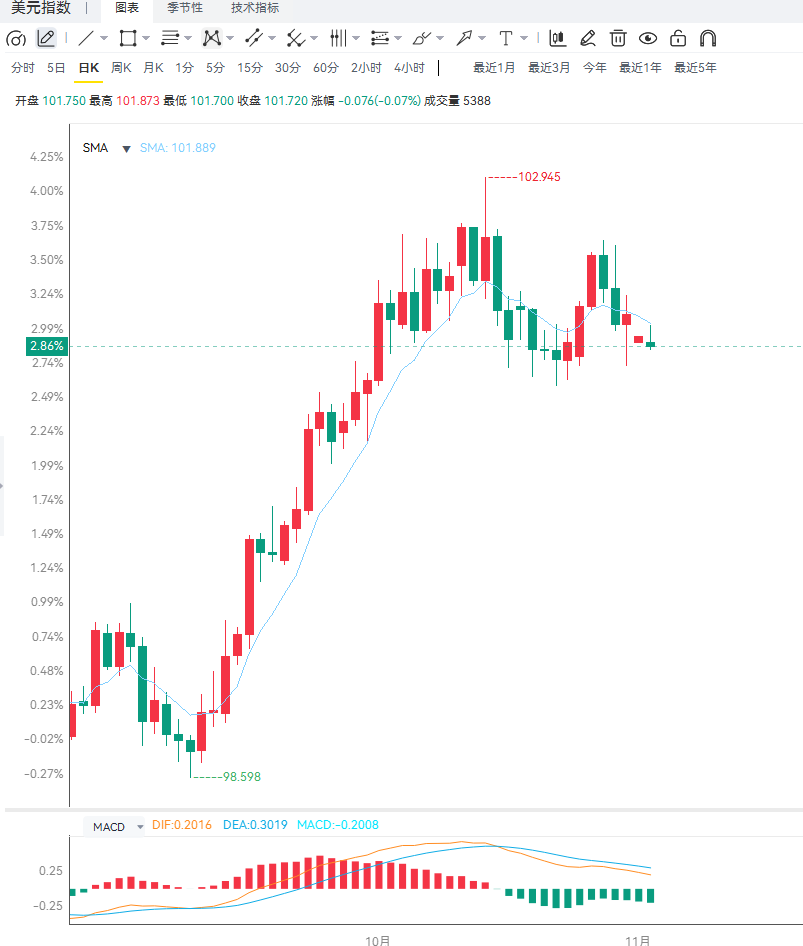 Editor's Summary: The US dollar is currently caught in a two-way struggle between safe-haven support and cooling expectations for monetary policy. The US-Iran conflict provides a safe-haven base, while the Fed's cautious stance and concerns about AI investments limit the dollar's upside potential. The key short-term variables are the US midterm elections and Friday's non-farm payrolls data. The new jobs, unemployment rate, and wage data in the non-farm payrolls will directly revise the probability of a December rate hike. On the risk side, a significantly stronger non-farm payrolls report coupled with escalating geopolitical conflicts will drive a dollar rebound; conversely, significantly weaker employment data will dampen rate hike expectations and trigger a dollar pullback. After the key data is released, we await a breakout signal from the 101.20 to 102.40 range and are wary of the risk of sharp volatility driven by events.
Aside from the election, the market will focus on the upcoming series of US employment data. The employment report reflects the current state of the labor market and further shapes expectations for the Federal Reserve's subsequent monetary policy. The Fed chose to keep interest rates unchanged at its October meeting, and current CME data shows a roughly 73% probability of a rate hike in December. Market surveys indicate that the limited covert strike on Iran's Qeshm Island triggered some safe-haven buying, providing support for the dollar. However, Fed Chairman Warsh's previously cautious policy stance, even with stalled inflation improvements, did not signal a strong tightening stance. Coupled with market concerns about a slowdown in AI investment, this lowered short-term US Treasury yields, further pressuring the dollar. Brown Brothers Harriman analysts pointed out that the simultaneous weakening of the dollar and short-term US Treasury yields last week stemmed from both the Fed's patient stance and market concerns about a cooling AI investment, which cast doubt on the US economic growth outlook and further weakened the pricing of a rate hike, putting pressure on the dollar. Institutional strategists are highlighting Friday's October non-farm payroll report, with the market expecting 65,000 new jobs, compared to 29,000 in September, reflecting a gradual stabilization in labor demand. The unemployment rate is expected to remain at 4.2%, higher than the Fed's 2026 forecast of 4.1%. Regarding wages, the market expects hourly wages to rise 0.3% month-over-month, but fall back to 2.9% year-over-year, indicating a marginal easing of wage pressures. Trade concerns are not currently the dominant factor; risk aversion, employment data, and Fed expectations are jointly driving the dollar's movement. On the daily chart, the dollar index is generally in a high-level consolidation pattern, with prices fluctuating around the medium-term moving average. Upward momentum has clearly weakened, and the RSI indicator has fallen back to the neutral zone, neither entering overbought nor oversold territory. The large-scale bullish structure has not been completely destroyed, but further upward momentum is insufficient. The daily chart shows a consolidation range between 101.20 and 102.40. A sustained move above 102.40 is needed to restart the upward trend, while a break below 101.20 could open up further downside potential. On the 4-hour chart, the price is currently trading sideways, with short-term moving averages intertwined and no clear trend forming. Indicators are oscillating in neutral territory, indicating a lack of intrinsic momentum and a wait-and-see approach awaiting fundamental news to determine the direction. The first resistance level is 102.10, with strong resistance at 102.40. Immediate support is at 101.50, with key support at 101.20. As the price remains within this range, a range-bound trading strategy is recommended. Editor's Summary: The US dollar is currently caught in a two-way struggle between safe-haven support and cooling expectations for monetary policy. The US-Iran conflict provides a safe-haven base, while the Fed's cautious stance and concerns about AI investments limit the dollar's upside potential. The key short-term variables are the US midterm elections and Friday's non-farm payrolls data. The new jobs, unemployment rate, and wage data in the non-farm payrolls will directly revise the probability of a December rate hike. On the risk side, a significantly stronger non-farm payrolls report coupled with escalating geopolitical conflicts will drive a dollar rebound; conversely, significantly weaker employment data will dampen rate hike expectations and trigger a dollar pullback. After the key data is released, we await a breakout signal from the 101.20 to 102.40 range and are wary of the risk of sharp volatility driven by events.
- Risk Warning and Disclaimer
- The market involves risk, and trading may not be suitable for all investors. This article is for reference only and does not constitute personal investment advice, nor does it take into account certain users’ specific investment objectives, financial situation, or other needs. Any investment decisions made based on this information are at your own risk.

