













Japan's intervention warning has limited upside potential, causing the USD/JPY pair to consolidate below 158.
2026-11-03 14:32:25
On Tuesday during Asian trading hours, the USD/JPY pair lacked upward momentum and failed to continue the previous day's rebound, consolidating below 158.00 with mixed bullish and bearish signals. Japanese Finance Minister Satsuki Katayama reiterated his intervention warning on Monday, emphasizing that the Japan-US Joint Exchange Rate Statement remains valid and that the Japanese government is prepared to intervene to curb disorderly and excessive yen depreciation, significantly constraining the USD/JPY bulls.  However, the timing of the Bank of Japan's next interest rate hike remains highly uncertain, a factor that continues to suppress the yen's performance; coupled with a slight strengthening of the US dollar, this provides underlying support for the USD/JPY exchange rate. The US October ISM Manufacturing PMI rose to 55.5, remaining in expansion territory for the tenth consecutive month, reinforcing expectations of a Fed rate hike. CME FedWatch shows the probability of a December rate hike remains above 70%, which is positive for the dollar. Expectations of an agreement in US-Iran diplomatic negotiations limit the dollar's upside potential; at the same time, the negotiations have not yet achieved a substantial breakthrough, and geopolitical risk premiums persist, supporting dollar assets. The market is awaiting the results of the US midterm elections, and the volatility resulting from the elections may be transmitted to the USD/JPY exchange rate. In the short term, the focus is on JOLTS job openings data and the US services PMI. This Friday's non-farm payroll report is the core macroeconomic event of the week; wage and employment data will directly revise expectations of a Fed rate hike, driving changes in the expected USD/JPY interest rate differential. On the daily chart, USD/JPY is maintaining a consolidation pattern within an overall upward trend. The price has stabilized above the daily moving average, and the bullish alignment of medium- and long-term moving averages remains intact. The RSI indicator is in the neutral zone, indicating the overall bullish structure still exists. However, the strong resistance at 158.60, coupled with the risk of Japanese intervention, has slowed the upward momentum, leading to a short-term consolidation phase. The daily trading range is locked at 156.35–158.60. A break above 158.60 is needed to open up new upward potential; a break below 156.35 would confirm a daily correction, opening up further downside potential. On the 4-hour chart, the price is trading slightly above the 100-period moving average, leaning towards a mild bullish bias in the short term. However, recent range-bound trading lacks a clear breakout signal. A sustained break above 158.60 is needed to confirm the start of a new upward move. The first support level is 157.00, and the core support level of the range is 156.35. Once this level is effectively broken, the short-term trend will turn bearish, with a further downside target around 155.60.
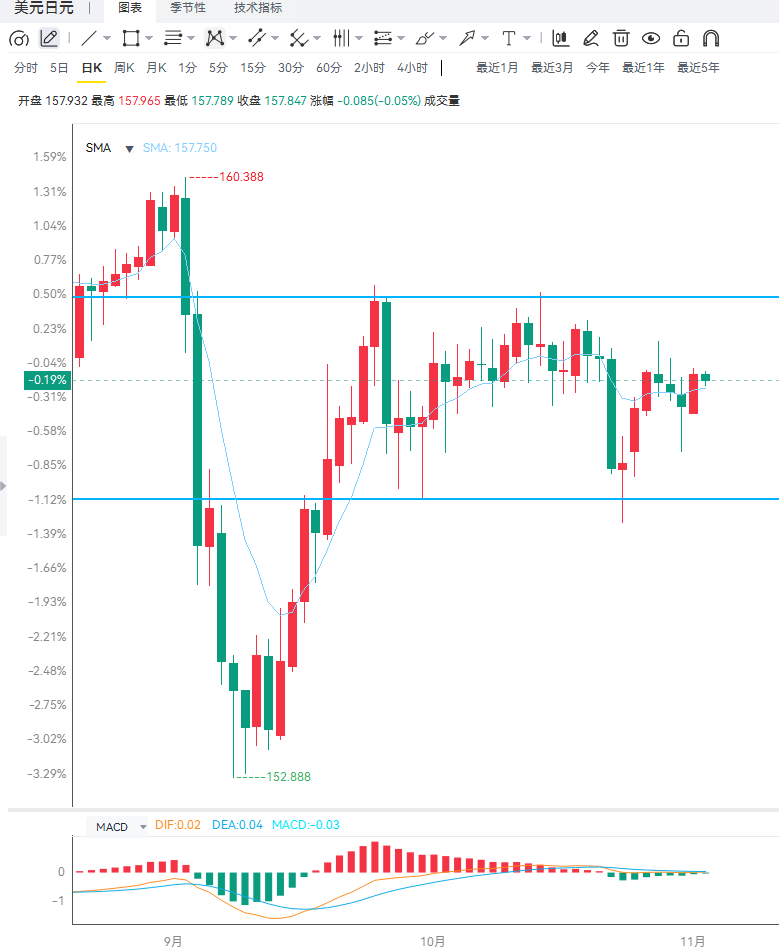 Editor's Summary : The core contradiction in the current USD/JPY exchange rate is the interplay between the bullish support from the USD/JPY interest rate differential and the upward risk constraint imposed by Japan's verbal intervention. Fundamentally, the resilience of the US economy supports expectations of a Fed rate hike, which is beneficial for USD/JPY; however, warnings of Japanese intervention could trigger a rapid pullback at any time, representing a typical high-risk bullish market. Short-term price action will be driven by the US election and employment data. Until a breakout from the 156.35–158.60 range is achieved, a range-bound trading strategy should be prioritized, with close monitoring of non-farm payroll data and statements from the Japanese authorities.
However, the timing of the Bank of Japan's next interest rate hike remains highly uncertain, a factor that continues to suppress the yen's performance; coupled with a slight strengthening of the US dollar, this provides underlying support for the USD/JPY exchange rate. The US October ISM Manufacturing PMI rose to 55.5, remaining in expansion territory for the tenth consecutive month, reinforcing expectations of a Fed rate hike. CME FedWatch shows the probability of a December rate hike remains above 70%, which is positive for the dollar. Expectations of an agreement in US-Iran diplomatic negotiations limit the dollar's upside potential; at the same time, the negotiations have not yet achieved a substantial breakthrough, and geopolitical risk premiums persist, supporting dollar assets. The market is awaiting the results of the US midterm elections, and the volatility resulting from the elections may be transmitted to the USD/JPY exchange rate. In the short term, the focus is on JOLTS job openings data and the US services PMI. This Friday's non-farm payroll report is the core macroeconomic event of the week; wage and employment data will directly revise expectations of a Fed rate hike, driving changes in the expected USD/JPY interest rate differential. On the daily chart, USD/JPY is maintaining a consolidation pattern within an overall upward trend. The price has stabilized above the daily moving average, and the bullish alignment of medium- and long-term moving averages remains intact. The RSI indicator is in the neutral zone, indicating the overall bullish structure still exists. However, the strong resistance at 158.60, coupled with the risk of Japanese intervention, has slowed the upward momentum, leading to a short-term consolidation phase. The daily trading range is locked at 156.35–158.60. A break above 158.60 is needed to open up new upward potential; a break below 156.35 would confirm a daily correction, opening up further downside potential. On the 4-hour chart, the price is trading slightly above the 100-period moving average, leaning towards a mild bullish bias in the short term. However, recent range-bound trading lacks a clear breakout signal. A sustained break above 158.60 is needed to confirm the start of a new upward move. The first support level is 157.00, and the core support level of the range is 156.35. Once this level is effectively broken, the short-term trend will turn bearish, with a further downside target around 155.60. Editor's Summary : The core contradiction in the current USD/JPY exchange rate is the interplay between the bullish support from the USD/JPY interest rate differential and the upward risk constraint imposed by Japan's verbal intervention. Fundamentally, the resilience of the US economy supports expectations of a Fed rate hike, which is beneficial for USD/JPY; however, warnings of Japanese intervention could trigger a rapid pullback at any time, representing a typical high-risk bullish market. Short-term price action will be driven by the US election and employment data. Until a breakout from the 156.35–158.60 range is achieved, a range-bound trading strategy should be prioritized, with close monitoring of non-farm payroll data and statements from the Japanese authorities.
- Risk Warning and Disclaimer
- The market involves risk, and trading may not be suitable for all investors. This article is for reference only and does not constitute personal investment advice, nor does it take into account certain users’ specific investment objectives, financial situation, or other needs. Any investment decisions made based on this information are at your own risk.

