













With the removal of guidelines and refusal to provide advance notice, has the Reserve Bank of Australia reached the end of this round of interest rate hikes?
2026-11-03 15:08:29
The Australian dollar traded lower against the US dollar during Asian trading hours on Tuesday (November 3), currently hovering around 0.6980. Reserve Bank of Australia (RBA) Governor Bullock stated on Tuesday that the central bank's latest interest rate hike was necessary to curb inflation, and that the economy would have to endure sluggish growth and higher unemployment to achieve this goal. At a press conference following the committee's 25 basis point increase in the cash rate to 4.85%, Bullock said the tightening was aimed at addressing domestic production pressures. She argued that accepting some pain now would help avoid greater pain later. She said growth needed to remain sluggish and unemployment needed to rise further. 
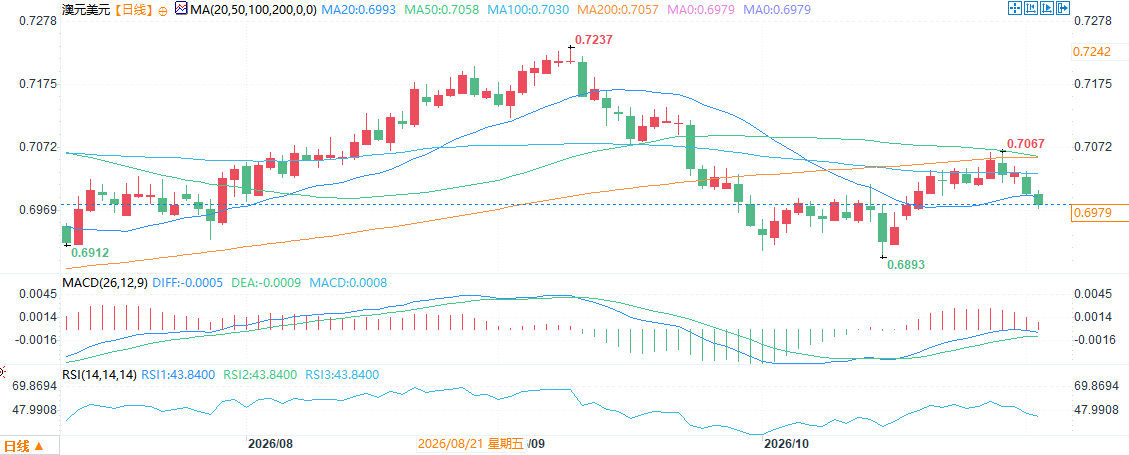 (Australian dollar to US dollar daily chart, source: EasyForex) At 15:06 Beijing time, the Australian dollar to US dollar exchange rate was 0.6980/81.
Inflation forecast: Most inflation is already locked in for next year; "not a good situation".
Block was outspoken about the near-term inflation outlook. She stated that inflation is largely locked in for next year, calling it "not a good situation." This statement aligns with the updated forecast released alongside the resolution: headline inflation is expected to peak at 4.5% in the December quarter, with both headline and cut-off mean inflation remaining above 3% until the end of 2027. In other words, even after the fifth rate hike this year, it will still take more than two years for inflation to return to the upper end of the target range, which is precisely what Block meant by "locked in."Committee Disagreement: Three members see further downside risks and advocate waiting for more data.
Block also revealed internal divisions within the committee. Six members voted to raise interest rates, while three favored maintaining the current rate at 4.60%. Block stated that those advocating for maintaining the rate believed the economy faced greater downside risks and felt the committee should wait longer and gather more data before taking action. The Reserve Bank of Australia released the voting results anonymously, so the identities of the dissenters were not disclosed. The essence of this division was that the majority believed production pressures needed an immediate response, while the minority argued that the lagged effects of tightening had not yet fully materialized and that the risks of premature action outweighed the costs of waiting.Lack of guidance: Not knowing what to do next, waiting for data "may be wise".
Looking ahead, Bullock stated that she did not know what the next interest rate action would be, and the committee would not provide forward guidance. She added that it might be wise to wait and assess the upcoming data – a statement that likely reinforced market speculation that Tuesday's rate hike would be followed by a pause. This rate hike was the Reserve Bank of Australia's fifth this year, bringing the cash rate to its highest level since 2008. The committee stated in its statement that it would monitor data and take necessary measures to bring inflation back to its target, but did not explicitly commit to further rate hikes. The Australian dollar fell after the decision was announced, as the market widely expected this rate hike, while some argued that the divided vote might mean this was the last rate hike of the current cycle.Economic assessment: Policies will have an effect, but it will take time; I do not believe the economy is cracking.
Block also expressed confidence that tightening would have the desired effect, saying that monetary policy would work, but it would take time for it to transmit to the economy. She pointed out that the unemployment rate remained relatively low and job growth continued, adding that she did not currently believe the economy was cracking. This assessment justifies her "wait and see" stance: since the economy has not yet shown obvious cracks and the labor market remains resilient, the central bank has room to observe the transmission effects of previous tightening rather than rushing to act again.in conclusion
At the press conference following the rate hike, Bullock offered no forward guidance, explicitly stating that she did not know the next rate move and that waiting for data "might be wise," reinforcing market speculation about a pause. Her statement presented two balanced points: on the one hand, inflation for next year was largely locked in and "not a good position," the rate hike aimed to address capacity pressures, growth needed to remain sluggish, and unemployment needed to rise further, demonstrating the central bank's determination to tighten; on the other hand, three committee members saw more downside risks and advocated waiting for more data, and Bullock acknowledged that policy transmission takes time and the economy had not yet cracked, indicating a substantial disagreement within the committee regarding the extent of tightening. This combination supported the assessment that "further rate hikes are still possible but far from certain," limiting the Australian dollar's rebound after the decision; the interest rate-sensitive banking, retail, and real estate sectors were under pressure due to the central bank's clear acceptance of weaker growth and higher unemployment. (Australian dollar to US dollar daily chart, source: EasyForex) At 15:06 Beijing time, the Australian dollar to US dollar exchange rate was 0.6980/81.
- Risk Warning and Disclaimer
- The market involves risk, and trading may not be suitable for all investors. This article is for reference only and does not constitute personal investment advice, nor does it take into account certain users’ specific investment objectives, financial situation, or other needs. Any investment decisions made based on this information are at your own risk.

