French interest rate spread of 162 basis points did not narrow despite falling oil prices: the persistent mechanism of euro risk premium
2026-11-03 17:58:25
On Tuesday, November 3rd, the euro was attempting to establish support around 1.12 against the US dollar after rebounding earlier in the week. The European Central Bank (ECB) has maintained a hawkish tone in recent statements, with the market focused on the possibility of at least one more rate hike. Meanwhile, French bond spreads remain above 150 basis points, and Brent crude oil prices remain around $106 per barrel, with energy costs and sovereign risk premiums continuing to constrain the euro. The US midterm elections are underway, and the results are not yet fully in, so market sentiment has not yet shifted significantly. Eurozone inflation in September reached 3.8%, the highest level since September 2023, with the energy component rising 18.9% year-on-year. The ECB's deposit facility rate remained at 2.50%, and the main refinancing rate was 2.65%. Slovakian central bank governor Kazimir recently stated that the question is no longer whether further action is needed, but how much additional action is required. The yield on French 10-year government bonds is approximately 4.92%, while the yield on German 10-year bonds is approximately 3.30%, a spread of approximately 162 basis points. 
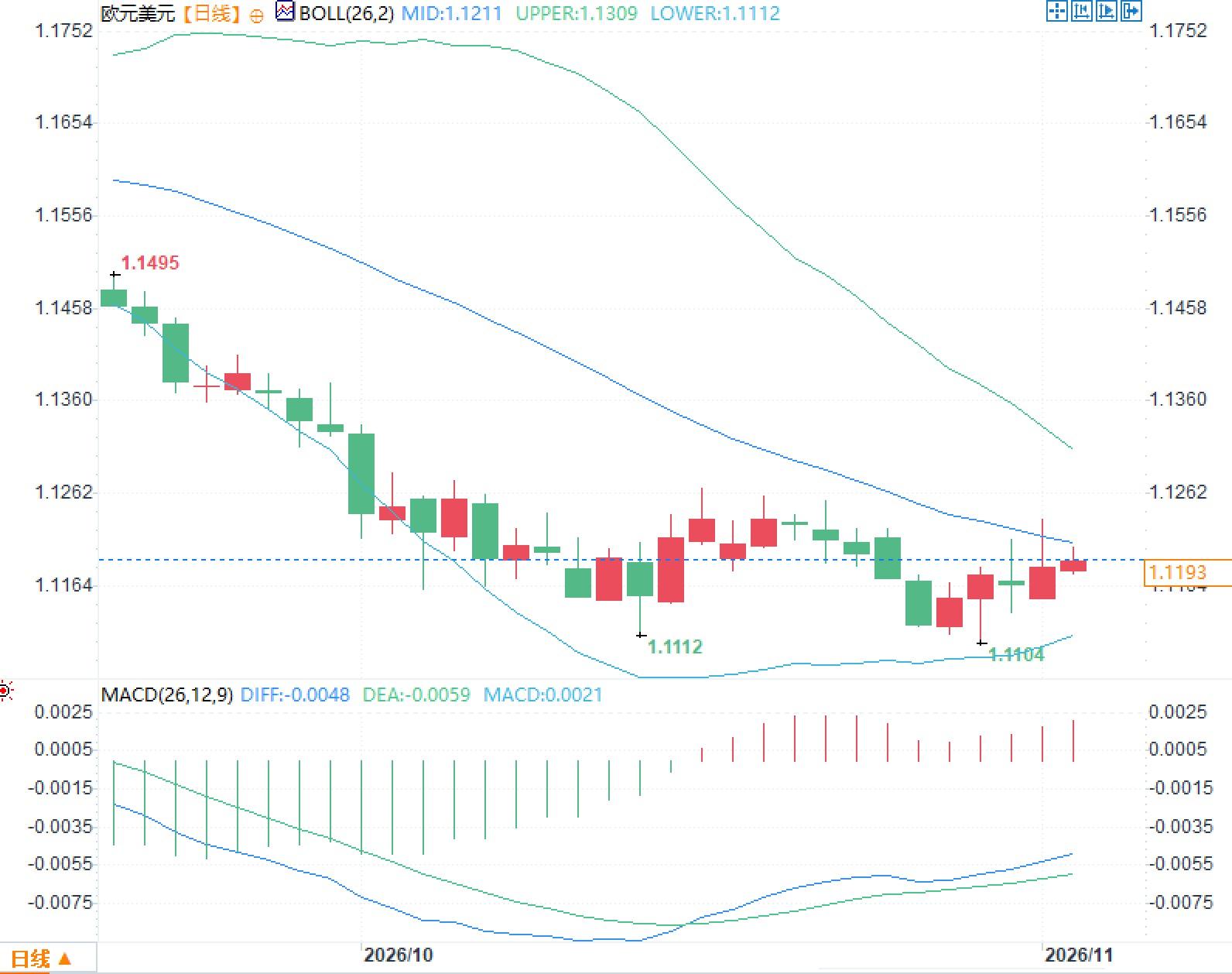 Volatility has recently converged, with prices repeatedly testing the 1.11 to 1.12 range. From a price structure perspective, resistance formed near the previous high of 1.1495, while support appeared near the low of 1.1104. Current price action suggests the market is digesting fundamental news and has not yet formed a clear breakout pattern.
Recent price performance and technical characteristics of the euro against the US dollar
The euro rebounded earlier this week after hitting a low of around 1.11 against the dollar in late October, and is currently fluctuating around 1.119. The daily chart shows the price trading near the middle Bollinger Band, with the upper band around 1.1309 and the lower band around 1.1112. The MACD indicator shows both the DIFF and DEA lines below the zero line, with the histogram turning positive, reflecting a slight recovery in short-term momentum, but the overall trend remains negative. Volatility has recently converged, with prices repeatedly testing the 1.11 to 1.12 range. From a price structure perspective, resistance formed near the previous high of 1.1495, while support appeared near the low of 1.1104. Current price action suggests the market is digesting fundamental news and has not yet formed a clear breakout pattern.Analysis of the European Central Bank's Hawkish Stance and Inflationary Pressures
The European Central Bank (ECB) kept interest rates unchanged at its policy meeting on October 29, while noting that rising energy prices posed an upside risk to the inflation outlook. Since the meeting, several officials have made hawkish comments, confirming market expectations for at least one more rate hike. Kazimir emphasized that the market may have underestimated the policy力度 needed to curb price pressures, and the issue lies in the path needed to pull inflation back to the target, not a single action. Eurozone core inflation rose to 2.5% in September, with high energy prices limiting the scope for dovish voices. ECB staff forecasts have been revised upwards for core inflation, with both 2027 and 2028 projections revised upwards. Lagarde stated after the meeting that the policy direction was clear, and the policymakers had discussed a rate hike but chose to wait for more data. She also announced that she would step down early on February 7, 2027, after her term was originally scheduled to end in October 2027. This personnel change adds a dimension to the observation of policy continuity, but the current focus remains on energy-driven inflation dynamics and data assessments ahead of the December meeting.French interest rate differentials and energy price risk premium mechanism
The spread between French and German 10-year government bond yields has remained above 150 basis points, becoming a significant source of the euro's risk premium. Even though oil prices fell in the previous trading day, the French yield spread did not narrow accordingly, indicating that the current level has become the new normal. Brent crude oil prices remained around $106 per barrel, a significant increase from the beginning of the year, with energy costs directly impacting the Eurozone's current account and inflation expectations through imports. High energy prices reduce the ECB's room for a dovish stance and also increase pressure on business costs and consumer spending. France's fiscal situation and political environment make it difficult to quickly compress the yield spread, and the sovereign risk premium affects euro funding costs through the interest rate channel. Market observations suggest that only a more sustainable and substantial decline in oil prices and clearer progress on France's fiscal path can gradually reduce this risk premium for the euro. Under the current structure, energy and sovereign factors reinforce each other, forming a continuous constraint on the euro.US Midterm Elections and Market Sentiment
The US midterm elections were held on November 3rd, with control of the House of Representatives and the Senate becoming the focus. The election results are not yet fully tallied, and the market remains vigilant for potential shifts in the power structure. Market analysts believe that even if the Democrats gain a majority in the House, the impact on the euro/dollar exchange rate will be limited and unlikely to trigger a fundamental shift. Market risk appetite typically fluctuates during elections, but the main drivers for the euro/dollar exchange rate remain internal European factors: the European Central Bank's policy path, the French interest rate differential, and energy prices. Policy expectations and economic data regarding the US dollar are currently priced in in a flat manner, without significant dominant changes. Traders are more focused on the short-term volatility following the election results and its ripple effects on global risk asset sentiment than on unilateral directional assumptions.- Risk Warning and Disclaimer
- The market involves risk, and trading may not be suitable for all investors. This article is for reference only and does not constitute personal investment advice, nor does it take into account certain users’ specific investment objectives, financial situation, or other needs. Any investment decisions made based on this information are at your own risk.