November 5th Financial Breakfast: A landslide victory for the Democrats in the US midterm elections weakened the dollar, causing gold prices to surge over 3% and oil prices to plummet over 9%.
2026-11-05 07:32:26
On Thursday (November 5th, Beijing time) in early Asian trading, spot gold was trading around $4063 per ounce. Gold prices surged more than 3% on Wednesday, marking the biggest one-day gain since mid-August. The Democratic Party's landslide victory in the US midterm elections caused the dollar to fall sharply to a more than one-month low. Investors are focused on the US non-farm payrolls report to be released this week for clues about the interest rate outlook. Oil prices plummeted more than 9% on Wednesday, hitting a three-month low during the session, as investors bet that a change of power in the US could accelerate the end of the war between the US and Israel and Iran. US crude oil is currently trading around $88.17 per barrel. 
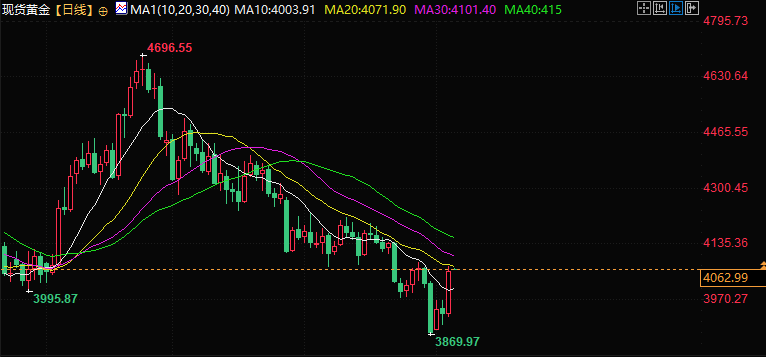 Jim Wyckoff, a market analyst at the U.S. Gold Exchange, said gold prices were supported by a weaker dollar, reflecting a widespread market belief that the U.S. Congress is likely to remain deadlocked on many legislative issues, potentially negatively impacting the U.S. economy and prompting the Federal Reserve to adopt a more accommodative monetary policy. Meanwhile, inflation concerns persist, and investors are closely watching Washington's next move in the U.S.-Israel alliance against Iran. The CME FedWatch tool shows traders expect an approximately 83% probability of a Fed rate hike in December. Wednesday's ADP report showed U.S. private sector employment grew in October, and investors await Friday's non-farm payroll report.
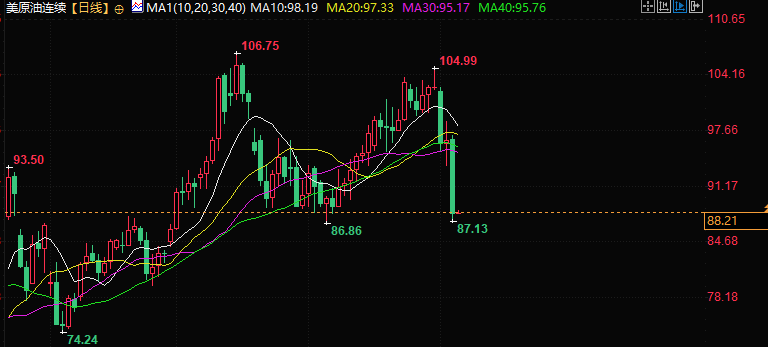 Trump now faces a choice between negotiating a withdrawal or a riskier escalation. Two sources close to Gulf government circles say that a weakened Trump, facing a Democratic-controlled Congress that could limit his military options, is more motivated to seek a deal, and a full-scale attack on Iran currently seems less likely. However, Gulf analysts point out that an agreement that allows Iran to claim a clear victory and makes Trump appear defeated could trigger reckless behavior rather than restraint. Trump told the Financial Times on Tuesday that the US currently has no plans to strike Iran; on Wednesday, he acknowledged that the Iran issue played a role in the Republican Party's midterm election defeat. Dennis Kissler, senior vice president of trading at BOK Financial, said that a Democratic-controlled Congress could also tighten US military spending in the Middle East and further increase the likelihood of an early peace agreement. Increased Middle Eastern oil exports and Trump's comments about not currently planning to strike Iran are exacerbating downward pressure on oil prices. Iranian Supreme Leader Khamenei stated in a written statement that the US's hostile stance will continue regardless of which party is in power; the Houthi rebels in Yemen have claimed to have targeted King Khalid International Airport in Riyadh, a claim that Saudi authorities have not yet confirmed. According to Vortexa vessel tracking data, Gulf region crude oil, condensate, and refined product exports (excluding liquefied petroleum gas) averaged 17.1 million barrels per day in October, down from 18.9 million barrels per day in September, but still about three-quarters of pre-war levels. The U.S. Energy Information Administration reported that U.S. crude oil, gasoline, and distillate fuel inventories all declined last week, with crude oil inventories falling by 865,000 barrels to 409.8 million barrels in the week ending October 30.
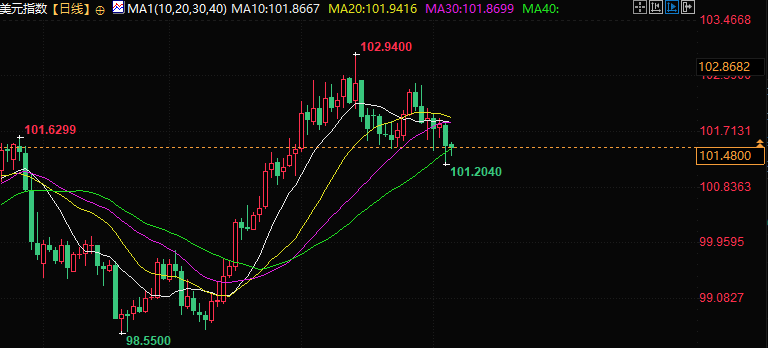 The Democratic Party's landslide victory eased market concerns about a potentially contested election result, but also raised the prospect of a divided government and legislative gridlock with Republicans controlling the White House and Democrats controlling Congress. Meanwhile, the US is grappling with the Iran war and the AI boom, which is both driving economic growth and exacerbating inflation. Investors await Washington's next move in the US-Israel conflict with Iran. Erik Bregar, head of foreign exchange and precious metals risk management at Silver Gold Bull, said the market is showing signs of increased risk appetite, and what we're seeing now may be partly a "sell the rumor, buy the fact" scenario. The market is also relieved that it won't get bogged down in claims of a manipulated election result. From a fundamental perspective, given the Democrats' stance on issues like data centers, market concerns about AI could still intensify further, but the fact that Trump is unlikely to contest the election result is a relief. A broad-based increase in risk appetite is generally unfavorable for the dollar. The euro rose 0.33% against the dollar to $1.1228, after earlier reaching a high of $1.1272, its highest level since October 6. Despite changes in the US political landscape, market expectations for the Federal Reserve's interest rate path remain largely unchanged. The CME Group's FedWatch tool shows the market expects an 81.2% probability of a 25 basis point rate hike at the Fed's December meeting, up from 77.4% in the previous trading day. The US midterm election results largely overshadowed the impact of a series of US economic data: the ADP National Employment Report showed that US private sector jobs increased by 86,000 in October, higher than the 69,000 forecast by economists in a Reuters poll; the Institute for Supply Management report showed that the non-manufacturing PMI fell to 54.5 last month, lower than September's 54.9 and economists' forecast of 54.8, but still above the 50-point threshold separating expansion from contraction. The pound rose 0.38% against the dollar to $1.3462, after earlier reaching a more than seven-week high of $1.3503, marking its sixth consecutive day of gains; the Bank of England will announce its policy decision on Thursday, and is expected to raise interest rates due to inflationary pressures from soaring energy costs, but this may refute investors' bets on multiple rate hikes next year.
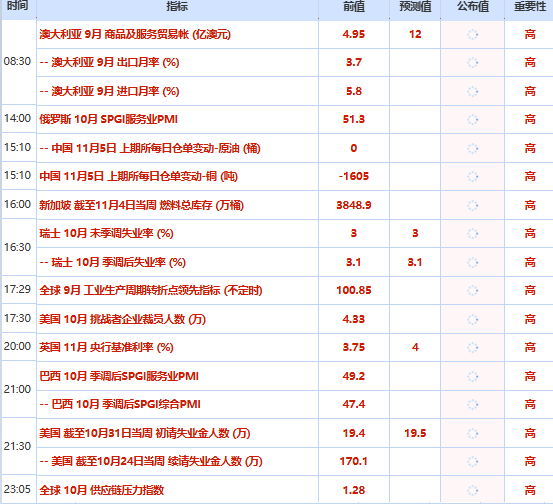
Key levels to watch today
Notestock market
U.S. stocks closed sharply higher on Wednesday, with the S&P 500 rising 1.6% to 7,688.62, the Nasdaq gaining 1.4% to 25,736.51, and the Dow Jones Industrial Average climbing 3% to 53,356.12. The Democratic Party's landslide victory in the midterm elections eased political uncertainty and boosted risk appetite, but concerns about stricter AI regulations led to a decline in data center-related stocks. AI giants Microsoft rose 6.7%, Amazon rose 6.1%, Alphabet rose 3.2%, and Meta rose 1.4%, while Hut 8 fell 23%, IREN fell 11%, Core Scientific fell 10%, and Applied Digital fell 6.7%. The Philadelphia Semiconductor Index fell 3.1%, hitting a six-month low, while AMD rose 1%. A sharp drop in oil prices also boosted market sentiment, with investors betting that a shift in the power structure would accelerate the end of the Iran-Iraq War. The S&P 500 consumer discretionary sector rose 4.3%, while the energy sector fell 4.8%. SpaceX fell 3.9%, Tesla fell 3.3%, and defense stocks Northrop Grumman, Raytheon, and Lockheed Martin declined as their $1.5 trillion defense budget request faced potentially tougher scrutiny in Congress. Solar and clean energy stocks rose, with the Invesco Solar ETF gaining nearly 6%.Gold Market
Spot gold rose 3.29% on Wednesday, its biggest one-day gain since mid-August, to settle at $4,059.92 an ounce. The dollar fell sharply to a more than one-month low as Democrats won a landslide victory in the U.S. midterm elections. Investors are now focused on this week’s U.S. non-farm payrolls report for clues about the interest rate outlook. Jim Wyckoff, a market analyst at the U.S. Gold Exchange, said gold prices were supported by a weaker dollar, reflecting a widespread market belief that the U.S. Congress is likely to remain deadlocked on many legislative issues, potentially negatively impacting the U.S. economy and prompting the Federal Reserve to adopt a more accommodative monetary policy. Meanwhile, inflation concerns persist, and investors are closely watching Washington's next move in the U.S.-Israel alliance against Iran. The CME FedWatch tool shows traders expect an approximately 83% probability of a Fed rate hike in December. Wednesday's ADP report showed U.S. private sector employment grew in October, and investors await Friday's non-farm payroll report.oil market
Oil prices fell on Wednesday, with WTI crude down 9.01% to settle at $88.04 a barrel, after hitting a three-month low of $87.13 a barrel during the session; Brent crude fell 9.36% to settle at $94.58 a barrel, after hitting a three-month low of $93.39 a barrel during the session. Investors bet that the change of power, following President Trump's Republican Party's loss of control of Congress in the midterm elections, could accelerate the end of the wars between the United States and Israel with Iran. Trump now faces a choice between negotiating a withdrawal or a riskier escalation. Two sources close to Gulf government circles say that a weakened Trump, facing a Democratic-controlled Congress that could limit his military options, is more motivated to seek a deal, and a full-scale attack on Iran currently seems less likely. However, Gulf analysts point out that an agreement that allows Iran to claim a clear victory and makes Trump appear defeated could trigger reckless behavior rather than restraint. Trump told the Financial Times on Tuesday that the US currently has no plans to strike Iran; on Wednesday, he acknowledged that the Iran issue played a role in the Republican Party's midterm election defeat. Dennis Kissler, senior vice president of trading at BOK Financial, said that a Democratic-controlled Congress could also tighten US military spending in the Middle East and further increase the likelihood of an early peace agreement. Increased Middle Eastern oil exports and Trump's comments about not currently planning to strike Iran are exacerbating downward pressure on oil prices. Iranian Supreme Leader Khamenei stated in a written statement that the US's hostile stance will continue regardless of which party is in power; the Houthi rebels in Yemen have claimed to have targeted King Khalid International Airport in Riyadh, a claim that Saudi authorities have not yet confirmed. According to Vortexa vessel tracking data, Gulf region crude oil, condensate, and refined product exports (excluding liquefied petroleum gas) averaged 17.1 million barrels per day in October, down from 18.9 million barrels per day in September, but still about three-quarters of pre-war levels. The U.S. Energy Information Administration reported that U.S. crude oil, gasoline, and distillate fuel inventories all declined last week, with crude oil inventories falling by 865,000 barrels to 409.8 million barrels in the week ending October 30.Foreign exchange market
The dollar index fell 0.33% on Wednesday to close at 101.50, after hitting a two-month low of 101.20 during the session. Wednesday's landslide victory for Democrats in the U.S. midterm elections, which secured control of both houses of Congress, removed a source of market uncertainty, prompting investors to assess potential changes in regulatory policy. The Democratic Party's landslide victory eased market concerns about a potentially contested election result, but also raised the prospect of a divided government and legislative gridlock with Republicans controlling the White House and Democrats controlling Congress. Meanwhile, the US is grappling with the Iran war and the AI boom, which is both driving economic growth and exacerbating inflation. Investors await Washington's next move in the US-Israel conflict with Iran. Erik Bregar, head of foreign exchange and precious metals risk management at Silver Gold Bull, said the market is showing signs of increased risk appetite, and what we're seeing now may be partly a "sell the rumor, buy the fact" scenario. The market is also relieved that it won't get bogged down in claims of a manipulated election result. From a fundamental perspective, given the Democrats' stance on issues like data centers, market concerns about AI could still intensify further, but the fact that Trump is unlikely to contest the election result is a relief. A broad-based increase in risk appetite is generally unfavorable for the dollar. The euro rose 0.33% against the dollar to $1.1228, after earlier reaching a high of $1.1272, its highest level since October 6. Despite changes in the US political landscape, market expectations for the Federal Reserve's interest rate path remain largely unchanged. The CME Group's FedWatch tool shows the market expects an 81.2% probability of a 25 basis point rate hike at the Fed's December meeting, up from 77.4% in the previous trading day. The US midterm election results largely overshadowed the impact of a series of US economic data: the ADP National Employment Report showed that US private sector jobs increased by 86,000 in October, higher than the 69,000 forecast by economists in a Reuters poll; the Institute for Supply Management report showed that the non-manufacturing PMI fell to 54.5 last month, lower than September's 54.9 and economists' forecast of 54.8, but still above the 50-point threshold separating expansion from contraction. The pound rose 0.38% against the dollar to $1.3462, after earlier reaching a more than seven-week high of $1.3503, marking its sixth consecutive day of gains; the Bank of England will announce its policy decision on Thursday, and is expected to raise interest rates due to inflationary pressures from soaring energy costs, but this may refute investors' bets on multiple rate hikes next year.International News
Trump Makes First Public Appearance Since Midterm Election Defeat On November 4th local time, US President Trump made his first public appearance since his midterm election defeat. Speaking to the media at the White House, he stated that the election loss was largely due to the conflict with Iran, but he would make the same decision if given the chance. Trump declared that Iran must never be allowed to possess nuclear weapons. When asked about the future of Defense Secretary Hergé, Trump said he would not replace Hergé, who "did a very good job." (CCTV International News) OPEC: Soaring Oil Transportation and Insurance Costs Exacerbate Global Inflationary Pressures OPEC Secretary General Heitham Guess stated on November 4th that international energy transportation and insurance costs have risen sharply since 2026, currently exceeding one-third of the value of crude oil itself. Rising transportation and risk costs are being transmitted along the oil and energy supply chain, increasing the economic burden on oil-producing and consuming countries and further exacerbating global inflationary pressures. A new report released by OPEC on the 4th shows that since 2026, the cost of crude oil shipping and insurance has risen sharply, with transportation costs on some routes increasing by about 12 times compared to the beginning of the year, pushing up global commodity prices and inflationary pressures. (CCTV News) Democrats Win Senate, Adding Another Barrier to Trump's Path to Reshaping the Fed With the Democrats winning control of the Senate, Donald Trump's efforts to reshape the Federal Reserve and make interest rate policy conform to his wishes have encountered a strong barrier. The change of control of the Senate is a major political shift, previously considered unlikely. This effectively blocks the White House's path to confirming a Trump-loyal candidate for the seven-member Federal Reserve Board of Governors, and also deprives the Trump administration of its most direct means of further strengthening its control over the US central bank. With the Democrats holding a majority, Massachusetts Senator Elizabeth Warren is likely to become the chair of the Senate Banking Committee. This means that the committee responsible for overseeing the Federal Reserve will be led by Warren, and she is expected to block any nominees deemed overly compliant with executive pressure from advancing. This election result may also give the Federal Reserve and its chairman, Kevin Warsh, more room to combat inflation by raising interest rates. The United Arab Emirates (UAE) is considering building a third crude oil pipeline to bypass the Strait of Hormuz, according to sources familiar with the matter. The pipeline would transport crude oil to areas outside the Strait of Hormuz, significantly reducing the UAE's reliance on this shipping route. The Abu Dhabi National Oil Company (ADNOC) is planning a pipeline connecting the UAE's west coast to the port of Fujairah in the east, the sources said. The sources requested anonymity because the information is not yet public. The pipeline may be open to third parties and interconnect with existing pipelines and another pipeline planned to begin construction next year, enhancing the UAE's ability to secure crude oil supplies in the event of disruptions in the Strait of Hormuz. The sources also indicated that ADNOC has already presented the pipeline project to some Asian clients. However, the plan is not yet finalized, and details such as the route are still subject to adjustment. Meanwhile, according to CME's FedWatch Tool, the probability of the Federal Reserve raising interest rates in December is 81.5%, and the probability of at least one rate hike next year is 85.8%. The probability of the Fed keeping interest rates unchanged in December is 18.5%, and the probability of a 25 basis point rate hike is 81.5%. The probability of the Federal Reserve keeping interest rates unchanged until January next year is 14.2%, the probability of a cumulative rate hike of 25 basis points is 67.1%, and the probability of a cumulative rate hike of 50 basis points is 18.7%.Domestic News
The National Development and Reform Commission (NDRC) announced on November 4th that China's total retail sales of consumer goods are expected to reach approximately 60 trillion yuan by the end of the 15th Five-Year Plan period . The NDRC held a press conference to introduce the relevant situation regarding strengthening development support. Kou Rong, Deputy Director of the Economic and Trade Department of the NDRC, stated that by the end of the 15th Five-Year Plan period, the overall scale of China's circulation industry is expected to continue to expand, with total retail sales of consumer goods reaching approximately 60 trillion yuan, and the circulation network will be more complete. The radiating and driving capacity of 102 modern circulation strategic pivot cities will be further enhanced. Six national-level important commodity backbone circulation corridors will be established, further improving the modern circulation system and better serving China's modernization. The People's Bank of China (PBOC) is intensifying its implementation of the stock repurchase and refinancing policy. To maintain the stable operation of the capital market, the PBOC is intensifying its implementation of the stock repurchase and refinancing policy. I. Effective November 4, 2026, the interest rate for stock repurchase and refinancing will be lowered by 0.25 percentage points to 1%. The stock repurchase and shareholding increase relending program supports 21 national banks and 5 systemically important city commercial banks, with a support ratio of 100% and a term of one year, which can be extended as needed by the banks. Banks can appropriately add a spread to the relending rate to reasonably determine the term and interest rate of the stock repurchase and shareholding increase loan, accelerate loan disbursement, and enhance the market capitalization management capabilities of listed companies and major shareholders. Secondly, sufficient relending quotas will be provided to banks. Following the stock repurchase and shareholding increase relending symposium on November 2nd, banks have submitted applications for stock repurchase and shareholding increase relending quotas exceeding RMB 200 billion to the People's Bank of China. Going forward, the People's Bank of China will continue to fully meet the banks' relending needs and support banks in actively connecting with the financing needs of listed companies and major shareholders. (People's Bank of China)- Risk Warning and Disclaimer
- The market involves risk, and trading may not be suitable for all investors. This article is for reference only and does not constitute personal investment advice, nor does it take into account certain users’ specific investment objectives, financial situation, or other needs. Any investment decisions made based on this information are at your own risk.