Concerns about a political gridlock, coupled with falling oil prices, caused the US dollar to weaken against the Canadian dollar for the second consecutive day.
2026-11-05 11:20:26
The US dollar fell for a second straight day against the Canadian dollar, trading around 1.3950 in Asian trading on Thursday (November 5). The pair declined as the dollar faced heavy selling pressure following the Democratic Party's sweep of the midterm elections and control of both houses of Congress, amid market concerns about a potential political deadlock in Washington. Furthermore, expectations of an end to Middle Eastern conflicts triggered by the election results pushed oil prices sharply lower, further weighing on the dollar. However, the dollar's decline may be limited as resilient US domestic economic data strengthened expectations of a Federal Reserve rate hike. The ADP report showed that private sector employment increased by 86,000 in October, higher than the expected 69,000, while the September figure was revised down from 90,000 to 86,000. Meanwhile, the ISM services PMI fell slightly to 54.5 from 54.9, slightly below the expected 54.8, but remained firmly in expansion territory. 
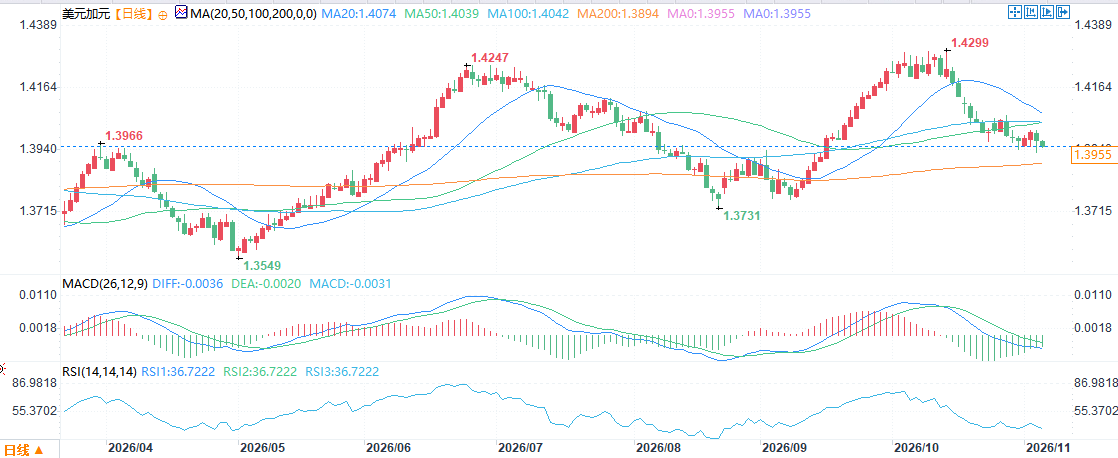 (USD/CAD daily chart, source: EasyForex) At 11:19 Beijing time, USD/CAD was trading at 1.3950/51.
Dollar under pressure: Double pressure from political gridlock and falling oil prices
The Democratic sweep of both houses of Congress is the core context for the weakening dollar. Concerns about a political gridlock mean major legislation is unlikely to advance, policy continuity will decline, and the dollar's risk premium will rise accordingly. Meanwhile, expectations of an end to the Middle East conflict following the election results drove oil prices sharply lower—the market anticipates a new Congress will push for de-escalation of the military conflict with Iran. Trump acknowledged that the Republican Party's electoral losses were largely due to voter dissatisfaction with conflict-related gasoline price increases, while simultaneously signaling no intention to immediately escalate military action. A Democratic-controlled Congress is expected to challenge funding for military action in the Middle East, and Senate Majority Leader Schumer has explicitly pledged to push for an end to the conflict. Furthermore, Persian Gulf oil exports have begun to recover, creating a market environment where supply currently exceeds near-term demand. These two channels—political uncertainty and falling oil prices—have combined to suppress the dollar.Limiting factors: Better-than-expected ADP data and an 82% probability of an interest rate hike limit the dollar's decline.
However, the dollar's decline may be constrained. ADP employment increased by 86,000, exceeding expectations, and the ISM services PMI, while slightly below expectations, remained in expansion territory. These resilient data reinforced expectations of a Fed rate hike. According to the CME FedWatch tool, the market is currently pricing in an 82% probability of another rate hike in December. Investors are now turning their attention to upcoming US economic data, including Thursday's initial jobless claims and Friday's non-farm payrolls report. This combination implies that political factors and oil prices are suppressing the dollar, while interest rates are providing support, creating a tug-of-war among the three.The Canadian dollar's contradictory situation: a weaker US dollar is a boon, while falling oil prices are a drag.
The Canadian dollar is currently in a contradictory position. On the one hand, a weaker US dollar provides it with room to rise; on the other hand, the commodity-linked Canadian dollar faces pressure from falling oil prices—Canada is one of the largest oil exporters to the United States, and lower energy prices directly suppress the Canadian dollar. This hedging relationship explains why the USD/CAD pair, although declining for the second consecutive day, saw limited losses. In the short term, the direction of oil prices may have a greater impact on the Canadian dollar than fluctuations in the US dollar index.Institutional Views
Some institutional strategists have observed that despite recent gains, the Canadian dollar has failed to keep pace with other major currencies. They point out that the Canadian dollar's "relative underperformance compared to its peers highlights its role as a low-beta risk and commodity currency," reinforcing its tendency to be more cautious than high-beta currencies even in supportive market environments. This observation implies that even with a broad-based weakening of the US dollar and a recovery in risk appetite, the Canadian dollar's gains may systematically lag behind high-beta commodity currencies like the Australian dollar, determined by its monetary characteristics rather than short-term fundamentals.in conclusion
The Canadian dollar strengthened, causing the USD/CAD pair to fall for the second consecutive day to around 1.3950. The core drivers were concerns about a political gridlock following the Democratic sweep of both houses of Congress and a drop in oil prices triggered by the election results. The latter, coupled with expectations of an end to the Middle East conflict, pressured the US dollar, but simultaneously weighed on the commodity currency, the Canadian dollar, creating a hedge. Better-than-expected ADP employment growth of 86,000 and an approximately 82% probability of a December rate hike provided support for the US dollar, limiting its decline. Analysts pointed out that the Canadian dollar, as a low-beta risk and commodity currency, has systematically lagged behind other major currencies in terms of gains. Its short-term direction depends on the direction of oil prices (which may have a greater impact on the Canadian dollar than the US dollar index fluctuations), the depth of the political gridlock's pricing, and the repricing of Friday's non-farm payroll data on interest rate hike expectations. (USD/CAD daily chart, source: EasyForex) At 11:19 Beijing time, USD/CAD was trading at 1.3950/51.
- Risk Warning and Disclaimer
- The market involves risk, and trading may not be suitable for all investors. This article is for reference only and does not constitute personal investment advice, nor does it take into account certain users’ specific investment objectives, financial situation, or other needs. Any investment decisions made based on this information are at your own risk.