Precious metals surged after the US midterm elections, with the US dollar being the key driver.
2026-11-05 13:48:27
Following the Democratic Party's sweep of both houses of the US Congress, precious metals experienced a strong rally, with gold, silver, platinum, and palladium all rising in tandem. The core driver behind this was the decline in the US dollar index and US Treasury yields. Historical analysis reveals that election results themselves have a limited impact on precious metals; the true determinant of gold and silver prices has consistently been the strength or weakness of the US dollar.
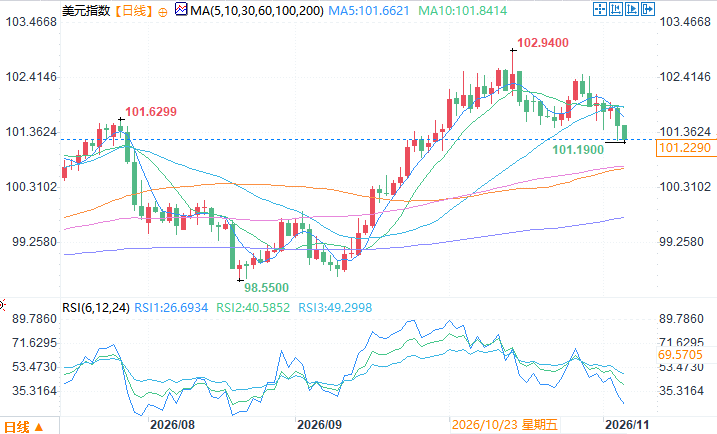 US Dollar Index Daily Chart Source: EFX At 13:46 Beijing time on November 5, the US Dollar Index was at 101.24.
The midterm election results triggered a broad rebound in precious metals.
Following the election results, precious metals surged, with spot gold rising 3.29% to close at $4,059.92 per ounce, regaining the $4,000 mark; silver rose 4.89% to close at $52.213. The US dollar index fell 0.33% to close at 101.5049, and US Treasury yields declined in tandem. Market analysts interpret this as a congressional check and balance that will hinder the implementation of tax cuts, tariffs, and regulatory deregulation, weakening the fiscal support for the dollar this year.Historical Review: Elections are just the trigger; the US dollar is the core variable.
Looking back at past midterm elections, the winning party's influence on precious metals is far less significant than that of the US dollar. In the 2010 midterm elections, the Republicans won a large number of House seats, which was already fully priced in by the market, resulting in minimal fluctuations in gold prices. The real driver was the Federal Reserve's second round of quantitative easing, which weakened the dollar and propelled silver to new highs. The 2014 elections, however, saw the opposite outcome: the Republicans controlled the Senate, the dollar index strengthened, and gold prices fell by 2%. The two Republican waves led to drastically different gold price performances, stemming from the opposing directions of the US dollar. The underlying logic of the dollar's strength in 2014 was the divergence in monetary policy. The Federal Reserve was preparing to raise interest rates, while the European Central Bank and the Bank of Japan continued their easing policies, initiating a major bull market for the dollar and putting sustained pressure on gold prices, which reached a low point at the end of 2015. Interestingly, gold prices bottomed out earlier, and even as the dollar continued to rise, gold did not reach new lows, indicating that the negative factors had already been fully priced in.Compared to the current market conditions, silver is facing a critical test at a key level.
This election disrupted the dollar's upward trend, a stark contrast to the 2014 election which propelled the dollar to a breakout. Silver has reached a critical historical juncture; the 2011 high of $49.83 served as a long-term strong resistance level. The recent price action briefly dipped below this level before quickly recovering, representing a pullback to confirm a key breakout point. However, history also offers a cautionary tale: after silver's surge in 2011, the brief rebound was followed by renewed weakness. Fortunately, the current gold-silver ratio is around 77, compared to 50 in 2011, indicating that silver's relative valuation is lower and it possesses a certain advantage.The comparison has limitations; key data points and non-farm payroll data require further verification.
Historical analogies cannot be directly applied. The 2014 dollar bull market relied on the divergence in global monetary policies. The current inflationary environment does not support a shift towards easing by the Federal Reserve, and institutions suggest that the Fed's hawkish stance will limit the upside potential for gold prices. Furthermore, the current gold price adjustment cycle and the extent of the previous decline differ significantly from those of 2015. The market will focus on the key support level of 101.25 for the dollar. A sustained break below 100 would confirm the failure of this dollar rebound, opening up upside potential for gold and silver; silver, on the other hand, needs to hold above $49.83. The upcoming non-farm payroll report will be the next major catalyst influencing expectations for Fed policy and the price movements of the dollar and precious metals.Conclusion
The midterm elections ignited a rebound in precious metals, but they were merely a trigger for a short-term shift in the dollar's trajectory. Whether gold and silver can sustain their upward trend depends on whether the dollar weakens effectively and whether silver can hold key price levels. The non-farm payroll data will be a watershed moment for short-term price movements. US Dollar Index Daily Chart Source: EFX At 13:46 Beijing time on November 5, the US Dollar Index was at 101.24.
- Risk Warning and Disclaimer
- The market involves risk, and trading may not be suitable for all investors. This article is for reference only and does not constitute personal investment advice, nor does it take into account certain users’ specific investment objectives, financial situation, or other needs. Any investment decisions made based on this information are at your own risk.