Spot silver is poised for a second consecutive day of gains; is this a trend reversal or just a rebound?
2026-11-05 14:22:27
Spot silver rose for a second straight day, climbing as much as 2.4% to $53.45 an ounce in Asian trading on Thursday (November 5), a one-week high, and is currently trading around $52.70 an ounce. The price increase was driven by the Democratic victory in the US midterm elections, which boosted hopes for an end to the US-Iran conflict and triggered a sharp drop in oil prices. The dollar-denominated, non-yielding white metal also benefited from a weaker dollar and lower US Treasury yields, increasing its appeal to investors. President Trump acknowledged the Republican Party's losses due to the conflict and cited high gasoline prices as a key factor in the defeat, while signaling no immediate intention to escalate the strike against Iran. 
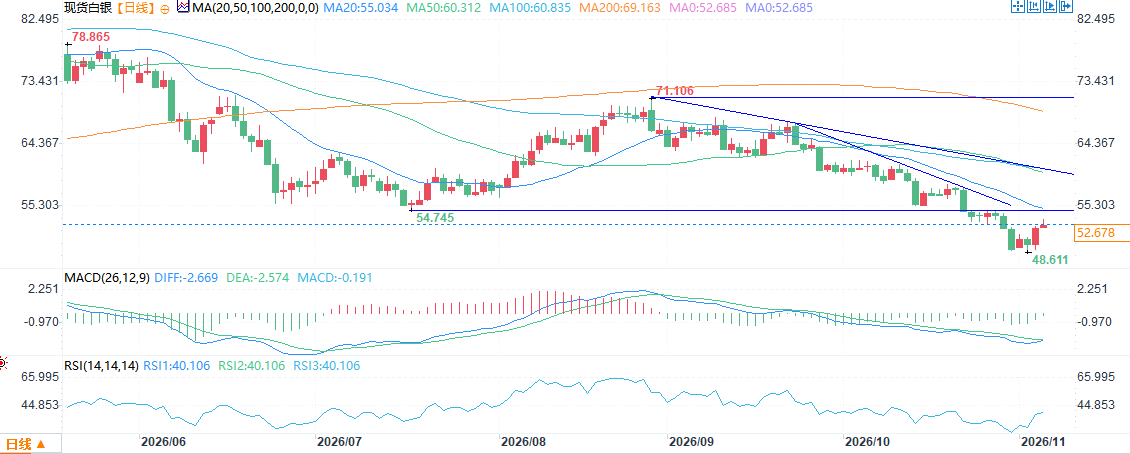 (Spot silver daily chart, source: EasyTrade) At 14:20 Beijing time, spot silver was trading at $52.93 per ounce.
Oil Prices and Inflation: Peace Hopes Could Lower Oil Prices and Ease Recent Inflationary Pressures
The peace hopes sparked by the Democratic victory have been transmitted to silver through oil prices. Following the election results, market expectations for a de-escalation of tensions in the Middle East rose, driving a significant drop in international oil prices. This sharp decline in oil prices may help ease inflationary pressures, particularly reducing energy-related imported inflation, thereby alleviating market concerns about further interest rate hikes by the Federal Reserve in the near future. For silver, which yields no interest, a cooling of inflationary expectations is theoretically beneficial because it lowers the opportunity cost of holding the precious metal—when inflation expectations decline and real interest rates are relatively stable, silver's attractiveness as a safe-haven asset increases. However, the strength of this transmission is highly dependent on whether the decline in oil prices can be sustained and whether the hopes for peace will translate into substantial progress. If geopolitical risks escalate again and oil prices rebound, inflationary pressures may rise again, offsetting the previous support for silver. Furthermore, the impact of oil prices on silver is not one-way: while lower energy costs may suppress inflation, they may also indirectly affect silver prices by reducing expectations of industrial demand. Therefore, the current support for silver from oil prices and inflation is still temporary and conditional, and its sustainability depends on close observation of subsequent geopolitical developments and energy market dynamics.Interest rate hike expectations: ADP report exceeds expectations with an 82% probability; resilient data maintains hawkish pricing.
However, the resilience of US domestic economic data continues to strengthen expectations of a Federal Reserve rate hike. The ADP employment report showed that private sector employment increased by 86,000 in October, higher than the expected 69,000. Even though the September figure was revised down from 90,000 to 86,000, the overall labor market still showed a certain level of activity. Meanwhile, the ISM Services PMI slightly decreased from 54.9 to 54.5, slightly below the expected 54.8, but remained firmly in expansion territory, indicating continued expansion in service sector activity. These strong US economic indicators keep expectations for a hawkish Federal Reserve monetary policy. The CME FedWatch tool shows the market pricing in a near 82% probability of another rate hike in December. Investors are now turning their attention to upcoming economic reports, including Thursday's initial jobless claims and Friday's non-farm payrolls report, to further confirm economic momentum. If subsequent data continues to exceed expectations, the probability of a rate hike may rise further, and a higher real interest rate center will put downward pressure on non-yielding silver. Conversely, if employment and service sector data show significant signs of slowing, it may weaken the hawkish pricing, providing breathing room for silver. The market is currently in a sensitive phase driven by data, and each key data release can quickly change interest rate expectations and the pricing logic of precious metals.US Dollar Valuation: The index remains above fair value; weakness may be a correction rather than a trend.
Some analysts reiterated that even if the dollar weakens after the election, the broader dollar index remains overvalued relative to its valuation framework. They "continue to emphasize that the dollar index is trading at a premium to its fair value estimated based on the 2-year interest rate spread, which is close to 100 (while the spot market is in the mid-range of 101)," highlighting their view that despite the recent weakening of G10 currencies, the dollar is still trading above its fair value. The post-election dollar weakness is more likely a correction of the previous premium than the start of a trend of depreciation, thus limiting the support silver receives from the dollar's weakness. If the dollar's decline is merely a temporary correction rather than the start of a medium-term depreciation cycle, its boost to dollar-denominated silver will be relatively limited and short-lived. Historical experience shows that when the dollar index is significantly higher than its fair value estimated based on interest rate parity or interest rate spread models, mean reversion often follows, but the magnitude and pace of this reversion are highly dependent on the Fed's policy path and global risk appetite. In the current context, if the US economy continues to demonstrate resilience and interest rate hike expectations persist, the dollar premium may be difficult to dissipate quickly; only after a slowdown in growth or a clear signal of a policy shift will the dollar be more likely to weaken in a trend, thus providing more lasting support for silver.in conclusion
The core drivers of silver's second consecutive day of gains were increased hopes for US-Iran peace following the Democratic victory, a sharp drop in oil prices, coupled with a weakening dollar and declining US Treasury yields. Lower oil prices may ease recent inflationary pressures, theoretically benefiting silver, which has no yield. However, the ADP employment increase of 86,000 exceeded expectations, the ISM services sector remained in expansion territory, and the probability of a December rate hike was around 82%, with resilient data maintaining a hawkish pricing, constraining upward movement. Analysts pointed out that the dollar index remains above its fair value, and the post-election dollar weakness is more likely a premium correction than a trend depreciation, limiting the support silver receives from the dollar. Short-term direction depends on the repricing of rate hike expectations by Thursday's initial jobless claims and Friday's non-farm payroll data, as well as the sustainability of the oil price decline and substantial progress in hopes of peace. (Spot silver daily chart, source: EasyTrade) At 14:20 Beijing time, spot silver was trading at $52.93 per ounce.
- Risk Warning and Disclaimer
- The market involves risk, and trading may not be suitable for all investors. This article is for reference only and does not constitute personal investment advice, nor does it take into account certain users’ specific investment objectives, financial situation, or other needs. Any investment decisions made based on this information are at your own risk.