A chart shows that the Baltic Dry Index continues its upward trend, with both Capesize and Panamax freight rates rising.
2026-11-05 23:52:27
Latest data shows that the Baltic Dry Index (BDI) reached 2740 points on November 5, 2026, a new high since October 13, 2026, up 1.71% month-on-month, marking the second consecutive day of increase (including zero growth). Looking at the short-term charts, the recent 11 BDI data points show: 6 positive increases, 5 negative increases, and 0 zero increases. Specifically, the Panamax Freight Index (BPI) was 1956 points, up 3.27% from the previous value; the Capesize Freight Index (BCI) was 4191 points, up 2.29%; and the Supramax Freight Index (BSI) was 1824 points, down 0.60%. For detailed 720-day and 10-year trend charts of the Baltic Dry Index and its three main sub-indices, please refer to the charts specially created by FX678. 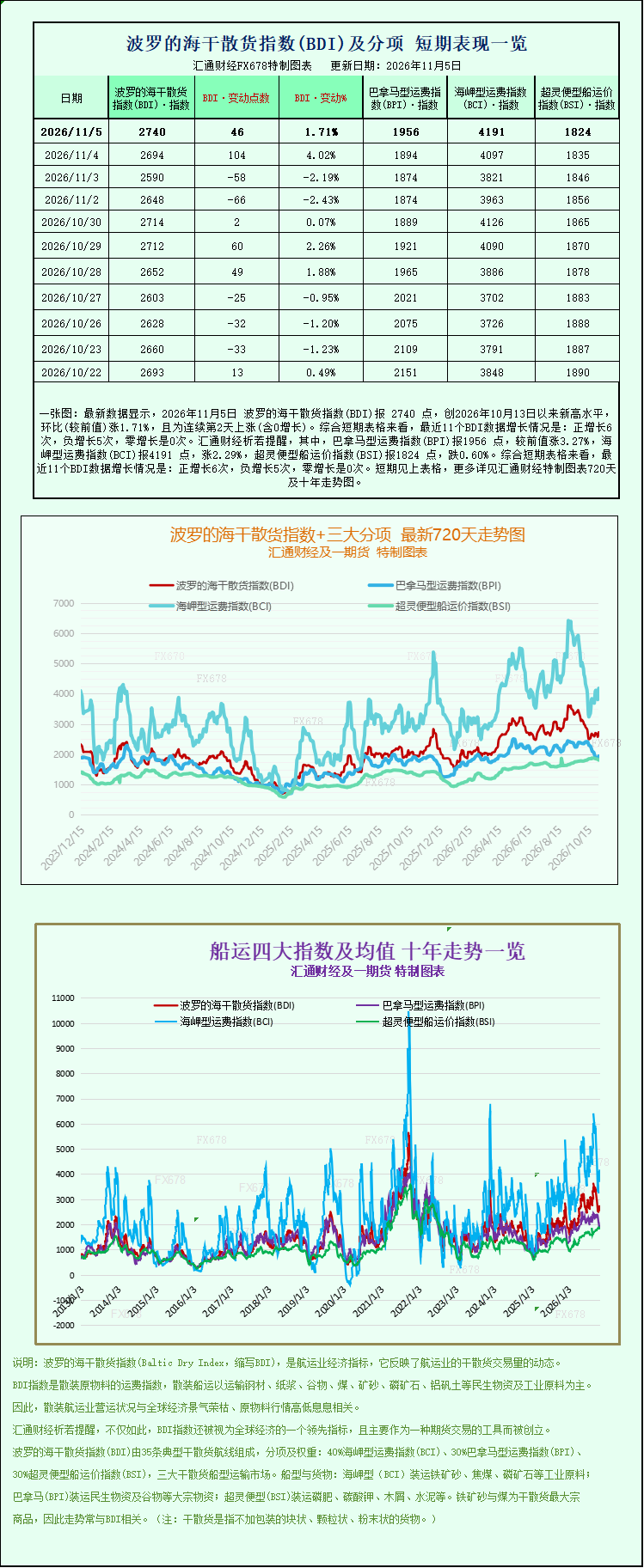 The Baltic Exchange's main dry bulk freight index continued its upward trend on Thursday, with strong rates for Capesize and Panamax vessels being the main drivers. The index has risen for the second consecutive trading day, indicating a significant improvement in market sentiment. The main index, which tracks rates for Capesize, Panamax, and Supramax vessels, rose 46 points, or 1.71%, to close at 2740 points, its highest level since October 13. Looking at the point structure, this round of gains was almost entirely driven by large and medium-sized vessels, while smaller vessels continued to weaken, showing a clear divergence within the index. The Capesize index rose 94 points, or 2.29%, to 4191 points, a near one-month high. Capesize vessels typically carry 150,000-ton dry bulk cargo, mainly iron ore and coal, and their average daily charter rate rose by $851 to $34,510. Based on current levels, charter rates for this vessel type have returned to the upper end of the range seen in early October, and shipowners' spot earnings have significantly recovered from the recent lows. Iron ore prices rose for the second consecutive trading day on Thursday, hitting a one-month high. A sharp rebound in the Chinese stock market, coupled with improved steel mill profits, boosted market sentiment. Capesize freight rates are highly sensitive to the pace of iron ore shipments; changes in cargo volume on long-haul routes from Brazil and Australia to China often translate into charter rates within a few trading days. The market is generally focused on spot inquiries on major routes such as Western Australia to Qingdao and Tubarão to Qingdao, as the pace of transactions for these cargoes directly determines the speed at which large vessel capacity is absorbed. The Panamax index rose 62 points, or 3.27%, to 1956 points, its highest level in over a week. Panamax vessels typically carry 60,000 to 70,000 tons of coal or grain, and the average daily charter rate rose by $554 to $17,603. These vessel types primarily serve transatlantic and Pacific routes, as well as coal routes from Indonesia to China. Their cargo types are relatively diversified, making them less affected by fluctuations in the prices of single commodities than Capesize vessels, but they are more sensitive to changes in the seasonal rhythm of grain export. The Supramax index, however, bucked the trend, falling 11 points, a 0.60% decrease, to 1824 points, continuing its downward trend and reaching its lowest level since October 12th. This vessel type mainly carries small-volume bulk cargoes such as steel, nickel ore, fertilizer, and cement, with scattered route distribution, making it more responsive to changes in regional industrial demand. Its continuously declining freight rates also reflect, to some extent, that the maritime demand for non-mainstream bulk commodities has not yet recovered in tandem. In terms of methodology, the Baltic Dry Index is composed of a weighted average of Capesize, Panamax, and Supramax components, with Capesize accounting for approximately 40%, and Panamax and Supramax each accounting for approximately 30%. Therefore, directional changes in Capesize charter rates have the most significant impact on the composite index, while fluctuations in smaller vessel types are usually partially diluted. This explains why the composite index still recorded a 1.71% increase despite the weakening of Supramax vessels. From both the supply and demand sides, recent freight rate support mainly comes from two aspects: first, the rebound in iron ore prices has eased shippers' wait-and-see sentiment, leading to an increase in spot inquiries; second, there has been no significant easing in shipping capacity supply, with some routes still experiencing port congestion and detours, resulting in actual available capacity being slightly lower than the on-paper figures. Meanwhile, the shipping schedule for South American grain exports and policy changes in Indonesian coal exports are also marginally affecting the freight rate performance of medium-sized vessels. It should be noted that the dry bulk market is quite sensitive to seasonal factors and changes in downstream demand; a single day or several days of continuous increases does not necessarily indicate a trend reversal. Whether the short-term upward trend can continue depends on the sustainability of subsequent iron ore shipments, the recovery of steel profits, and the actual implementation of demand related to China's real estate and infrastructure sectors. If iron ore shipments experience a temporary decline, downward pressure on Capesize vessel charter rates may emerge relatively quickly; conversely, if cargo volume continues to increase while capacity replenishment remains limited, freight rates still have room to rise further. Overall, the upward structure of the index on that day was biased towards "large vessels driving growth, smaller vessels under pressure," reflecting that this round of improvement is more concentrated on mainstream bulk commodities such as iron ore and coal, rather than a comprehensive recovery in demand. Market participants remain divided on the future trend, with most viewing it as a phase of correction within a range, rather than the start of a new upward cycle.
- Risk Warning and Disclaimer
- The market involves risk, and trading may not be suitable for all investors. This article is for reference only and does not constitute personal investment advice, nor does it take into account certain users’ specific investment objectives, financial situation, or other needs. Any investment decisions made based on this information are at your own risk.