What do the US midterm elections mean for policy and markets?
2026-11-06 01:32:28
On Wednesday (November 5), U.S. Vice President Vance posted a tweet explaining why the Republicans suffered such a crushing defeat on Tuesday, directly blaming the war with Iran.  The chart below shows the intraday movement of Brent crude oil futures for the near month: within an hour of the tweet being posted, the price fell by nearly 7%. This drop in oil prices drove everything else yesterday, including the strong performance of the S&P 500—which closed up 1.6% on the day.
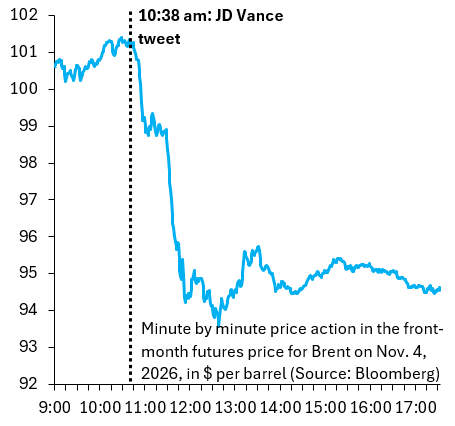 The reason Brent crude fell so sharply is that the market (quite reasonably) believes the tweet indicates an increasing probability of a swift end to the war with Iran. That said, Brent near-month futures are still nearly 60% higher than at the beginning of 2026, meaning the market still prices a significant risk premium. As always, the market is struggling to sift through the noise for a signal. Does Vance's tweet signal a substantial shift in the Iranian situation and eliminate the tail risk of a "perpetual war" that everyone has been worried about? Or is the president going to bomb Iran anyway, perhaps to divert attention from the disastrous midterm elections? This article is divided into two parts. I'll first outline what I believe are the four most important policy implications, and then discuss what this means for the market. Let's start with the four policy implications: Iran: In my view, Vance's tweet has effectively ended the war with Iran. The midterm elections mark a change of leadership within the Trump administration, and the most obvious successor has now been identified. This doesn't mean there won't be a brief airstrike—rumors suggest it could happen as early as this weekend. But if it actually happens, it will be a performance, designed to allow Trump to declare victory and end the war. In other words, it's all about saving face; the real work of funding appeasement of Iran and securing the Strait of Hormuz will be left to regional countries.
 Political polarization: Democratic Socialists of America (DSA) see themselves as big winners in the midterm elections and will pull the Democratic Party to the left. Admittedly, a move towards the center would be better as the Democratic Party prepares for the 2028 presidential election, but a quick recollection of the Biden administration—where progressives wielded significant influence on everything from COVID-19 stimulus to immigration—shows they will have considerable influence. Political polarization will intensify further, making any compromises aimed at curbing runaway fiscal policy even more difficult. As I said yesterday, the U.S. is firmly on the path to yield curve control.
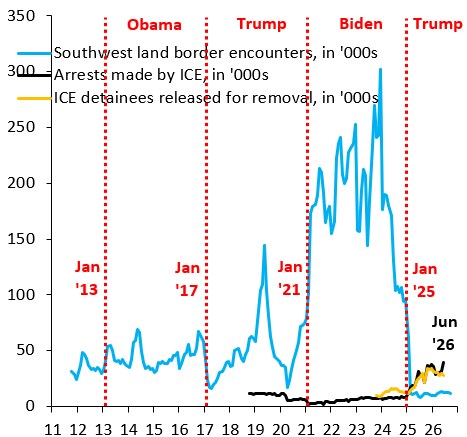 Immigration: The blue line in the chart above shows the number of people crossing the border during different administrations, while the black and orange lines represent the number of arrests and deportations by ICE, respectively. There's no doubt that immigration enforcement needs to change, and I believe it will. This is also what Vance mentioned in his tweet. But the fundamental challenge is: what if an administration effectively opens the border? Is it possible to retroactively reverse this policy—that is, deport these people—or is this not supported by public opinion, and if so, the probability of a new wave of immigration in the future increases? This is perhaps the biggest single policy challenge facing the United States and Europe.
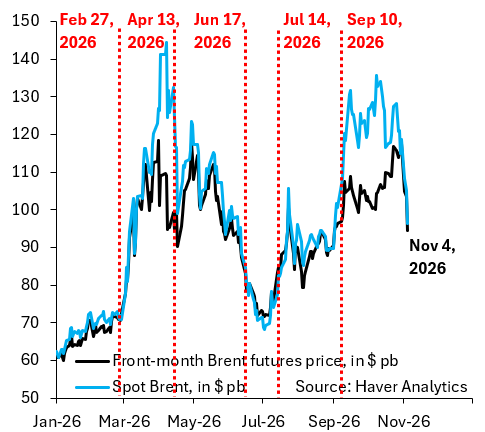
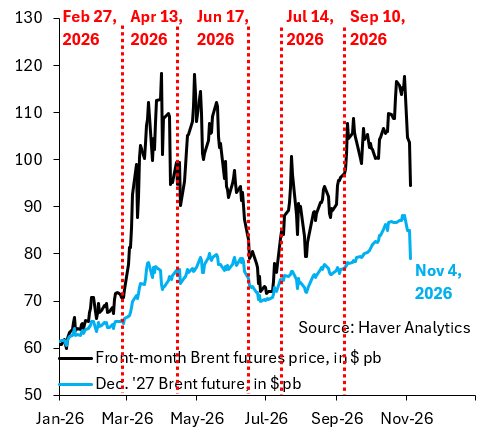
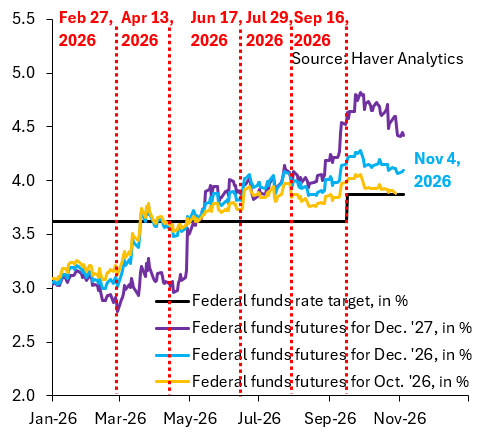 Federal Reserve: In my view, Trump's crushing defeat has changed the Fed's dynamics. Recall that after Kevin Warsh took over as chairman, many who had previously held hawkish views were quite willing to cut rates in 2025 under Powell, when inflation was significantly above target. In my opinion, this hawkish stance will now largely fade because "going against Trump" is no longer as appealing. After all, voters have already done just that. Therefore, I believe that the rate hikes currently priced in by the market will fail, especially in 2027. Here are what I believe are the key implications for the market: Brent still has downside: I value Brent at $90 per barrel, therefore oil prices still have downside, as shown by the black line in the chart below. This week's sharp drop in Brent reminds us that last week's high oil prices were entirely a risk premium, not, as some have suggested, due to supply constraints or demand driven by hoarding. Risk premiums can compress instantly, which is exactly what we are seeing now.
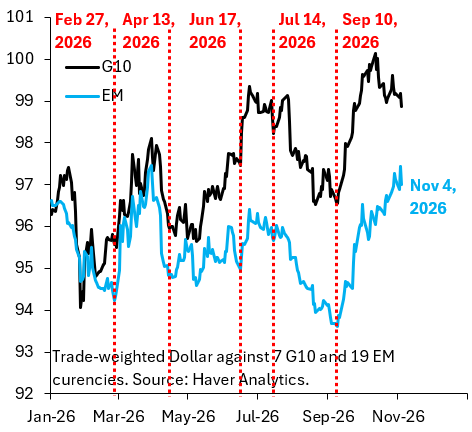
 The dollar is weakening again: the war and the resulting surge in oil prices had boosted the dollar, but that was just a temporary phase. Our underlying equilibrium is a weaker dollar, and we are now returning to that state. The chart below shows that there is still much work to be done in this regard. The dollar has been flat against emerging market currencies (blue line) this year, but has risen significantly against other G10 currencies (black line). There is still considerable downside potential.
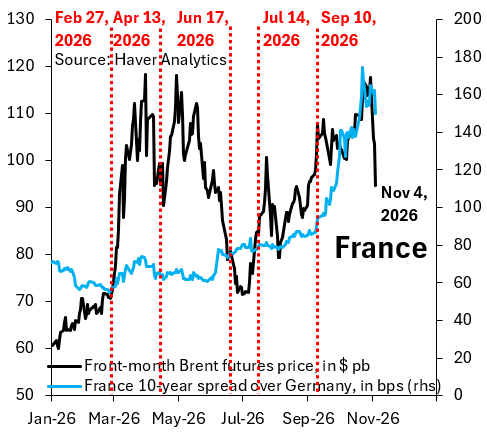
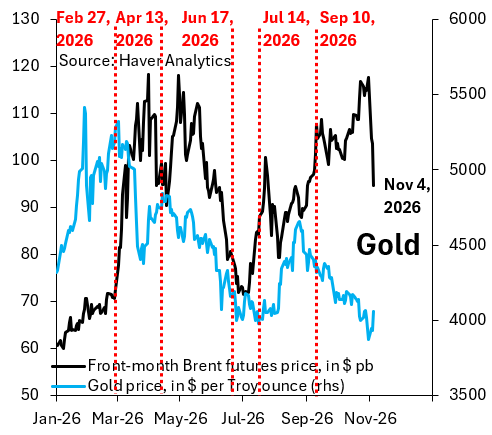
 France Gains Breathing Room: I have consistently emphasized that the recent sell-off in French government bonds was driven by the surge in oil prices following the attack on the east-west pipeline on September 10th, as shown in the chart below. The drop in oil prices has given France some breathing room.
 Depreciation is back: As shown by the blue line in the chart below, gold performed well yesterday. Vance's tweet suggests that "perpetual war" is no longer an option, implying a further decline in oil prices in the longer term. This is good news for gold and other precious metals—they have been hit whenever oil prices surge this year.
The chart below shows the intraday movement of Brent crude oil futures for the near month: within an hour of the tweet being posted, the price fell by nearly 7%. This drop in oil prices drove everything else yesterday, including the strong performance of the S&P 500—which closed up 1.6% on the day. The reason Brent crude fell so sharply is that the market (quite reasonably) believes the tweet indicates an increasing probability of a swift end to the war with Iran. That said, Brent near-month futures are still nearly 60% higher than at the beginning of 2026, meaning the market still prices a significant risk premium. As always, the market is struggling to sift through the noise for a signal. Does Vance's tweet signal a substantial shift in the Iranian situation and eliminate the tail risk of a "perpetual war" that everyone has been worried about? Or is the president going to bomb Iran anyway, perhaps to divert attention from the disastrous midterm elections? This article is divided into two parts. I'll first outline what I believe are the four most important policy implications, and then discuss what this means for the market. Let's start with the four policy implications: Iran: In my view, Vance's tweet has effectively ended the war with Iran. The midterm elections mark a change of leadership within the Trump administration, and the most obvious successor has now been identified. This doesn't mean there won't be a brief airstrike—rumors suggest it could happen as early as this weekend. But if it actually happens, it will be a performance, designed to allow Trump to declare victory and end the war. In other words, it's all about saving face; the real work of funding appeasement of Iran and securing the Strait of Hormuz will be left to regional countries. Political polarization: Democratic Socialists of America (DSA) see themselves as big winners in the midterm elections and will pull the Democratic Party to the left. Admittedly, a move towards the center would be better as the Democratic Party prepares for the 2028 presidential election, but a quick recollection of the Biden administration—where progressives wielded significant influence on everything from COVID-19 stimulus to immigration—shows they will have considerable influence. Political polarization will intensify further, making any compromises aimed at curbing runaway fiscal policy even more difficult. As I said yesterday, the U.S. is firmly on the path to yield curve control. Immigration: The blue line in the chart above shows the number of people crossing the border during different administrations, while the black and orange lines represent the number of arrests and deportations by ICE, respectively. There's no doubt that immigration enforcement needs to change, and I believe it will. This is also what Vance mentioned in his tweet. But the fundamental challenge is: what if an administration effectively opens the border? Is it possible to retroactively reverse this policy—that is, deport these people—or is this not supported by public opinion, and if so, the probability of a new wave of immigration in the future increases? This is perhaps the biggest single policy challenge facing the United States and Europe. Federal Reserve: In my view, Trump's crushing defeat has changed the Fed's dynamics. Recall that after Kevin Warsh took over as chairman, many who had previously held hawkish views were quite willing to cut rates in 2025 under Powell, when inflation was significantly above target. In my opinion, this hawkish stance will now largely fade because "going against Trump" is no longer as appealing. After all, voters have already done just that. Therefore, I believe that the rate hikes currently priced in by the market will fail, especially in 2027. Here are what I believe are the key implications for the market: Brent still has downside: I value Brent at $90 per barrel, therefore oil prices still have downside, as shown by the black line in the chart below. This week's sharp drop in Brent reminds us that last week's high oil prices were entirely a risk premium, not, as some have suggested, due to supply constraints or demand driven by hoarding. Risk premiums can compress instantly, which is exactly what we are seeing now. The dollar is weakening again: the war and the resulting surge in oil prices had boosted the dollar, but that was just a temporary phase. Our underlying equilibrium is a weaker dollar, and we are now returning to that state. The chart below shows that there is still much work to be done in this regard. The dollar has been flat against emerging market currencies (blue line) this year, but has risen significantly against other G10 currencies (black line). There is still considerable downside potential. France Gains Breathing Room: I have consistently emphasized that the recent sell-off in French government bonds was driven by the surge in oil prices following the attack on the east-west pipeline on September 10th, as shown in the chart below. The drop in oil prices has given France some breathing room. Depreciation is back: As shown by the blue line in the chart below, gold performed well yesterday. Vance's tweet suggests that "perpetual war" is no longer an option, implying a further decline in oil prices in the longer term. This is good news for gold and other precious metals—they have been hit whenever oil prices surge this year.
- Risk Warning and Disclaimer
- The market involves risk, and trading may not be suitable for all investors. This article is for reference only and does not constitute personal investment advice, nor does it take into account certain users’ specific investment objectives, financial situation, or other needs. Any investment decisions made based on this information are at your own risk.