Gold Trading Alert: With the Non-Farm Payrolls report approaching, can gold prices surge towards $4200?
2026-11-06 07:28:26
Global gold markets saw a significant rebound on Thursday, with spot gold briefly surging to $4,146.77 per ounce, its highest level in over two weeks, before ultimately closing up about 0.7% at around $4,088.80. Gold futures also strengthened, with the December contract closing up 1% at $4,113.50. Just a few days ago, gold prices were hovering around $3,869, meaning the week's rebound has exceeded $250, with Wednesday's single-day gain approaching 3.4%, the largest single-day increase since mid-August. Market sentiment has shifted from pessimism to cautious optimism, driven by a confluence of factors. On Friday (November 6th) in Asian trading, spot gold traded in a narrow range, with market focus shifting to the US October non-farm payroll report due later in the day. 
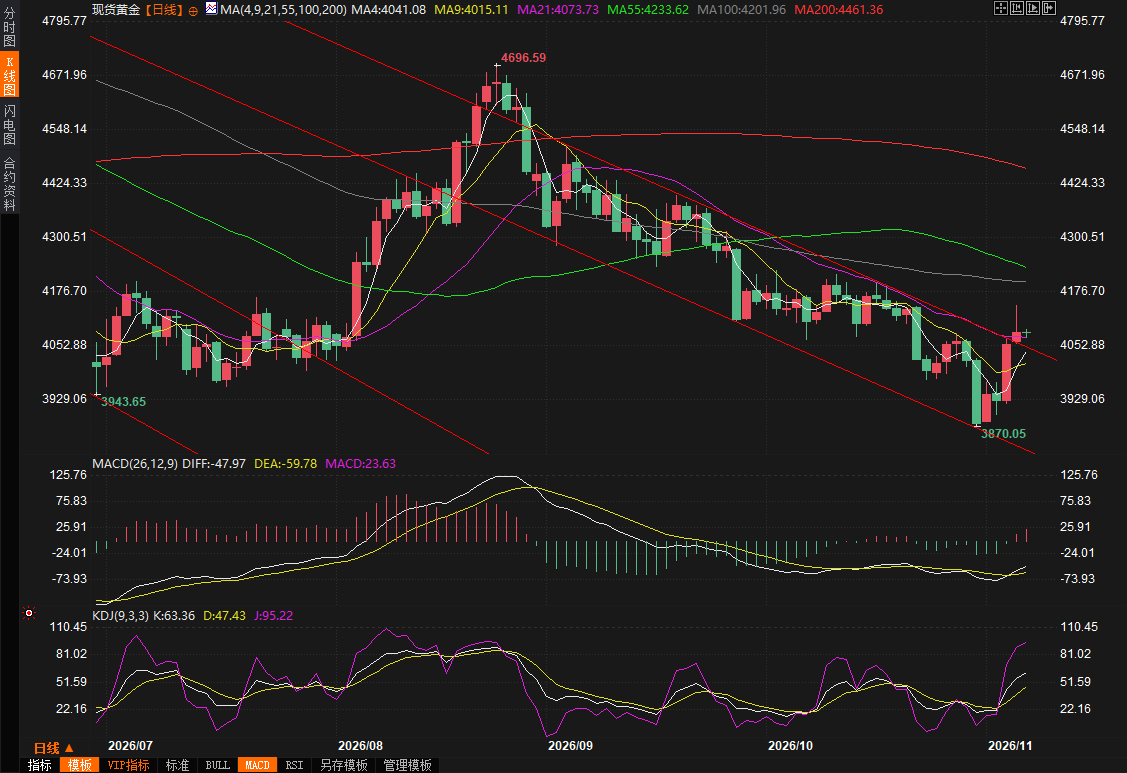 (Spot gold daily chart, source: FX678) At 07:24 Beijing time, spot gold is currently trading at $4084.20 per ounce.
The dollar and yields both weakened this week, providing direct support for gold.
The direct driving force behind this round of price increases comes from the simultaneous decline in the US dollar and US Treasury yields. The US dollar index is hovering at its lowest level since September 30, meaning that gold priced in US dollars has become cheaper for investors holding other currencies. At the same time, the 10-year US Treasury yield has fallen to a near two-month low, significantly reducing the opportunity cost of holding non-interest-bearing gold. David Meger, director of precious metals trading at High Ridge Futures, points out that the market doesn't believe that expectations of interest rate hikes have completely disappeared, but rather that with weakening energy prices and easing inflation concerns, the necessity for future rate hikes may have decreased. This subtle shift in expectations is enough to give gold some breathing room in the short term. Following Wednesday's nearly 9% plunge in oil prices, Brent crude remained below $100 per barrel, further reinforcing the narrative that "inflationary pressures may be temporarily easing."Federal Reserve officials signal a gradual approach, but uncertainty remains regarding the path of interest rate hikes.
The rise in gold prices was echoed by the latest statements from Federal Reserve officials. Cleveland Fed President Hammarck and Richmond Fed President Barkin both publicly supported a "gradual rate hike" on Thursday. Hammarck emphasized that monetary policy needs to shift to a restrictive stance to bring inflation back to the 2% target in a timely manner, but he prefers to achieve this through more frequent and smaller adjustments to reduce the impact on households, businesses, and financial markets. Barkin bluntly stated that inflation is "too high" and remains high, making the policy implications quite clear. The Fed kept interest rates in the 3.75%-4.00% range last week. The market had previously pushed the probability of a December rate hike to over 80%, but it has now fallen back to around 66%. The statements from the two officials made the market realize that even if tightening continues, the pace may be more moderate than previously expected. This is a relatively favorable signal for gold—rising interest rates increase the opportunity cost of holding gold, but if the pace of rate hikes slows, the pressure on gold will be correspondingly reduced.Midterm elections are altering political and economic expectations; oil prices and AI investment are key variables.
A deeper driving force stemmed from the US midterm election results. The Democrats regained control of Congress, and the market quickly adjusted its expectations regarding the situation in Iran and the prospects for artificial intelligence investment. Oil prices plummeted on Wednesday, largely because investors bet that a shift in political direction might reduce the risk of further escalation of the US-Iran conflict. However, oil prices rebounded on Thursday, indicating that market optimism about a "quick end to the war" had cooled. Meanwhile, technology stocks, especially those related to artificial intelligence, suffered heavy losses. The Nasdaq index corrected sharply, with the market concerned that data center construction might slow due to local opposition and tighter approval processes, thus impacting capital expenditure and economic growth momentum over the next year or two. Institutions such as Evercore ISI pointed out that a slowdown in AI investment could reduce the risk of an overheated economy, thereby reducing the need for further significant interest rate hikes by the Federal Reserve. TD Securities predicted that if the situation in Iran deteriorates or AI investment slows significantly, the Federal Reserve may no longer need to tighten rates after a cumulative 50 basis point increase early next year. These changes all point to one direction: short-term inflationary pressures may ease due to oil price volatility and a slowdown in investment, but the long-term path remains highly uncertain. Gold, as an asset that simultaneously hedges against inflation, geopolitical factors, and currency devaluation, often attracts capital in such ambiguous areas.Non-farm payroll data and Iran's nuclear proposal became the focus over the weekend.
Investors are currently focused on Friday's US non-farm payrolls report. The market widely expects approximately 65,000 jobs to be added in October, with the unemployment rate remaining around 4.2%. Initial jobless claims fell to 189,000 last week, matching the lowest level in 57 years, indicating a resilient labor market. If the data is significantly weak, it could further weaken expectations of a December rate hike, providing additional upward momentum for gold; conversely, strong data could reinforce the logic of continued tightening by the Federal Reserve, putting downward pressure on gold prices. Meanwhile, news that Iran submitted a nuclear proposal to the US through Qatar is also noteworthy. Iran insists on meeting seven conditions (including the lifting of sanctions, unfreezing assets, and war reparations) before formal discussions, while the US emphasizes that the nuclear issue must be part of the initial negotiations. If the two sides can begin substantive dialogue after the election, oil prices and geopolitical premiums may further decline; if negotiations stall or conflict reignites, safe-haven demand for gold will quickly return.Market Outlook: The short-term rebound is expected to continue, but confirmation above $4100 is still needed.
In summary, this round of gold price rebound is not driven by a single factor, but rather by a combination of factors including a weakening dollar, declining yields, oil price volatility, the Federal Reserve's gradual statements, and changes in political expectations. Technically, gold prices have quickly recovered from their one-year lows and have briefly climbed back above the $4,100 mark, indicating a significant recovery in market sentiment. If Friday's non-farm payroll data falls short of expectations, or if there are positive signals from the Iran nuclear negotiations, gold prices could further test the $4,150-$4,200 range, or even challenge higher levels. However, risks remain. Strong employment data, a continued rebound in oil prices, or more hawkish signals from Federal Reserve officials could put renewed pressure on gold prices. Currently, the market is pricing in a December rate hike at around 66%, indicating that policy uncertainty is far from over. Gold's performance above $4,000 will depend on the dynamic balance between inflation expectations, real interest rates, and geopolitical risks. For investors, short-term focus should be on the volatility opportunities presented by non-farm payroll data and weekend news related to Iran, while medium-term attention should be paid to the Federal Reserve's policy path and the evolving situation in the Middle East. Gold has staged a decent rebound from its deep correction, but a true trend confirmation still requires more fundamental clues to emerge. (Spot gold daily chart, source: FX678) At 07:24 Beijing time, spot gold is currently trading at $4084.20 per ounce.
- Risk Warning and Disclaimer
- The market involves risk, and trading may not be suitable for all investors. This article is for reference only and does not constitute personal investment advice, nor does it take into account certain users’ specific investment objectives, financial situation, or other needs. Any investment decisions made based on this information are at your own risk.