Oil prices hover around $90: Strait transit risks and diplomatic progress become key variables.
2026-11-06 16:22:27
On Friday (November 6), West Texas Intermediate (WTI) crude oil rose to $92.50 per barrel during the European session. Crude oil prices rose as ongoing Middle East conflict and lingering supply concerns continued to provide a floor for the market. The rebound in oil prices followed a surge in attacks on tankers in the Persian Gulf and the Strait of Hormuz—key maritime routes for most Middle Eastern oil exports—rekindling concerns about regional supply disruptions. 
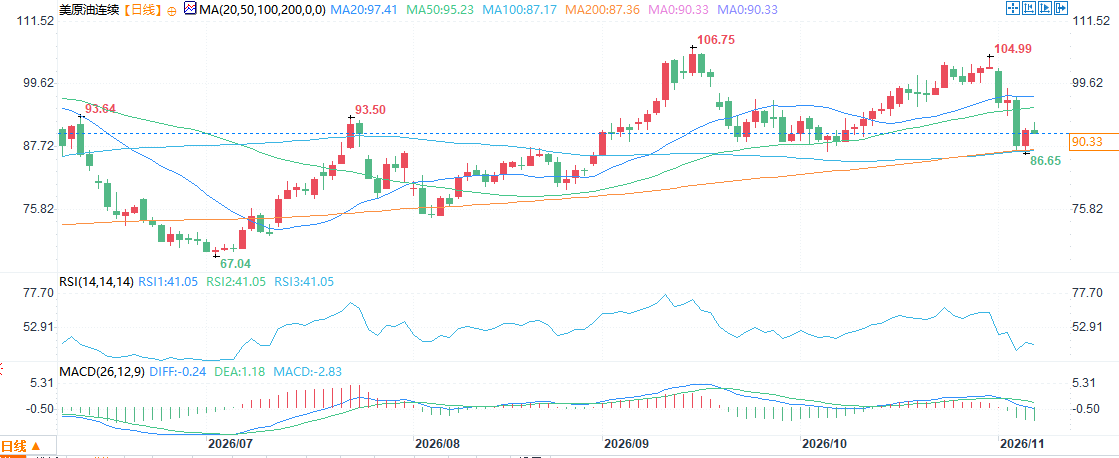 (US crude oil futures daily chart, source: FX678) At 16:18 Beijing time, US crude oil futures were trading at $90.30 per barrel.
Technical corrections and unresolved fundamentals: Transit risks support buying on pullbacks
Some institutions, citing KCM's chief analyst Tim Waterer, characterized Friday's price action as a "technical correction" following the sharp sell-off triggered by the US election. However, he emphasized that fundamental issues remain unresolved, noting that despite the Democratic victory, the transit risk through the Strait of Hormuz persists. Waterer stated, "Until a safer and cheaper reliable path through the Gulf emerges, oil prices are likely to find support on pullbacks and are vulnerable to sharp fluctuations from any escalating news." This assessment implies that Friday's rebound was not a fundamental shift, but rather a technical correction after being oversold; however, the existence of transit risk limits the downside for oil prices, and any new escalating news could trigger a sharp upward move.Weekly decline of over 11%: Election results trigger expectations of easing tensions
However, oil prices are still expected to fall by more than 11% this week. This broader decline stems from market expectations that the conflict with Iran may ease following the election defeat of Trump's party. Earlier this week, oil prices plummeted as the US midterm election results gave Democrats control of both the Senate and the House of Representatives—the market held onto hope for a diplomatic solution to the nine-month-long US-Israel-Iran conflict. The weekly drop is priced in "expectations of political détente," while the daily rebound is priced in "real supply threats," and the coexistence of both is the current tug-of-war characteristic of the oil market.The Strait of Hormuz incident: oil tanker and tugboat fires highlight the vulnerability of the passage.
Analysts have warned of new supply-side risks, noting that the Iranian Revolutionary Guard reported a maritime incident at this crucial chokepoint. According to the firm, the Revolutionary Guard stated that "two oil tankers and a tugboat caught fire after allegedly attempting to pass through the Strait of Hormuz on an unauthorized route," highlighting the vulnerability of traffic through this most critical global oil shipping corridor. This detail is noteworthy: the incident stemmed from an "unauthorized route," rather than a simple attack—meaning that passage through the strait is subject not only to security risks but also to Iran's control over the waterway. This combination increases the probability of supply disruptions compared to a purely geopolitical conflict scenario.in conclusion
The initial rebound in US crude oil futures prices was supported by the ongoing Middle East conflict and the tanker attacks in the Strait of Hormuz. Analysts characterized Friday's price action as a technical correction following the election sell-off, emphasizing that the fundamentals remain unresolved—as long as the risk of transit through the Gulf persists, oil prices will find support during pullbacks and remain sensitive to escalating news. However, a weekly decline of over 11% is still expected, as the market anticipates a possible easing of tensions with Iran following a Democratic victory in both houses of Congress. The Iranian Revolutionary Guard stated that two oil tankers and a tugboat caught fire after traveling on an unauthorized route, highlighting the dual constraints on passage through the Strait of Hormuz, including security risks and navigational restrictions. Short-term direction depends on the tug-of-war between expectations of political easing and supply threats—the coexistence of a sharp weekly decline and a daily rebound directly reflects this tug-of-war. (US crude oil futures daily chart, source: FX678) At 16:18 Beijing time, US crude oil futures were trading at $90.30 per barrel.
- Risk Warning and Disclaimer
- The market involves risk, and trading may not be suitable for all investors. This article is for reference only and does not constitute personal investment advice, nor does it take into account certain users’ specific investment objectives, financial situation, or other needs. Any investment decisions made based on this information are at your own risk.