Oil prices rebounded in the short term: Ship attacks increased risk, and the congressional defense spending ceiling suppressed long-term gains.
2026-11-06 15:54:27
On Friday (November 6th) during the Asian and European sessions, yesterday's article indicated that crude oil prices had bottomed out and subsequently rebounded, accumulating a rebound of over 3% from last night to today. Following the US midterm elections, the Strait of Hormuz has once again seen attacks on merchant ships. Iran reported that multiple oil tankers and tugboats struck mines and caught fire, and the British Maritime Authority also confirmed that an oil tanker was attacked by unidentified ammunition in the waters north of Qatar. These repeated reports of ship attacks have repeatedly disrupted crude oil prices. 
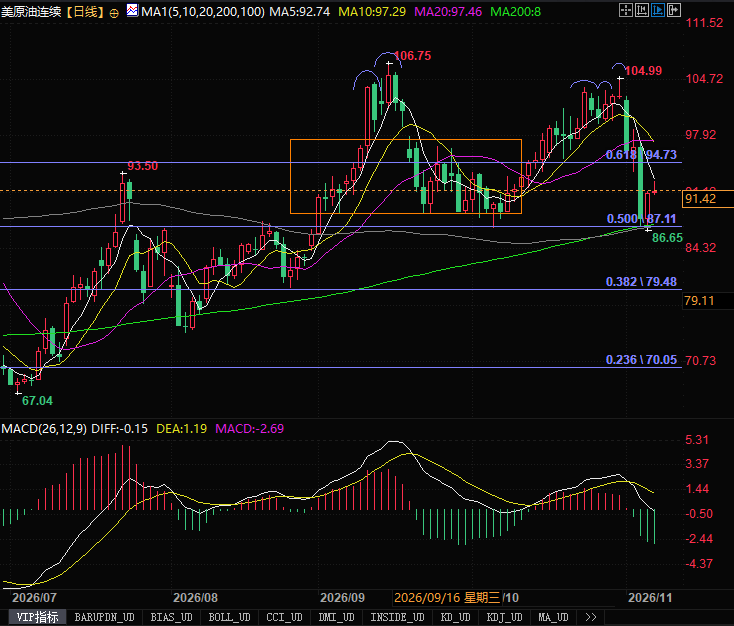 (WTI crude oil futures daily chart, source: EasyForex) At 15:52 Beijing time, WTI crude oil futures are currently trading at $91.24 per barrel.
Attacks on ships in the Straits resurge, Saudi Arabia's price differential confirms high shipping risks.
The Iranian Revolutionary Guard reported that two oil tankers caught fire in the Strait of Hormuz. The two tankers, one operating illegally in the eastern part of the Strait and the other in the Strait itself, were struck by mines and became stranded in the waters. Meanwhile, a key signal is Saudi Arabia's differentiated pricing: Saudi Arabia offers discounts on crude oil to Asian buyers, while shipping costs to the United States remain high. This price difference clearly indicates that the risks of navigating the strait have not truly dissipated, and the additional costs of insurance and detours continue to increase pressure on physical cargoes. However, the persistently high shipping risks do not necessarily mean that the United States will compromise with Iran or quickly sign a ceasefire agreement.Trump's strategic logic: characterizing it as an occupation operation, urgently needing results to conclude the campaign.
Trump does not define the current conflict as a traditional war, but rather as an "occupation" operation. The US narrative maintains that the overall casualties in the standoff are minimal, and that the naval blockade and strikes against Iran have severely damaged Iran's oil export capacity, bringing exports to a near standstill, essentially crippling it. Trump also claims that the military expenditure for this operation against Iran has been offset by revenue from Venezuelan energy exports, making the financial pressure manageable. Currently, the Strait of Hormuz continues to allow a stable flow of large quantities of oil, and the supply has not been completely interrupted. However, given Trump's political ambitions—the Republican Party's crushing defeat in the midterm elections—he urgently needs tangible military achievements to solidify his ruling authority and is unlikely to hastily sign an agreement to conclude the conflict. The Pentagon has completed its troop deployment, with over ten ships and thousands of personnel on standby, ready to launch short, intensive strikes against Iranian energy facilities, nuclear facilities, and missile and drone arsenals at any time, maintaining a state of encirclement without direct attack.Major constraint: With only two months left in the window for congressional elections, the approval of military spending remains unresolved.
Trump's military options face a hard time constraint. The newly elected Democratic-controlled House and Senate will officially take office in January of the following year, holding the power to approve defense budgets and oversee war. With less than two months between now and the new members' inauguration, the key issue is whether the additional $350 billion in special funding for the Iran conflict can be approved smoothly. Hedges' public speech at the Department of War today also urged Congress to expedite the approval of this funding. If subsequent budgets fail to materialize, the sustainability of large-scale US airstrikes and naval blockades will rapidly decline, passively shrinking operational capabilities. To offset domestic energy inflation pressures from the Middle East situation, Trump is bypassing congressional oversight and pushing forward with a plan to repatriate Russian diesel to the US, thereby stabilizing domestic fuel prices and reducing the impact of the Middle East conflict on domestic inflation. Russia has clarified that the reports of tankers being forced to change course are false, and this energy procurement route is still underway.Conflict spillover: Houthi counterattacks put pressure on Gulf aviation infrastructure.
The US-Iran standoff is spilling over, with tensions escalating in the Red Sea and Yemen. The Houthi rebels reported 61 airstrikes against Yemen in the past 24 hours, causing numerous civilian casualties; meanwhile, the Houthis continue their counterattacks, attacking airports within Saudi Arabia, including King Fahd Airport in Dammam. The aviation hubs built by Gulf states with hundreds of billions of dollars are facing ongoing security challenges. Besides Oman, airports in several Gulf states have been attacked, with some experiencing declining passenger traffic, delays in expansion projects, and even halts. This spread of regional security risks is further amplifying short-term fluctuations in oil prices.Summary of institutional views: Short-term rebound has support, long-term conflict ceiling is clear.
In the short term, the market quickly retraced nearly $20/barrel of geopolitical risk premium, primarily based on bets that a Democratic-led Congress would force the US to cease hostilities. However, the recurrence of the ship attack, coupled with Trump's publicly assertive signals, reignited expectations of military escalation, creating a window for a price rebound. Multiple institutions believe that further downside for oil prices is limited: firstly, expectations of geopolitical easing could be disproven by unforeseen circumstances; secondly, low oil inventories mean that restocking demand from traders will provide bottom support once the situation eases marginally. Bank of America Securities further warns of chain risks: if oil prices continue to rise over the next 3-6 months, energy inflation will push up two-year interest rate swaps, reducing the Fed's concerns about raising rates, and the resulting energy price increases will further transmit to the global interest rate market, amplifying financial market volatility. In the medium to long term, institutions such as FGE believe that the chances of a short-term peace agreement between the US and Iran are slim. Iran believes that Trump's election defeat and weakened political position have led to tough negotiating demands; the US insists on achieving military results before negotiating, resulting in significant differences between the two sides. However, the conflict has a clear ceiling. After the Democratic Congress takes office, military spending approvals will be tightened, and the Pentagon will find it difficult to obtain continuous funding to support long-term, high-intensity operations. The intensity of the standoff will gradually cool down, shipping risks in the Taiwan Strait will steadily decline, geopolitical premiums will not remain high, and oil prices will slowly return to supply and demand fundamentals.Summary and Technical Analysis:
In the short term, the Strait of Hormuz attack on ships, coupled with the window of opportunity for Trump's military action, has escalated geopolitical risks, leading to a temporary rebound in oil prices. Low inventory levels have supported the market, limiting downside potential and raising the central level of price fluctuations. In the medium term, before the congressional elections in January of the following year, military frictions will continue, but budget constraints will limit large-scale, protracted warfare, resulting in a stalemate between the US and Iran. Oil prices will fluctuate widely at high levels, and the geopolitical premium will slowly dissipate. In the long term, after the new Democratic Congress takes office, Congress will tighten military spending approvals, the intensity of confrontation will decrease, shipping in the Strait of Hormuz will continue to recover, geopolitical disturbances will take a back seat, and oil prices will gradually decline along with supply and demand. However, the market often directly reflects long-term expectations. While short-term geopolitical disturbances in the Strait of Hormuz drive oil price rebounds, congressional fiscal constraints will limit the scope of conflict, and the geopolitical premium will eventually gradually subside, leading to a final decline in oil prices. Technical Analysis: WTI oil prices fell sharply before rebounding, but the overall trend remains bearish. The area around 92.3 is a key resistance level, which is also the 5-day moving average and the previous trading range with high volume. Support is around 87.11. (WTI crude oil futures daily chart, source: EasyForex) At 15:52 Beijing time, WTI crude oil futures are currently trading at $91.24 per barrel.
- Risk Warning and Disclaimer
- The market involves risk, and trading may not be suitable for all investors. This article is for reference only and does not constitute personal investment advice, nor does it take into account certain users’ specific investment objectives, financial situation, or other needs. Any investment decisions made based on this information are at your own risk.