Frequent incidents in the Gulf region, coupled with EIA inventory reductions, have led to a reassessment of risk premiums in the crude oil market.
2026-11-06 08:20:29
On Friday (November 6) during Asian trading hours, US crude oil futures continued their rebound, currently trading around $91 per barrel. US crude oil futures closed at $90.52 per barrel on Thursday, up 3.5%. This rebound follows Wednesday's drop of over 8% – when the US midterm election results raised hopes that a Democratic-controlled Congress would increase pressure on the Trump administration to end the conflict with Iran. 
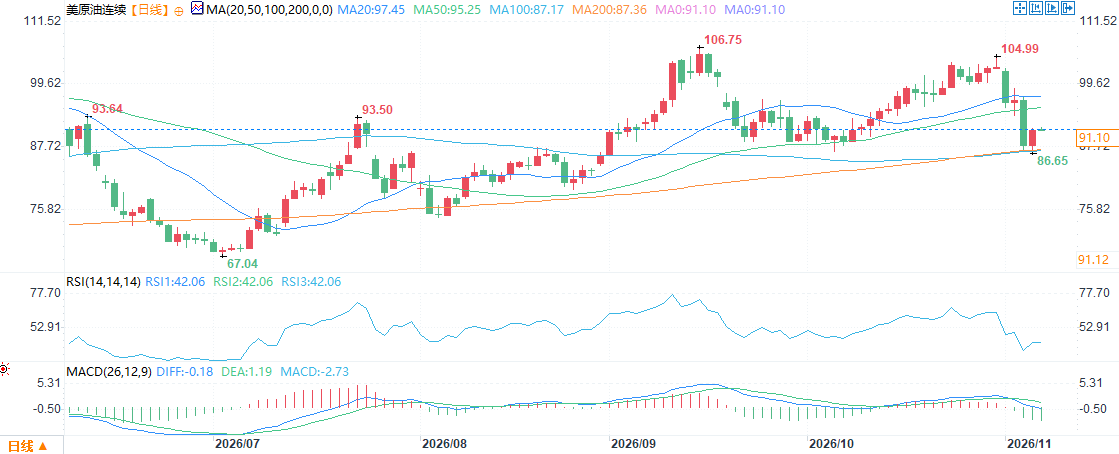 (US crude oil futures daily chart, source: FX678) At 8:13 Beijing time, US crude oil futures were trading at $91.07 per barrel.
Gulf shipping risks return: at least five vessels report incidents
On Wednesday, Senate Majority Leader Chuck Schumer clearly stated that Democrats would actively seek to end the current conflict, emphasizing Congress's ultimate control over government spending. This statement signaled a de-escalation of political tensions, leading the market to initially lower geopolitical premiums. However, by Thursday, traders' attention quickly refocused on the actual risks in oil shipping routes. According to the latest report from the UK's Maritime Trade Operations Office, at least five vessels have reported incidents in the Gulf since Sunday, involving navigational obstruction, suspicious approach, or security incidents. Meanwhile, the Iranian Foreign Minister held diplomatic talks with the foreign ministers of Saudi Arabia and Qatar to discuss ways to de-escalate regional tensions. While Wednesday's oil price increases partially squeezed out risk premiums due to easing expectations, Thursday's shipping incident reports immediately gave traders ample reason to re-include premiums. The recurring shipping risks mean that the uncertainty surrounding the Strait of Hormuz and related shipping lanes has not truly been eliminated; any new incidents could quickly push up freight and insurance costs, directly impacting crude oil prices. The market is therefore repeatedly weighing political de-escalation against real shipping threats, resulting in increased short-term volatility.Inventory reduction: Simultaneous declines in crude oil, gasoline, and distillate fuel prices provide support.
The U.S. Energy Information Administration's inventory report released on Wednesday showed that crude oil, gasoline, and distillate fuel inventories all declined in the week ending October 30, providing substantial support to the market. Crude oil inventory reduction reflects the continued resilience of refinery operations and export demand, gasoline inventory reduction suggests that end-user consumption has not weakened significantly, and distillate fuel inventory reduction echoes the seasonal demand for industrial and transportation fuels. The simultaneous contraction across all three product lines indicates that the supply-demand balance in the spot market has not shifted to a looser position as some had previously anticipated. These data were fully priced in after Wednesday's close, providing a floor for Thursday's opening. The combined effect of inventory reduction and Gulf shipping risks forms the fundamental basis for this price rebound: the former directly reflects the immediate tight balance in the North American spot market, while the latter affects the forward curve through geopolitical premium repricing. It is under this dual support that Wednesday's sell-off failed to effectively break below the $86 level, instead stabilizing above that area, creating conditions for subsequent technical buying.Institutional Views
Goldman Sachs' commodities research team recently raised its price forecasts for WTI crude oil futures. The average price forecast for December 2026 WTI crude oil futures was revised upwards from $81 to $94, and the average price forecast for 2027 was revised upwards from $73 to $78. Analysts, including Daan Struyven, pointed out that although Middle Eastern production has recovered as expected, downside risks to supply remain "substantial," supporting a large near-term risk premium. Increased market concerns about a potential escalation following the US midterm elections led the team to add a buffer of 1 million barrels per day of global supply disruptions in 2027 to its baseline scenario. The risk premium has risen to approximately $27 per barrel, explaining most of the oil price gains in October. Goldman Sachs believes that unless a sustainable diplomatic solution emerges, the risk premium is unlikely to recede quickly, and upside risks to prices remain dominant.in conclusion
WTI crude oil's decline on Wednesday priced in hopes of an end to the war following the midterm elections, while Thursday's rebound priced in the return of shipping risks in the Gulf – with reports of at least five vessels reporting accidents in the Gulf since Sunday, and Wednesday's inventory report showing declines in crude oil, gasoline, and distillate fuels, providing support for the rebound. (US crude oil futures daily chart, source: FX678) At 8:13 Beijing time, US crude oil futures were trading at $91.07 per barrel.
- Risk Warning and Disclaimer
- The market involves risk, and trading may not be suitable for all investors. This article is for reference only and does not constitute personal investment advice, nor does it take into account certain users’ specific investment objectives, financial situation, or other needs. Any investment decisions made based on this information are at your own risk.