Trump's threat to "destroy Iran" fueled safe-haven buying of the dollar.
2026-11-06 14:01:27
The US dollar index gained some upward momentum in Asian trading on Friday (November 6), recovering further from its lowest level since the end of September, reached the previous day. Currently trading around 101.80, the dollar index remains on a modest decline for the week as traders await key US monthly employment data for new momentum. The closely watched US non-farm payroll report is expected to show 65,000 new jobs added in October, up from a weaker 29,000 in the previous month; the unemployment rate is expected to remain unchanged at 4.2%. In addition, investors will be closely watching average hourly earnings, as wage growth pressures could significantly impact expectations for Federal Reserve policy and drive dollar demand. 
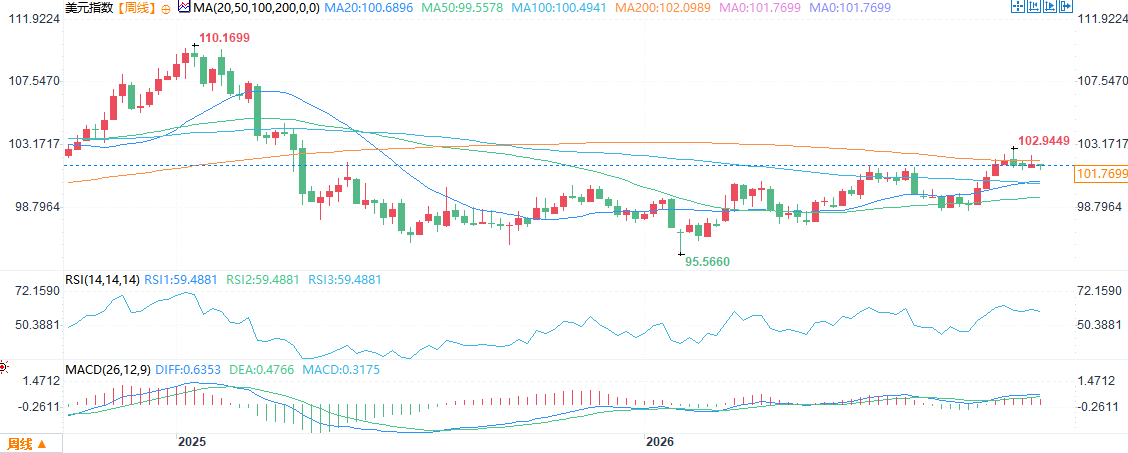 (US Dollar Index Daily Chart, Source: FX678) At 13:58 Beijing time, the US Dollar Index was at 101.75.
Yields and Interest Rate Hike Expectations: Oil Price Rebound Rekindles Inflation Concerns, with a 70% Probability of a December Hike.
Ahead of this crucial data release risk, the overnight surge in oil prices reignited inflation concerns. Meanwhile, traders are still pricing in a roughly 70% probability of another Fed rate hike in December. As a result, US Treasury yields have moderately recovered from the midweek decline triggered by the midterm elections, providing support for the dollar index. This transmission chain is clearly discernible: the oil price rebound fuels renewed inflation concerns, which in turn support rate hike expectations, which in turn drive a yield rebound, and the yield rebound further supports the dollar. These four factors are interconnected, forming a complete logical chain that explains why the dollar index was able to rebound for two consecutive days after hitting its late September lows.Geopolitical uncertainty: Trump says he might destroy Iran, but Schumer vows to push for an end to the conflict.
Geopolitical uncertainty has provided further justification for the safe-haven dollar's rise. Trump stated on Thursday that the U.S. might have to destroy the rest of Iran, adding that people would know quickly if he took action. Furthermore, the U.S. and Iran remain divided over Tehran's nuclear program and the Strait of Hormuz. However, Senate Majority Leader Schumer pledged on Wednesday to push for an end to the conflict with Iran. This division illustrates the two-way nature of geopolitical risks—Trump's tough stance supports safe-haven demand, while Schumer's push to end the conflict weakens that support. Therefore, it is prudent to wait for strong follow-through buying before confirming a recent bottom for the dollar index.Institutional Views
Bank of America FX strategist Alex Cohen stated that the dollar's depreciation path is likely to resume next year, but the risk lies in the dollar's ability to be supported or its resilience to last longer. A strong Democratic election performance has "already been priced in by the market," and a surprise Republican sweep of both houses could push up stocks, interest rates, and the dollar. Bank of America previously maintained a bullish stance on the dollar until the third quarter, expecting the Fed to still have room for further rate hikes to widen interest rate differentials. The current view emphasizes that although the consensus leans towards a weaker dollar, the resilience of the labor market, sticky inflation, and policy path uncertainty may limit the dollar's downside. Strategists warn that exchange rate volatility will increase after the election due to policy maneuvering, and investors need to pay attention to the rebalancing of relative growth and interest rate differentials. UBS stated that the dollar has strengthened in recent months due to Fed rate hikes and strong activity data, but the economic rebound driven by European fiscal easing is expected to limit the dollar's appreciation. Global interest rate expectations have already been significantly adjusted, narrowing the room for further surprises. In the medium term, structural headwinds such as the US twin deficits will push the dollar weaker against most G10 and emerging market currencies. In the near term, the probability of a significant weakening is low due to the Fed's continued strong hawkish bias. UBS stated that the US dollar is unlikely to depreciate significantly in the short term, but the medium-term trend is towards a moderate weakening. Investors should pay attention to the growth gap between Europe and the US and the divergence in policy paths.in conclusion
The US dollar index continued its rebound to around 101.80, recovering further from its late September lows, but still maintained a modest decline this week. Support came from two sources: a sharp overnight rebound in crude oil prices reignited inflation concerns, and the probability of a December rate hike remained around 70%, pushing US Treasury yields back from their post-election decline; geopolitical uncertainty—Trump's statement that the US might have to destroy the rest of Iran—provided additional justification for the safe-haven dollar. However, upside potential was limited by Schumer's vow to end the conflict and the wait-and-see attitude ahead of the non-farm payroll data. Short-term direction hinges on the non-farm payrolls data—strong data, especially better-than-expected wage growth, could see the dollar index test higher levels; weak data could lead to a pullback to test late September lows. A wait-and-see approach awaiting strong follow-through buying before confirming a recent bottom is prudent. (US Dollar Index Daily Chart, Source: FX678) At 13:58 Beijing time, the US Dollar Index was at 101.75.- Risk Warning and Disclaimer
- The market involves risk, and trading may not be suitable for all investors. This article is for reference only and does not constitute personal investment advice, nor does it take into account certain users’ specific investment objectives, financial situation, or other needs. Any investment decisions made based on this information are at your own risk.