It is too early to assert that the US dollar has begun a full-blown decline.
2026-11-06 19:00:26
The recent sharp decline in US tech stocks was triggered by market concerns about the prospects of AI investment and tightening regulations on data centers. The sell-off in risky assets has spread from the tech sector to traditionally defensive sectors such as consumer staples, utilities, and healthcare. This signal clearly indicates that asset management institutions with persistently low cash positions are concentrating on clearing their holdings and reducing risk exposure as the year draws to a close. Looking at global markets, apart from A-shares, most major equity indices have still closed higher this year. This decline is not a global bear market, but rather a phase of correction driven by year-end portfolio adjustments and policy expectations.  The sharp decline in risk assets spurred demand for safe-haven assets, but the foreign exchange market saw relatively mild volatility, exhibiting a typical divergence in safe-haven demand. Within the G10 currencies, the Australian dollar and New Zealand dollar, with their high beta characteristics, weakened first; traditional safe-haven currencies such as the Japanese yen and Swiss franc saw buying interest. However, the volatility was limited, with forex traders generally characterizing the recent tech stock sell-off as an isolated event resulting from the Democratic victory, rather than a systemic negative factor related to deteriorating macroeconomic fundamentals. Volatility data clearly confirms this: the Philadelphia Semiconductor Index's one-month implied volatility reached 61%, while the USD/JPY volatility was only 7%. Compared to the dramatic fluctuations in tech stocks, the correlation between foreign exchange assets and the stock market was significantly lower. The currency with the strongest correlation between exchange rates and the stock market is the Israeli shekel. Local investors have long maintained a high foreign exchange hedging ratio for US assets, and as their holdings of US tech assets continue to shrink, investors are repurchasing their dollar hedging positions, further amplifying the shekel's exchange rate volatility. In an environment of rapidly declining risk appetite, funds began to flow into US Treasury bonds and US dollar cash. Foreign long-term funds, which previously made large-scale purchases of US technology stocks, are now actively reducing their foreign exchange hedging operations, further supporting the dollar's buying power. However, the dollar is facing two opposing forces: on the one hand, safe-haven funds continue to flow in; on the other hand, since the end of September, the yield on short-term US Treasury bonds has fallen by nearly 50 basis points, significantly narrowing the dollar's interest rate advantage relative to other major currencies, thus weakening the support for the dollar from the interest rate side. Defensive positioning driven by the decline in AI market sentiment has not provided the dollar with a one-sided, unconditional upward momentum. Non-farm payrolls: The core variable determining the short-term direction of the dollar The biggest disagreement in the market right now is whether the decline in technology stocks will trigger a repricing of the US economic growth and inflation outlook. The US October non-farm payrolls report released on Friday will be a key variable in disrupting the current balance. Previous employment data has already released a clear signal: the initial jobless claims released on Thursday were significantly lower than market expectations, fully demonstrating the resilience of the US labor market. Multiple secondary employment indicators have strengthened across the board, and the market generally does not expect a weak non-farm payrolls report. The market currently privately expects 82,000 new jobs, significantly higher than last month's weak figure of only 29,000. If this non-farm payrolls report remains robust, it will further confirm the Fed's assessment that the "job market remains solid," potentially supporting short-term Treasury yields and providing temporary support for the dollar. CME Group interest rate derivatives data shows that the probability of a 25 basis point rate hike by the Fed in December has risen to two-thirds, and the probability of two rounds of tightening policies in the next 12 months has reached 52%. Even with short-term political turmoil caused by the election, the Fed still retains considerable policy autonomy on inflation. The fundamentals of the US economy and the determination of its tightening policies remain the core strength of the dollar, and short-term dollar weakness caused by political expectations is likely only a temporary fluctuation. Conversely, if job growth and wage growth fall short of expectations, the market will lower its pricing of a Fed rate hike, Treasury yields will continue to decline, and the dollar's interest rate support will further weaken. Safe-haven buying will hardly drive a sustained dollar strengthening on its own. Major Non-US Currencies Diverge: Pound Weak, Yen's Hedging Effectiveness Limited In this round of market movements, non-US currencies have shown significant divergence, with the pound being a particularly notable example. The Bank of England raised interest rates for the first time since 2023, increasing the benchmark rate to 4%, but this positive news failed to boost the pound against the dollar. Bank of England Governor Bailey explicitly stated that this rate hike was not the start of a new tightening cycle, and subsequent policy direction would be highly dependent on the geopolitical situation in the Middle East. Prior to this, the futures market had already priced in five rounds of rate hikes, and the central bank's dovish stance directly reversed market expectations, causing the pound to fall rapidly from its six-week high. The yen is considered by Goldman Sachs as a preferred tool for hedging against the impact of AI-driven stock market fluctuations, but even with declining US Treasury yields, short-selling pressure has not completely subsided. Market pricing indicates that Japan's overnight interest rate will gradually rise from the current 1.25% to 2% in 2027, and the yen's medium- to long-term interest rate disadvantage remains, making a deep decline in the dollar/yen exchange rate unlikely. Dollar Index Forecast It is too early to conclude that the dollar has begun a comprehensive decline. Risk aversion in the foreign exchange market will not directly drive a one-sided upward movement in the US dollar index; rather, it will be reflected more in cross-currency pairs: risk crosses such as the Australian dollar against the Japanese yen continue to decline; emerging market currencies are under pressure, with the South African rand and Mexican peso facing downward pressure. The US dollar index (DXY) has shown strong resilience and is likely to remain oscillating within the middle of the 101.50–102.50 range in the short term. The US dollar's unique global liquidity advantage, coupled with a one-week US dollar deposit rate close to 4%, constitutes a solid bottom support.
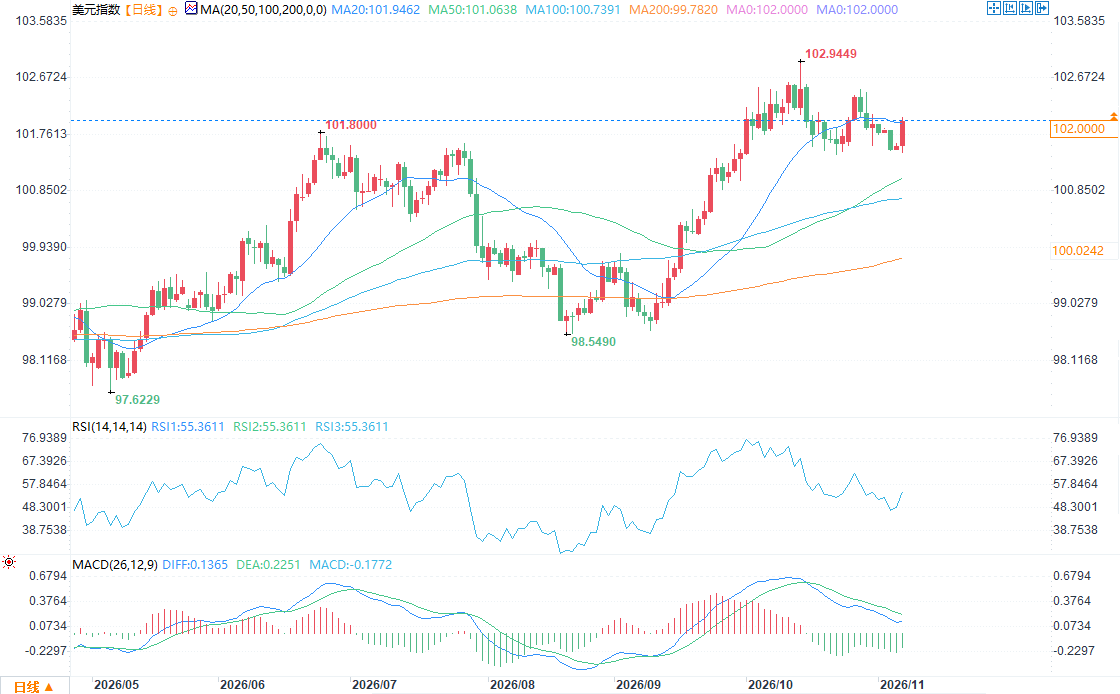 The sell-off in the AI sector triggered a global risk asset correction, with safe-haven funds flowing into the US dollar. However, declining US Treasury yields continued to erode the dollar's interest rate advantage, resulting in a stalemate between bulls and bears. Short-term market movements will depend entirely on the October non-farm payroll data: robust employment data will solidify expectations of a Fed rate hike, providing temporary support for the dollar; weaker employment data will further depress US Treasury yields, limiting the dollar's upside potential. The pound sterling is constrained by the Bank of England's dovish rate hikes and continues to weaken. The yen's ability to hedge against stock market risks is limited, making it difficult for it to break out of its current range. Under the dual pressures of year-end portfolio adjustments and interest rate negotiations, the US dollar index is likely to remain range-bound, with no clear directional trend yet established.
The sharp decline in risk assets spurred demand for safe-haven assets, but the foreign exchange market saw relatively mild volatility, exhibiting a typical divergence in safe-haven demand. Within the G10 currencies, the Australian dollar and New Zealand dollar, with their high beta characteristics, weakened first; traditional safe-haven currencies such as the Japanese yen and Swiss franc saw buying interest. However, the volatility was limited, with forex traders generally characterizing the recent tech stock sell-off as an isolated event resulting from the Democratic victory, rather than a systemic negative factor related to deteriorating macroeconomic fundamentals. Volatility data clearly confirms this: the Philadelphia Semiconductor Index's one-month implied volatility reached 61%, while the USD/JPY volatility was only 7%. Compared to the dramatic fluctuations in tech stocks, the correlation between foreign exchange assets and the stock market was significantly lower. The currency with the strongest correlation between exchange rates and the stock market is the Israeli shekel. Local investors have long maintained a high foreign exchange hedging ratio for US assets, and as their holdings of US tech assets continue to shrink, investors are repurchasing their dollar hedging positions, further amplifying the shekel's exchange rate volatility. In an environment of rapidly declining risk appetite, funds began to flow into US Treasury bonds and US dollar cash. Foreign long-term funds, which previously made large-scale purchases of US technology stocks, are now actively reducing their foreign exchange hedging operations, further supporting the dollar's buying power. However, the dollar is facing two opposing forces: on the one hand, safe-haven funds continue to flow in; on the other hand, since the end of September, the yield on short-term US Treasury bonds has fallen by nearly 50 basis points, significantly narrowing the dollar's interest rate advantage relative to other major currencies, thus weakening the support for the dollar from the interest rate side. Defensive positioning driven by the decline in AI market sentiment has not provided the dollar with a one-sided, unconditional upward momentum. Non-farm payrolls: The core variable determining the short-term direction of the dollar The biggest disagreement in the market right now is whether the decline in technology stocks will trigger a repricing of the US economic growth and inflation outlook. The US October non-farm payrolls report released on Friday will be a key variable in disrupting the current balance. Previous employment data has already released a clear signal: the initial jobless claims released on Thursday were significantly lower than market expectations, fully demonstrating the resilience of the US labor market. Multiple secondary employment indicators have strengthened across the board, and the market generally does not expect a weak non-farm payrolls report. The market currently privately expects 82,000 new jobs, significantly higher than last month's weak figure of only 29,000. If this non-farm payrolls report remains robust, it will further confirm the Fed's assessment that the "job market remains solid," potentially supporting short-term Treasury yields and providing temporary support for the dollar. CME Group interest rate derivatives data shows that the probability of a 25 basis point rate hike by the Fed in December has risen to two-thirds, and the probability of two rounds of tightening policies in the next 12 months has reached 52%. Even with short-term political turmoil caused by the election, the Fed still retains considerable policy autonomy on inflation. The fundamentals of the US economy and the determination of its tightening policies remain the core strength of the dollar, and short-term dollar weakness caused by political expectations is likely only a temporary fluctuation. Conversely, if job growth and wage growth fall short of expectations, the market will lower its pricing of a Fed rate hike, Treasury yields will continue to decline, and the dollar's interest rate support will further weaken. Safe-haven buying will hardly drive a sustained dollar strengthening on its own. Major Non-US Currencies Diverge: Pound Weak, Yen's Hedging Effectiveness Limited In this round of market movements, non-US currencies have shown significant divergence, with the pound being a particularly notable example. The Bank of England raised interest rates for the first time since 2023, increasing the benchmark rate to 4%, but this positive news failed to boost the pound against the dollar. Bank of England Governor Bailey explicitly stated that this rate hike was not the start of a new tightening cycle, and subsequent policy direction would be highly dependent on the geopolitical situation in the Middle East. Prior to this, the futures market had already priced in five rounds of rate hikes, and the central bank's dovish stance directly reversed market expectations, causing the pound to fall rapidly from its six-week high. The yen is considered by Goldman Sachs as a preferred tool for hedging against the impact of AI-driven stock market fluctuations, but even with declining US Treasury yields, short-selling pressure has not completely subsided. Market pricing indicates that Japan's overnight interest rate will gradually rise from the current 1.25% to 2% in 2027, and the yen's medium- to long-term interest rate disadvantage remains, making a deep decline in the dollar/yen exchange rate unlikely. Dollar Index Forecast It is too early to conclude that the dollar has begun a comprehensive decline. Risk aversion in the foreign exchange market will not directly drive a one-sided upward movement in the US dollar index; rather, it will be reflected more in cross-currency pairs: risk crosses such as the Australian dollar against the Japanese yen continue to decline; emerging market currencies are under pressure, with the South African rand and Mexican peso facing downward pressure. The US dollar index (DXY) has shown strong resilience and is likely to remain oscillating within the middle of the 101.50–102.50 range in the short term. The US dollar's unique global liquidity advantage, coupled with a one-week US dollar deposit rate close to 4%, constitutes a solid bottom support. The sell-off in the AI sector triggered a global risk asset correction, with safe-haven funds flowing into the US dollar. However, declining US Treasury yields continued to erode the dollar's interest rate advantage, resulting in a stalemate between bulls and bears. Short-term market movements will depend entirely on the October non-farm payroll data: robust employment data will solidify expectations of a Fed rate hike, providing temporary support for the dollar; weaker employment data will further depress US Treasury yields, limiting the dollar's upside potential. The pound sterling is constrained by the Bank of England's dovish rate hikes and continues to weaken. The yen's ability to hedge against stock market risks is limited, making it difficult for it to break out of its current range. Under the dual pressures of year-end portfolio adjustments and interest rate negotiations, the US dollar index is likely to remain range-bound, with no clear directional trend yet established.
- Risk Warning and Disclaimer
- The market involves risk, and trading may not be suitable for all investors. This article is for reference only and does not constitute personal investment advice, nor does it take into account certain users’ specific investment objectives, financial situation, or other needs. Any investment decisions made based on this information are at your own risk.