Gold Trading Alert: After a tumultuous week, the US CPI takes over this week! The battle between bulls and bears intensifies.
2026-11-09 07:58:28
Last Friday (November 6th), the gold market experienced a rollercoaster ride that sent both bulls and bears racing. A much stronger-than-expected US non-farm payroll report came as a bolt from the blue, suppressing the short-term rebound in gold prices. Spot gold plunged more than 1% at one point, hitting a low of $4028.43 per ounce, but recovered some of its losses by the close, ultimately closing down 0.43% at $4071. Despite the "Black Friday"-style sell-off, gold prices still rose by a cumulative 5.2% last week, marking its best weekly performance since the end of August. This stark contrast between a dismal daily chart and a stellar weekly chart reflects the complex interplay of bullish and bearish factors in the current gold market: on one hand, strong employment data reinforced expectations of a Fed rate hike, leading to a rise in the dollar and US Treasury yields; on the other hand, geopolitical risks, physical buying provided support, and the market's safe-haven demand amid long-term uncertainty. This week, US October CPI and PPI inflation data, along with speeches from several Federal Reserve officials, will be released, and the real directional test for gold may have just begun. On Monday (November 9th) in early Asian trading, spot gold fluctuated slightly lower, currently trading around $4060 per ounce. 
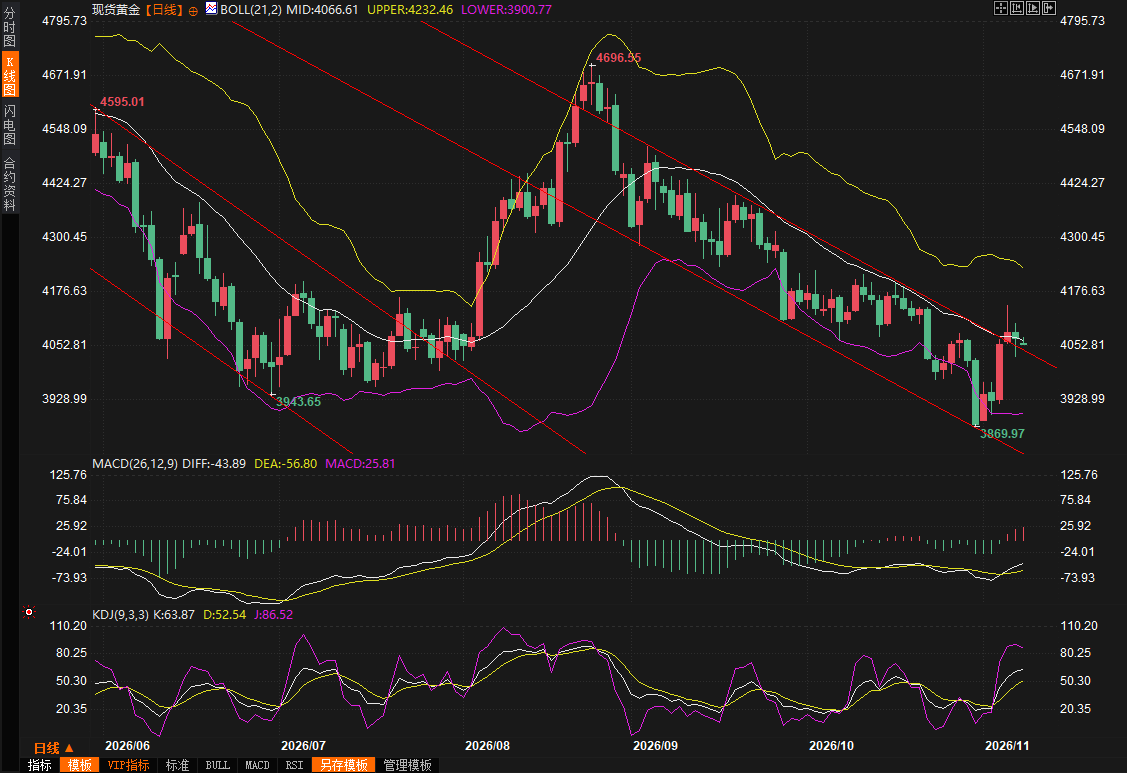 (Spot gold daily chart, source: also very nice) At 07:52 Beijing time, spot gold is currently trading at $4059.59 per ounce.
I. The Unexpected Black Swan Event of Non-Farm Payrolls: Gold Prices Plunged on Friday, and the US Dollar and US Treasury Bonds Suffered Double Losses.
The immediate trigger for gold price declines last Friday was a broadly strong US jobs report. Data released by the US Bureau of Labor Statistics showed that non-farm payrolls increased by 165,000 in October, more than double economists' expectations. September's job growth was revised upwards to 60,000, while the unemployment rate slightly decreased to 4.1%. This data suggests that the US labor market remains resilient and gives the Federal Reserve more room to focus its attention on inflationary pressures stemming from the Middle East conflict. Independent metals trader Tai Wong noted, "Gold prices opened lower after the broadly strong jobs report, but are currently attempting to recover. This is a litmus test for the recent rebound." Following the data release, the dollar index surged 0.77% to 102.26, marking its largest single-day gain in nearly five months. A stronger dollar makes dollar-denominated gold more expensive for investors holding other currencies, thus suppressing gold prices. Meanwhile, U.S. Treasury yields also rose, with the 10-year Treasury yield increasing by 1.6 basis points to 4.85% and the 2-year Treasury yield increasing by 4.1 basis points to 4.52%. With both the dollar and U.S. Treasury yields, traditional enemies of gold, exerting downward pressure, gold prices naturally came under pressure. Spot gold earlier in the session fell by more than 1%, hitting a low of $4,028.43, while U.S. gold futures for December delivery also closed down 0.9%, settling at $4,074.90.II. Weekly chart still shows August high: Physical buying provides resilient support.
Despite a pullback in gold prices on Friday, the overall performance last week was still commendable. Spot gold rose 5% cumulatively last week, marking its best weekly performance since the end of August, while silver, platinum, and palladium also showed upward momentum. This strong weekly gain was supported by multiple factors. First, gold exhibited clear safe-haven characteristics for most of the week, rebounding from a low of $3870 in the cash market to nearly $4147 before retreating under pressure from employment data and rising oil prices. Marc Chandler, Managing Director of Bannockburn Global Forex, noted that while gold prices showed safe-haven characteristics for most of the week, he remained unsure if a bottom had been confirmed. A break below $3975 would validate his doubts, with mild support seen at $3935. Second, buying in the physical market also provided significant support for gold prices. The decline in gold prices stimulated retail demand in India ahead of the important festival of Diwali. On October 30, gold prices fell to a one-year low of $3,869.85 per ounce, a price drop that ignited Indian consumers' enthusiasm for buying gold. Diwali, a significant gold consumption event in India, often provides a temporary floor for gold prices due to pre-event physical buying. Furthermore, after the Democrats won the US midterm elections, market concerns about the Middle East situation significantly eased, with oil prices surging by over 12%, temporarily reducing pressure on the Federal Reserve to raise interest rates in December. This attracted bargain hunters to the gold market, providing an opportunity for a price rebound. However, investors still need to be aware of geopolitical risks. Following months of naval blockade against Iran, the US is forming "Iron Gate Task Force" to strengthen efforts to restrict the transport of advanced weapons systems and other sanctioned goods from Tehran through the land border and the Caspian Sea. Saudi Arabia claimed the attack on the Saudi Aramco building in Riyadh was a plot, with limited damage; over the weekend, a third "illegal" oil tanker exploded in the Strait of Hormuz, causing a serious fire. Despite US President Trump's statement that a renewed US attack on Iran is "highly unlikely" if negotiations around the country progress, he also emphasized that the US military is ready to act, with three aircraft carriers in position and fully prepared for combat. This tense situation of "talking without breaking down, pressure without attack" leaves markets still worried about the geopolitical outlook.III. Renewed Expectations of a Fed Rate Hike: Probability Rises to 80% in December
Following the release of the jobs report, market expectations for the Federal Reserve's policy path shifted significantly. According to the CME Group's FedWatch tool, traders now see an 80% probability of a December rate hike, up from 72.8% before the non-farm payrolls report and from approximately 67% last Thursday. Traders also anticipate that the next, and final, rate hike in this cycle, could come as early as April next year, compared to the previous expectation of June, as the Fed addresses inflation exceeding its 2% target for more than five consecutive years. This shift in expectations has put real downward pressure on gold, as higher interest rates mean a higher opportunity cost for holding gold, a non-interest-bearing asset. Comments from Fed officials further reinforced these rate hike expectations. San Francisco Fed President Daly stated explicitly in an interview, "I expect we will have to tighten policy further." She pointed out that the current robust labor market actually provides the Fed with the space and conditions to accomplish its task of controlling inflation. Daly is not a voting member of the Federal Open Market Committee (FOMC) this year, but her views generally align with the committee's mainstream opinion. St. Louis Fed President Mossallem also stated that inflation remains the most pressing issue when communicating with businesses in his district. He advocated for further interest rate hikes, saying, "The best thing we can do for economic growth and employment is to bring inflation down in time." New York Fed President Williams also stated last Friday that despite the continuous shocks, the US economy has shown remarkable resilience, but inflation is too high and must be brought back down to 2%. Fitch Ratings analyst Olu Sonola wrote after the jobs report was released that following the strong GDP and consumer spending data of the previous week, this jobs report again showed a very strong labor market, further confirming that economic momentum remains solid. The resilience of the labor market allows the Fed to continue focusing on inflation and push policy discussions further towards a December rate hike.IV. The Shadow of AI
The market turmoil triggered by the AI boom cannot be ignored. Last Thursday, the Nasdaq suffered its biggest single-day drop in 19 months, and the S&P 500 lost approximately $3 trillion in market capitalization, due to market concerns that stricter government regulations on AI development following the US midterm elections would stifle economic growth. Democrats regained control of Congress in Tuesday's midterm elections and won several gubernatorial elections. Several winning Democratic gubernatorial candidates had pledged to limit data center construction, and the Democratic congressional leadership is also planning a series of new AI regulatory bills. Anxiety surrounding the future of AI prompted traders to reduce their positions that had previously heavily bet on a Fed rate hike next month, believing that a slowdown in AI-related demand could cool economic growth and inflationary pressures, thus reducing the urgency for further monetary tightening. However, the latest jobs report has brought the issue of interest rate hikes back into the market spotlight. Daly commented that although tech stocks rebounded, last week's fourth consecutive week of declines does not mean the market has completely rejected the importance of data centers and cloud computing; looking beyond short-term fluctuations, this rebalancing as investors reassess the pace of AI-driven growth is precisely what we hope to see for an orderly adjustment. Mussalem pointed out that the emerging AI industry is currently driving up inflation by increasing demand for commodities such as copper. Even if these investments bring profits and productivity improvements in the future, monetary policy should focus on the current economic situation, not the economic situation five years from now.V. Wall Street Divergence Intensifies: Retail Investors Bullish While Experts Remain Cautious
Amidst this mixed backdrop of bullish and bearish sentiment, Wall Street's divergence of opinions on the short-term outlook for gold has widened significantly. Last week, 13 analysts participated in Kitco News' gold survey. Four experts (31%) predicted a rise in gold prices this week, while five experts (38%) predicted a fall. The remaining four analysts (31%) were unable to predict gold's movement or expected it to trade sideways this week. Meanwhile, in Kitco's online poll, 212 votes were cast, and following the gold rally after the midterm elections, retail investor sentiment surged again, with 143 retail traders (68%) predicting a rise in gold prices this week. This contrast between cautious experts and optimistic retail investors reflects the market's conflicted sentiment at current levels. Specifically, analysts' views differ. Adam Button, head of currency strategy at investingLive, is bullish, believing that last week's price action, despite significant volatility, performed well, and that seasonal tailwinds are starting to emerge. Adrian Day, president of Adrian Day Asset Management, cautioned that while the post-midterm election rise in gold prices had a reasonable logic, it also contained excessive optimism regarding easing tensions in Iran and falling oil prices, which would reduce inflation and pressure on the Federal Reserve. He expects most of the gains to be given back this week, but emphasizes that this is a short-term correction. Kevin Grady, president of Phoenix Futures and Options, analyzed from a longer-term perspective that if the Democratic Congress pushes forward with its high-spending agenda, it could ultimately weaken the dollar and benefit gold. He also believes that the employment data reinforced expectations of subsequent interest rate hikes, but he places more emphasis on long-term trends than single-day data. Regarding the Iran issue, he believes Trump may have more room for negotiation and may continue to exert pressure. John Weyer, co-director of commercial hedging at Walsh Trading, emphasized that the Federal Reserve and the president still hold the key to the dollar and gold's trajectory. While the election has eliminated some uncertainty, its impact on the Federal Reserve is limited. He expects the $3,900 and $4,000 levels to hold, becoming areas for forced-out funds to replenish their positions, and believes that "returning to previously reached prices" is easier than reaching new highs. In the long term, the uncertainty surrounding Trump's policies itself constitutes the basis for safe-haven demand for gold.VI. This Week's Outlook: Inflation Data and Official Speeches Set the Tone
Looking ahead to this week, US inflation data and speeches by several central bank officials are expected to dominate market sentiment, while the latest developments in the US-Iran conflict and significant volatility in tech stocks may keep traders on their toes. The US will release October CPI and PPI data, which are crucial for the Fed's December interest rate decision, as well as initial jobless claims. Cisco and Applied Materials will release their quarterly earnings reports. Fed officials Barkin, Gusby, Logan, Schmid, Williams, Hamak, and Daly will speak. Additionally, the US Treasury market will be closed on Wednesday for Veterans Day. For gold, if inflation data continues to show persistent price pressure, it will further strengthen expectations of a December rate hike, and gold prices may continue to be under pressure in the short term; however, if the data shows signs of cooling, or if geopolitical tensions escalate again, gold's safe-haven appeal may regain its dominance. Overall, the current gold market is in a complex phase of "short-term pressure, medium-term volatility, and long-term support." Last Friday's strong non-farm payrolls data led to a rise in both the US dollar and US Treasury yields, and the probability of a Fed rate hike in December surged to 80%, forming the core short-term resistance for gold prices. However, gold still managed to record a 5% weekly gain last week, indicating that safe-haven demand, physical buying, and market concerns about US political and geopolitical risks are providing resilient support for gold prices. The coexistence of divergent opinions among Wall Street analysts and optimistic sentiment among retail investors also means that the market has not yet formed a unified direction. This week's inflation data and Fed officials' speeches will be key clues to break the deadlock. For investors, rather than chasing highs and lows in single-day fluctuations, it is better to closely monitor inflation trends, Fed policy signals, and the evolution of the US-Iran situation, seeking the true value anchor of gold amidst volatility. After all, against the backdrop of the dollar's credibility being eroded by fiscal deficits, frequent geopolitical risks, and the AI revolution reshaping the economic landscape, the long-term logic of gold as the ultimate safe-haven asset has not been fundamentally shaken by a single jobs report. (Spot gold daily chart, source: also very nice) At 07:52 Beijing time, spot gold is currently trading at $4059.59 per ounce.
- Risk Warning and Disclaimer
- The market involves risk, and trading may not be suitable for all investors. This article is for reference only and does not constitute personal investment advice, nor does it take into account certain users’ specific investment objectives, financial situation, or other needs. Any investment decisions made based on this information are at your own risk.