What will happen to asset prices if AI investment returns disappoint? The Reserve Bank of Australia issues a warning.
2026-11-09 08:28:27
The Australian dollar traded in a narrow range against the US dollar during Asian trading hours on Monday (November 9), currently hovering around 0.6870, after hitting a new low since early July in the previous trading session. Reserve Bank of Australia Assistant Governor Sarah Hunt warned that artificial intelligence could pose a growing risk to financial stability. She stated that if AI investments yield lower-than-expected returns, some asset prices will face sharp repricing, or even disorderly adjustments. Speaking at a conference in Sydney on Monday, Hunt said that evidence to date is limited; AI has not significantly improved overall productivity, and there are few signs that it has already had a large-scale employment impact in developed economies. 
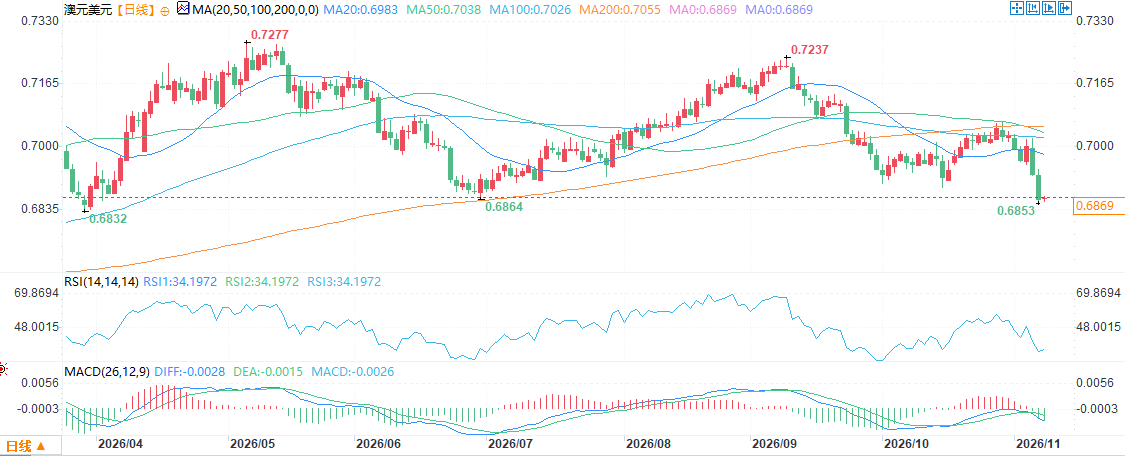 (Australian dollar to US dollar daily chart, source: EasyForex) At 8:25 Beijing time, the Australian dollar to US dollar exchange rate was 0.6874/75.
Inflation Path: Short-term push up, long-term neutral, supporting the Reserve Bank of Australia's tightening bias.
Regarding inflation, her view is that the impact of AI will change over time. In the short term, the technology will positively impact demand when supply capacity is limited, thus pushing up price pressures. In the long term, she expects supply to catch up and alleviate bottlenecks as data center capacity and related industries expand. If AI subsequently leads to broader productivity gains, the initial inflationary pressures from the investment boom will subside, with the long-term effect being roughly neutral. This assessment carries weight in the policy outlook. The surge in domestic data center investment in Australia is one of the forces driving economic demand and one of the reasons why the Reserve Bank of Australia has raised interest rates five times this year, bringing the cash rate to an 18-year high of 4.85%. Hunt describes AI as a short-term inflationary force, which aligns with a tightening bias rather than pointing to any early easing. This means that AI is one of the reasons for raising interest rates at the current stage, not for lowering them.Labor Market: Initial Signs of Adjustment Emerging in AI-Exposed Occupations
Hunt points out that the impact of AI on employment is currently primarily structural rather than quantitative. Evidence shows that in occupations more vulnerable to AI, the number of job advertisements and employment performance have shown relatively weaker signs; while in areas less affected by the technology, growth is stronger, a divergence particularly pronounced among young workers. Feedback from the Reserve Bank of Australia's Liaison Program also indicates that most businesses have not yet significantly adjusted their workforce due to AI, and large-scale layoffs are not expected in the coming year. This means that AI has not yet left a clear "disruptive footprint" in overall unemployment or total employment data, but is instead changing the relative demand structure between different occupations. This localized adjustment has two implications. On the one hand, it prompts policymakers and businesses to pay attention to skills mismatches and retraining needs, especially for positions with a high proportion of routine, coded tasks; on the other hand, it also indicates that technology diffusion is still in its early stages, and the overall resilience of the job market has not yet been significantly weakened. The relative advantage of young workers in areas with low AI exposure may partly reflect their skills adaptability and flexibility in career choices. Hunter's observations thus avoid the overly pessimistic narrative that "AI is about to replace human jobs on a large scale," while reminding the market and policy levels that structural transformation has already begun and needs to be smoothed out through education, training, and labor market policies, rather than waiting for the overall impact to manifest before responding passively.Financial Stability Warning: At a Sensitive Time When Markets Are Examining AI Spending and Funding
Hunt's financial stability warning comes at a time when global markets are highly sensitive to the scale and financing structure of AI capital expenditures. Instead of predicting an inevitable correction, she explicitly defines the risk as "conditional on disappointing investment returns": if long-term returns on AI investments fail to meet current high market expectations, some asset prices (including stocks and corporate bonds) will face sharp repricing, and may even experience disorderly adjustments. This wording is noteworthy—it highlights tail risks while avoiding providing specific trigger points or probability judgments for the market, leaving the final judgment to the actual realization of returns. The current context adds weight to this warning. AI-related companies are increasingly using debt to finance large-scale projects, and private and public market investors' exposure to this sector continues to rise; the use of off-balance-sheet financing and special purpose vehicles is also becoming more prevalent, potentially concealing additional risks of linkage and opacity. Approximately 5.3% of Australian household financial wealth is directly or indirectly allocated to AI-related companies through superannuations. When risk premiums are at historically low levels, any revisions to expected returns can be amplified. Hunt's inclusion of this issue within the framework of the central bank's mandate indicates that the Financial Stability Unit has incorporated it into its ongoing monitoring. For traders, this means that while pursuing AI themes, they must remain highly vigilant regarding valuations, leverage, and funding structures, as the central bank has explicitly listed "disappointing returns" as one of the potential systemic triggers.in conclusion
Hunt characterized AI as "today's inflation problem, tomorrow's financial stability problem," while signs of productivity returns are still insufficient. In the short term, AI is driving up demand and inflation amid supply constraints, supporting the RBA's tightening bias—the data center boom is one of the reasons for the five rate hikes to 4.85% this year; in the long term, the effect is broadly neutral as supply expands and productivity improves. The labor market has shown initial signs of occupational adjustments related to AI exposure, but the overall employment impact is limited. The financial stability warning comes at a sensitive time when markets are scrutinizing AI spending and financing, with the risk contingent on disappointing investment returns, and no specific pullback is predicted. For traders, this means a central bank that sees AI driving up current inflation while also being wary of a sharp reversal in related asset prices. (Australian dollar to US dollar daily chart, source: EasyForex) At 8:25 Beijing time, the Australian dollar to US dollar exchange rate was 0.6874/75.
- Risk Warning and Disclaimer
- The market involves risk, and trading may not be suitable for all investors. This article is for reference only and does not constitute personal investment advice, nor does it take into account certain users’ specific investment objectives, financial situation, or other needs. Any investment decisions made based on this information are at your own risk.