Falling oil prices eased inflationary pressures, and the dollar index declined slightly.
2026-11-09 13:48:27
On Monday during Asian trading hours, the US dollar index retreated after rising for two consecutive trading days, trading around 102.20 . The short-term pressure on the dollar stemmed primarily from easing inflationary pressures due to falling oil prices—US President Donald Trump signaled that further military action against Iran was "highly unlikely" as long as negotiations on the Iranian nuclear program continued and the Strait of Hormuz remained open. Trump also acknowledged that the Middle East conflict, which had previously driven up energy costs, played a key role in the Republican Party's recent midterm election losses. The decline in oil prices and energy costs reduced market concerns about a renewed acceleration of inflation, thereby suppressing the dollar's safe-haven appeal and interest rate differential advantage.  Despite this, the US dollar is still expected to regain support based on strong employment data and rising tightening expectations. According to the CME FedWatch tool, the market's probability of a 25 basis point rate hike at the December Federal Open Market Committee meeting has risen to over 78% . This expectation is strongly supported by employment data: October non-farm payrolls increased by 165,000 , significantly exceeding the market expectation of 65,000 and also higher than the revised 60,000 in September; the unemployment rate fell to 4.1% , better than the expected 4.2%. A robust labor market means that the Fed's narrative of "maintaining high interest rates for a longer period" is still difficult to disprove. Therefore, the US dollar is currently facing a confrontation between "negative inflation" and "positive tightening expectations." On the one hand, falling oil prices have cooled inflation expectations, reducing the necessity for further Fed rate hikes; on the other hand, strong employment and a rate hike probability of over 78% provide solid bottom support for the dollar. The market is largely focused on Tuesday's US Consumer Price Index (CPI) and Friday's Producer Price Index (PPI) for clues about the Federal Reserve's future policy path. Stronger inflation data would disprove the "oil price decline - inflation easing" logic, potentially allowing the dollar to regain its upward momentum; weaker data could further cool tightening expectations. From a broader perspective, the dollar index's movement is spilling over through multiple channels: for commodities, a stronger dollar typically suppresses dollar-denominated crude oil and gold; for emerging markets, a weaker dollar alleviates external financing pressures and currency depreciation risks. Currently, the dollar index is near its recent high around 102, and its direction will directly impact the pricing center of global risk assets. Technically, the daily dollar index maintains a bullish bias, currently trading at 102.20 above the 9-day moving average (approximately 101.95) and the 50-day moving average (approximately 101.36) , forming a constructive trend. In terms of momentum, the 14-day Relative Strength Index (RSI) is around 57 , indicating positive upward momentum but not yet overbought; the FXS Fed Sentiment Index is at 143.10 , reflecting that expectations of policy tightening remain high, providing support for dollar buying. On the downside, the first line of defense is at the 9-day moving average around 101.95. If the pullback pressure extends, a deeper technical bottom lies at the 50-day moving average around 101.36. As long as the dollar index holds above these two moving averages, the path of least resistance remains upward, and any pullback can be seen as consolidation within a broader bullish trend. On the 4-hour chart, the US dollar index has experienced a technical pullback after two consecutive days of gains, entering a short-term consolidation zone of 101.95-102.20 . If it can hold above 101.95 and regain a foothold above 102.20, it may resume its upward trend and challenge previous highs. If it falls below 101.95, the pullback will extend to the 101.36 level. However, as long as the 50-day moving average holds, the medium-term bullish structure remains intact.
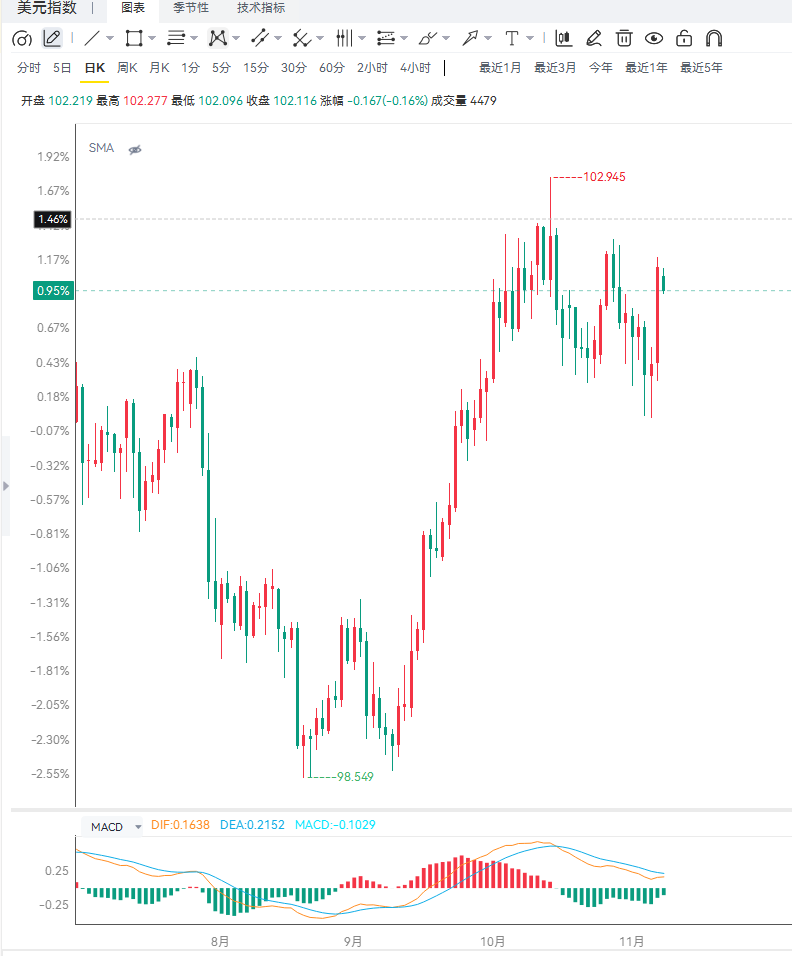 Editor's Summary: Currently, the US dollar index is caught between short-term headwinds of "falling oil prices and easing inflation" and medium-term support of "strong employment and a tightening expectation of over 78%." The pullback to 102.20 is more like a consolidation within an uptrend than a trend reversal. In the medium term, as long as the support levels of 101.95 and 101.36 are not effectively broken, the path of least resistance for the dollar still points upwards. Conversely, if both CPI and PPI weaken and interest rate hike expectations cool further, the dollar may seek support at 101.36 or even lower. Close attention should be paid to Tuesday's CPI and Friday's PPI, as well as statements from officials ahead of the December FOMC meeting. The direction of the dollar will simultaneously affect the pricing of crude oil, gold, and emerging market assets.
Despite this, the US dollar is still expected to regain support based on strong employment data and rising tightening expectations. According to the CME FedWatch tool, the market's probability of a 25 basis point rate hike at the December Federal Open Market Committee meeting has risen to over 78% . This expectation is strongly supported by employment data: October non-farm payrolls increased by 165,000 , significantly exceeding the market expectation of 65,000 and also higher than the revised 60,000 in September; the unemployment rate fell to 4.1% , better than the expected 4.2%. A robust labor market means that the Fed's narrative of "maintaining high interest rates for a longer period" is still difficult to disprove. Therefore, the US dollar is currently facing a confrontation between "negative inflation" and "positive tightening expectations." On the one hand, falling oil prices have cooled inflation expectations, reducing the necessity for further Fed rate hikes; on the other hand, strong employment and a rate hike probability of over 78% provide solid bottom support for the dollar. The market is largely focused on Tuesday's US Consumer Price Index (CPI) and Friday's Producer Price Index (PPI) for clues about the Federal Reserve's future policy path. Stronger inflation data would disprove the "oil price decline - inflation easing" logic, potentially allowing the dollar to regain its upward momentum; weaker data could further cool tightening expectations. From a broader perspective, the dollar index's movement is spilling over through multiple channels: for commodities, a stronger dollar typically suppresses dollar-denominated crude oil and gold; for emerging markets, a weaker dollar alleviates external financing pressures and currency depreciation risks. Currently, the dollar index is near its recent high around 102, and its direction will directly impact the pricing center of global risk assets. Technically, the daily dollar index maintains a bullish bias, currently trading at 102.20 above the 9-day moving average (approximately 101.95) and the 50-day moving average (approximately 101.36) , forming a constructive trend. In terms of momentum, the 14-day Relative Strength Index (RSI) is around 57 , indicating positive upward momentum but not yet overbought; the FXS Fed Sentiment Index is at 143.10 , reflecting that expectations of policy tightening remain high, providing support for dollar buying. On the downside, the first line of defense is at the 9-day moving average around 101.95. If the pullback pressure extends, a deeper technical bottom lies at the 50-day moving average around 101.36. As long as the dollar index holds above these two moving averages, the path of least resistance remains upward, and any pullback can be seen as consolidation within a broader bullish trend. On the 4-hour chart, the US dollar index has experienced a technical pullback after two consecutive days of gains, entering a short-term consolidation zone of 101.95-102.20 . If it can hold above 101.95 and regain a foothold above 102.20, it may resume its upward trend and challenge previous highs. If it falls below 101.95, the pullback will extend to the 101.36 level. However, as long as the 50-day moving average holds, the medium-term bullish structure remains intact. Editor's Summary: Currently, the US dollar index is caught between short-term headwinds of "falling oil prices and easing inflation" and medium-term support of "strong employment and a tightening expectation of over 78%." The pullback to 102.20 is more like a consolidation within an uptrend than a trend reversal. In the medium term, as long as the support levels of 101.95 and 101.36 are not effectively broken, the path of least resistance for the dollar still points upwards. Conversely, if both CPI and PPI weaken and interest rate hike expectations cool further, the dollar may seek support at 101.36 or even lower. Close attention should be paid to Tuesday's CPI and Friday's PPI, as well as statements from officials ahead of the December FOMC meeting. The direction of the dollar will simultaneously affect the pricing of crude oil, gold, and emerging market assets.
- Risk Warning and Disclaimer
- The market involves risk, and trading may not be suitable for all investors. This article is for reference only and does not constitute personal investment advice, nor does it take into account certain users’ specific investment objectives, financial situation, or other needs. Any investment decisions made based on this information are at your own risk.