The Bank of England raised interest rates to 4.00% for the first time in over three years, causing the pound to rebound.
2026-11-09 14:30:27
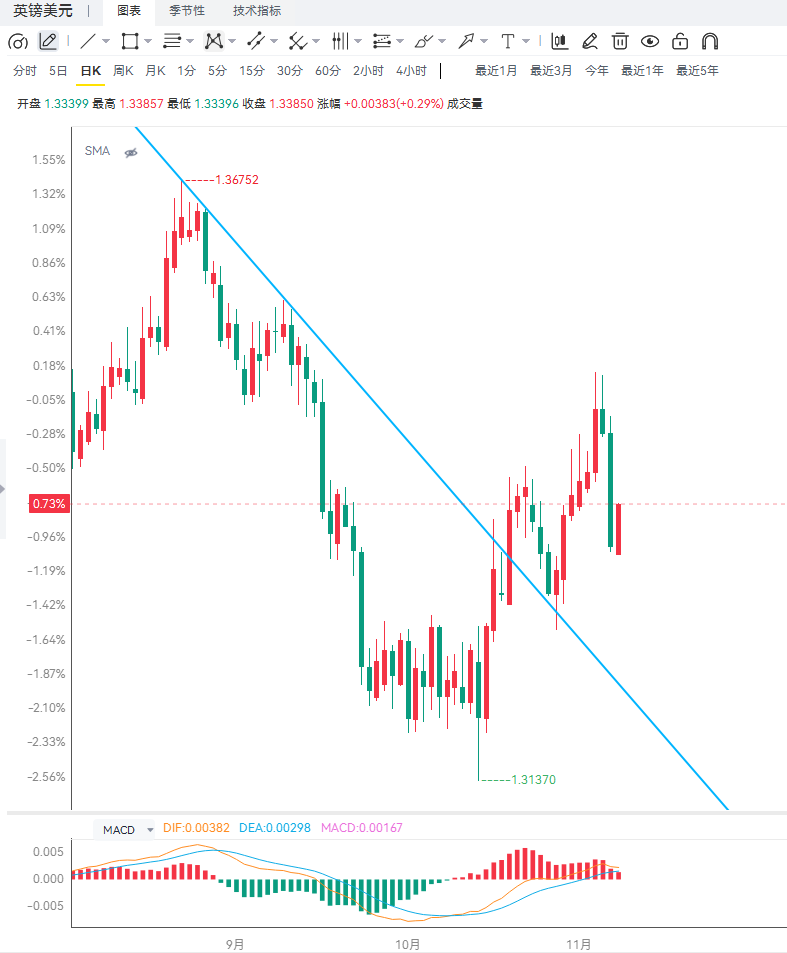
The pound rebounded against the dollar in early Asian trading on Monday, ending a two-day losing streak and rising to around 1.3370 . The pound's strength stemmed from the Bank of England's stronger-than-expected policy stance: last week, the Bank of England raised its benchmark interest rate by 25 basis points to 4.00% , its first rate hike in over three years. Governor Andrew Bailey emphasized that the Middle East conflict, which is driving up energy prices, is the main factor in its assessment of the future path of interest rates. The market is currently pricing in three more rate hikes by the end of next year, exceeding the expectations of most economists.  Bailey stated that the market's reaction to the drop in oil prices after the US midterm elections would not change the decision to raise interest rates made that day, but he also acknowledged that oil price movements "clearly" would influence his view on the future. This statement both confirmed policy continuity and left room for data-dependent adjustments to the subsequent path. Analysts at ABN AMRO pointed out that the Bank of England has taken another step on the path of tightening, with this rate hike receiving solid support within the committee— eight members supported the rate hike, and one member favored a 50 basis point increase , indicating that the Monetary Policy Committee remains hawkish. The bank also emphasized that the committee expects inflation to reach approximately 5% by mid-2027 and hinted at further rate hikes unless the Middle East conflict is resolved. However, Bank of England official Pill's remarks were noticeably dovish: his FXS speech tracking score was only 4.2/10 , far below the historical baseline of 6.4/10; he emphasized that there is "no predetermined path" for interest rates next year, and no predetermined upward trajectory after spring; if economic growth stagnates, interest rates may remain unchanged or even be lowered. For the pound, this policy divergence and the possibility of interest rate cuts constitute a mild negative factor. On the other hand, a stronger-than-expected US jobs report may limit the dollar's decline. October's non-farm payrolls increased by 165,000 , higher than September's 60,000 and also exceeding market expectations of 65,000; the unemployment rate fell to 4.1% , down from 4.2% previously. According to the CME Group's FedWatch tool, the market's pricing in a December rate hike by the Fed has risen to approximately 79.6% , up from 72.8% before the non-farm payrolls data release. Thus, the pound/dollar exchange rate is exhibiting a two-way tug-of-war between "hawkish rate hikes from the Bank of England" and "strong expectations of Fed tightening," while dovish voices within the Bank of England are weakening the pound's upward momentum. In the short term, the market will focus on marginal changes in inflation data from the UK and the US, as well as the impact of the Middle East situation on energy prices and consequently on the monetary policy paths of both countries. If oil prices continue to decline, expectations for further interest rate hikes by the Bank of England may cool, limiting the upside potential of the pound. Conversely, if geopolitical risks resurface and energy prices rebound, tightening pressures on both central banks will increase simultaneously, potentially providing relative support for the pound. Technically, the GBP/USD pair remains constrained by the 100-day simple moving average (1.3395) on the daily chart, with the price trading closely below this level, indicating significant upward pressure. The current price is slightly above the 20-day Bollinger Band middle line, suggesting underlying demand nearby, but the proximity of the 100-day moving average limits upside potential. In terms of momentum, the Relative Strength Index (RSI) is around 51.1 , in neutral territory, indicating insufficient momentum to challenge the current resistance structure. Initial resistance is at the 100-day moving average of 1.3395, with a higher barrier at the 20-day Bollinger Band upper line around 1.3485 – only a break above this level would shift the recent bias towards a more constructive bullish pattern. On the downside, initial support is located at the 20-day Bollinger Band middle line around 1.3355 . If selling pressure extends, a deeper technical buffer lies at the lower Bollinger Band around 1.3225 . On the 4-hour chart, the exchange rate found support and rebounded near 1.3370, entering a narrow consolidation range of 1.3355-1.3395 in the short term. If it can hold above 1.3370 and break through 1.3395, it may test the previous high in the short term. If it falls back and breaks below the 1.3355 middle line support, it will likely test the 1.3225 lower line, increasing the risk of a pullback.
 Editor's Summary: The core driver of the current GBP/USD exchange rate is the hawkish stance of the Bank of England (BOE) regarding its first rate hike in over three years, with the market pricing in three more hikes before the end of next year, offset by a 79.6% probability of a Fed rate hike in December and strong non-farm payroll data . The 100-day moving average at 1.3395 is the first hurdle to determine whether the rebound can continue. In the medium term, if the BOE continues its tightening and the expectation of inflation rising to around 5% by mid-2027 materializes, the medium-term support for the pound will strengthen. However, Pierre's dovish statements within the committee suggest uncertainty about the policy path. If UK economic growth slows and expectations of rate cuts intensify, the pound will come under renewed pressure. Close attention should be paid to UK and US inflation data, oil prices, the situation in the Middle East, and the evolving divergence in subsequent statements from central bank officials of both countries.
Bailey stated that the market's reaction to the drop in oil prices after the US midterm elections would not change the decision to raise interest rates made that day, but he also acknowledged that oil price movements "clearly" would influence his view on the future. This statement both confirmed policy continuity and left room for data-dependent adjustments to the subsequent path. Analysts at ABN AMRO pointed out that the Bank of England has taken another step on the path of tightening, with this rate hike receiving solid support within the committee— eight members supported the rate hike, and one member favored a 50 basis point increase , indicating that the Monetary Policy Committee remains hawkish. The bank also emphasized that the committee expects inflation to reach approximately 5% by mid-2027 and hinted at further rate hikes unless the Middle East conflict is resolved. However, Bank of England official Pill's remarks were noticeably dovish: his FXS speech tracking score was only 4.2/10 , far below the historical baseline of 6.4/10; he emphasized that there is "no predetermined path" for interest rates next year, and no predetermined upward trajectory after spring; if economic growth stagnates, interest rates may remain unchanged or even be lowered. For the pound, this policy divergence and the possibility of interest rate cuts constitute a mild negative factor. On the other hand, a stronger-than-expected US jobs report may limit the dollar's decline. October's non-farm payrolls increased by 165,000 , higher than September's 60,000 and also exceeding market expectations of 65,000; the unemployment rate fell to 4.1% , down from 4.2% previously. According to the CME Group's FedWatch tool, the market's pricing in a December rate hike by the Fed has risen to approximately 79.6% , up from 72.8% before the non-farm payrolls data release. Thus, the pound/dollar exchange rate is exhibiting a two-way tug-of-war between "hawkish rate hikes from the Bank of England" and "strong expectations of Fed tightening," while dovish voices within the Bank of England are weakening the pound's upward momentum. In the short term, the market will focus on marginal changes in inflation data from the UK and the US, as well as the impact of the Middle East situation on energy prices and consequently on the monetary policy paths of both countries. If oil prices continue to decline, expectations for further interest rate hikes by the Bank of England may cool, limiting the upside potential of the pound. Conversely, if geopolitical risks resurface and energy prices rebound, tightening pressures on both central banks will increase simultaneously, potentially providing relative support for the pound. Technically, the GBP/USD pair remains constrained by the 100-day simple moving average (1.3395) on the daily chart, with the price trading closely below this level, indicating significant upward pressure. The current price is slightly above the 20-day Bollinger Band middle line, suggesting underlying demand nearby, but the proximity of the 100-day moving average limits upside potential. In terms of momentum, the Relative Strength Index (RSI) is around 51.1 , in neutral territory, indicating insufficient momentum to challenge the current resistance structure. Initial resistance is at the 100-day moving average of 1.3395, with a higher barrier at the 20-day Bollinger Band upper line around 1.3485 – only a break above this level would shift the recent bias towards a more constructive bullish pattern. On the downside, initial support is located at the 20-day Bollinger Band middle line around 1.3355 . If selling pressure extends, a deeper technical buffer lies at the lower Bollinger Band around 1.3225 . On the 4-hour chart, the exchange rate found support and rebounded near 1.3370, entering a narrow consolidation range of 1.3355-1.3395 in the short term. If it can hold above 1.3370 and break through 1.3395, it may test the previous high in the short term. If it falls back and breaks below the 1.3355 middle line support, it will likely test the 1.3225 lower line, increasing the risk of a pullback. Editor's Summary: The core driver of the current GBP/USD exchange rate is the hawkish stance of the Bank of England (BOE) regarding its first rate hike in over three years, with the market pricing in three more hikes before the end of next year, offset by a 79.6% probability of a Fed rate hike in December and strong non-farm payroll data . The 100-day moving average at 1.3395 is the first hurdle to determine whether the rebound can continue. In the medium term, if the BOE continues its tightening and the expectation of inflation rising to around 5% by mid-2027 materializes, the medium-term support for the pound will strengthen. However, Pierre's dovish statements within the committee suggest uncertainty about the policy path. If UK economic growth slows and expectations of rate cuts intensify, the pound will come under renewed pressure. Close attention should be paid to UK and US inflation data, oil prices, the situation in the Middle East, and the evolving divergence in subsequent statements from central bank officials of both countries.
- Risk Warning and Disclaimer
- The market involves risk, and trading may not be suitable for all investors. This article is for reference only and does not constitute personal investment advice, nor does it take into account certain users’ specific investment objectives, financial situation, or other needs. Any investment decisions made based on this information are at your own risk.