Strong non-farm payrolls data meets a hawkish ECB: what's next for the euro against the dollar?
2026-11-09 15:36:30
The euro traded around 1.1165 against the dollar in European trading on Monday (November 9). The European Central Bank's hawkish stance provided some support for the euro against the dollar. ECB President Christine Lagarde stated last week that after keeping interest rates unchanged in October, the central bank is watching indicators to determine whether a rate hike is needed next month. Lagarde said, "From now until December, we will have many indicators that will really help us determine whether a rate hike is needed." On the other hand, signs of improvement in the US labor market may boost the dollar and create headwinds for the currency pair. The US added 165,000 jobs in October, up from 60,000 in September and exceeding expectations; the unemployment rate fell to 4.1%. These data reinforced expectations that the labor market remains resilient and that the Federal Reserve remains on track for a December rate hike. 
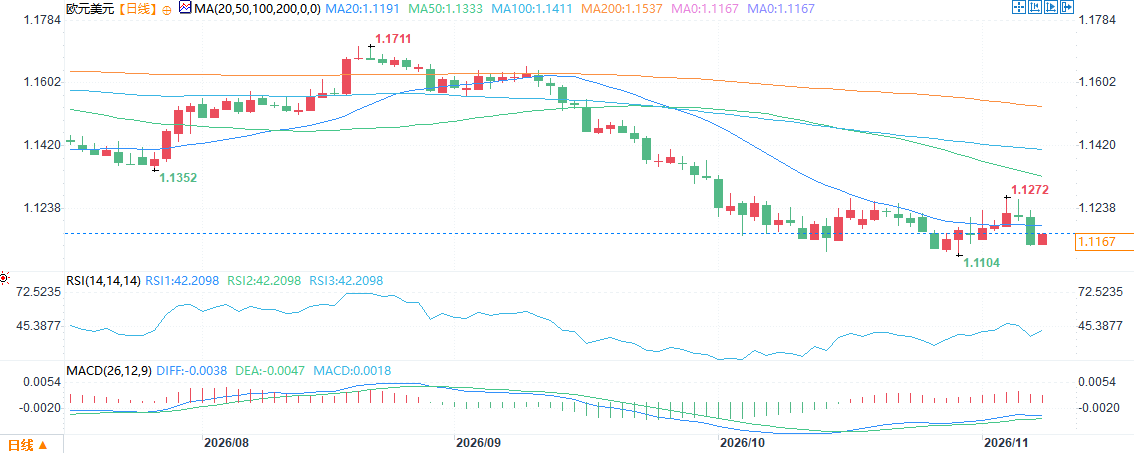 (Euro/USD daily chart, source: FX678) At 15:320 Beijing time, the euro was trading at 1.1167/68 against the US dollar.
Institutional view: Investors are shifting to dollar cash, rather than withdrawing from the dollar.
Some analysts described the euro's recent performance as "rather lackluster," noting that even "the sharp sell-off in US tech stocks wasn't enough to generate much buying interest against the dollar." They pointed out that "European buyers have a low hedging ratio for their US investments," but the expected demand for a single currency hasn't materialized. The bank believes that "global investors are currently happy to keep cash in the dollar. In other words, we're seeing a shift to cash, not a withdrawal from the dollar." They added that this is reinforced by "a return to a more familiar correlation, namely that US Treasuries are now playing a safe-haven role." Looking ahead, the bank believes that "unless today's US jobs report is weak, the euro is expected to consolidate around 1.12 against the dollar," with the Eurozone also focused on the speech by ECB Chief Economist Ryan. On the policy front, they emphasized that "the market is still pricing in an 18 basis point rate hike by the ECB in December, and this expectation should remain sticky unless there is a deeper stock market correction." This assessment implies that the euro's rebound lacks support from capital flows—investors are choosing dollar cash over the euro as a safe haven, which limits the euro's upside potential to structural factors in capital flows, rather than simply interest rate differential expectations.Lagarde's stance: Slightly hawkish, but policy uncertainty remains high.
Lagarde emphasized the continued need to use tools to prevent runaway inflation and stated that several indicators would be assessed before the December meeting. This statement points to a hawkish bias towards the euro, although she also acknowledged the difficulty in distinguishing between supply and demand shocks. Her remarks that US tariffs are unlikely to be reconsidered soon and that the US midterm elections could ultimately influence trade policy highlight external risks that could continue to push up price pressures in the eurozone. She described the current environment as a tug-of-war between energy shocks and AI forces, highlighting policy uncertainty; however, her commitment to combating inflation suggests that the dollar faces downside risks against the euro if the market prices a relatively tighter ECB policy.Technical Analysis: The bearish bias remains unchanged below the 100-day moving average.
From a technical perspective, the euro/dollar pair remains below its 100-day simple moving average, and the bearish outlook remains unchanged. The first resistance level is at the 20-day moving average of 1.1190, while the key support level to watch is 1.1104. The current rise is more of a rebound than a trend reversal – as long as the pair fails to break through the resistance of both the 100-day and 20-day moving averages, the bearish bias remains valid; a drop below 1.1104 would open up further downside potential.in conclusion
The euro rose to around 1.1165 against the dollar, supported by the European Central Bank's hawkish stance, but remains below the 100-day moving average, indicating a continued bearish bias. Resistance is seen at 1.1190, and support at 1.1104. Lagarde stated that several indicators will be assessed before December to determine the need for an interest rate hike, a slightly hawkish statement. The US October non-farm payrolls increased by 165,000, and the unemployment rate fell to 4.1%, strengthening expectations of a December rate hike and creating headwinds for the euro. Analysts point out that investors are turning to dollar cash rather than withdrawing from the dollar, and US Treasuries are returning to their safe-haven role. The euro's rebound lacks capital flow support, and the exchange rate is expected to consolidate around 1.12 unless the US jobs report is weak. Short-term direction depends on Lane's speech, US data, and the relative pricing of December's central bank policies in Europe and the US—with capital flows unfavorable to the euro, the upside is limited by the 100-day moving average and the 1.1190 resistance level. (Euro/USD daily chart, source: FX678) At 15:320 Beijing time, the euro was trading at 1.1167/68 against the US dollar.
- Risk Warning and Disclaimer
- The market involves risk, and trading may not be suitable for all investors. This article is for reference only and does not constitute personal investment advice, nor does it take into account certain users’ specific investment objectives, financial situation, or other needs. Any investment decisions made based on this information are at your own risk.