Oil price oscillations fuel expectations of easing tensions between the US and Iran; Iranian nuclear proposal remains uncertain.
2026-11-09 15:54:27
On Monday (November 9th) during the Asian and European sessions, international oil prices continued to weaken, with the current pricing theme primarily driven by the fluctuating expectations of a US-Iran conflict. Trump has repeatedly stated publicly that the possibility of a new round of US military strikes against Iran is "extremely low" as long as US-Iran negotiations continue, provided Iran signs a strong agreement acceptable to the US. He also emphasized that previous military actions have weakened Iran's conventional military capabilities and delayed its nuclear program, but he has not completely abandoned the option of military action, leaving considerable flexibility in his statements. Meanwhile, Iranian lawmakers stated that nine proposals to withdraw from the Treaty on the Non-Proliferation of Nuclear Weapons (NPT) are on the parliamentary agenda, meaning that if Iran judges itself to be the victor, it may increase its leverage, potentially leading to a resurgence of tensions between the US and Iran. 
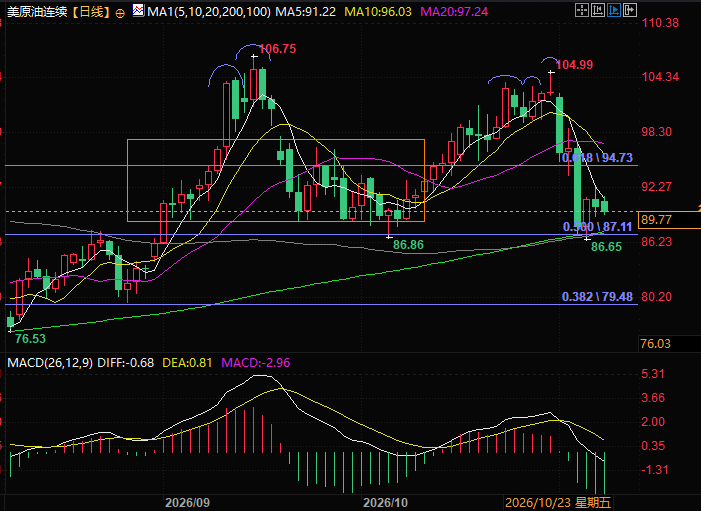 (WTI crude oil futures daily chart, source: EasyTrade) At 15:50 Beijing time, WTI crude oil futures are currently trading at $89.75 per barrel.
The US-Iran rivalry: The negotiation window opens, but the bottom lines of both sides are vastly different.
US Secretary of State Marco Rubio took a more pessimistic stance, pointing out that consultations through intermediaries had yielded little result, with the US finding Iran's demands completely unacceptable, and some conditions even difficult to agree to. However, the US still maintained a diplomatic solution. The good news, however, is that Qatar, a key intermediary in this mediation effort, will send its Prime Minister to the White House to meet with Trump and Vice President Vance. The market is closely watching whether this meeting will result in a ceasefire and the restoration of navigation in the Strait of Hormuz. Iran's stance is equally firm, with its Foreign Minister warning that if the US continues to exert pressure, Iran will implement retaliatory actions without geographical limitations. In terms of the practical implementation of the blockade, the US has activated "Iron Gate Task Force" to cut off Iran's land and Caspian Sea supply routes; the maritime blockade has been expanded, no longer only intercepting ships entering Iranian ports but also targeting departing merchant ships. On November 7, the US military damaged the cargo ship Huda in the Gulf of Oman for refusing to cooperate with the blockade. Since July, the US has forced 147 merchant ships to divert their routes, crippled five that refused to comply, and destroyed 10 oil tankers belonging to the shadow network of the Iranian Revolutionary Guard. Dangers in the Gulf have continued, with multiple missile launches and explosions reported around the Strait of Hormuz. The Houthi rebels have continued their attacks on targets within Saudi Arabia, and Saudi air defenses have intercepted several incoming missiles. The UAE has completed the rescue of 22 crew members in the Gulf of Oman, and regional flights have been significantly adjusted, indicating that risks to shipping lanes and airspace have not been eliminated. Meanwhile, China has consistently maintained that the Strait of Hormuz is a crucial global energy corridor and has dispatched a special envoy to call on all parties to cease fire and support resolving differences through diplomatic negotiations to de-escalate regional tensions.With the Russia-Ukraine conflict at a stalemate, diesel trade has become a new variable.
The ongoing stalemate in the Russia-Ukraine conflict is a major factor influencing the global supply and demand of refined petroleum products, particularly diesel. Russian forces continue their attacks on Ukrainian energy infrastructure, while Ukraine has responded by using drones to strike targets within Russia. Europe is preparing for talks on the Ukraine crisis in Abu Dhabi; German Chancellor Merz has stated that dialogue with Putin is inevitable, and Trump has extended an invitation to Putin to attend the G20 summit, leaving room for future diplomatic communication. Domestic fuel subsidies in Russia have increased, reaching 415 billion rubles in October, a more than four-year high. These subsidies are primarily intended to incentivize refineries to prioritize domestic fuel supplies, offsetting the allure of export profits. Russia has also made a clear commitment to fulfilling its contractual obligations regarding diesel shipments to the US under the Russia-US diesel agreement, providing some stability to the global diesel market.OPEC production continues to recover, limiting the upside potential of oil prices from the supply side.
The recovery on the supply side is the core driver of the recent decline in international oil prices. Data shows that OPEC's daily crude oil production increased by 930,000 barrels month-on-month in October, reaching 22.8 million barrels, recovering to 88% of pre-war levels, with the increase mainly coming from Saudi Arabia. Saudi Arabia is gradually resuming the pace of tanker shipments from the Strait of Hormuz and oil loading along the Red Sea coast. Increased production in Iraq and Kuwait offset production cuts in Nigeria and Iran; suppressed by the US maritime blockade, Iranian crude oil production has fallen to a near 30-year low. Driven by easing expectations, Brent crude oil once fell towards $97 per barrel, and WTI weakened in tandem. Last week, the two benchmark contracts saw a cumulative decline of over 13%, although Murban crude oil bucked the trend and rose, reflecting a structurally tight spot market in the region. In addition, the US Treasury Department is evaluating a plan to conditionally lift the licensing requirements for some sanctioned tankers to alleviate global tanker capacity shortages. This plan adopts a case-by-case approval model and cannot exempt relevant sanctions from the EU and the UK, so its actual effect on relieving oil prices remains uncertain. It's worth noting that supply recovery doesn't equate to risk clearing. Freight and insurance costs remain high, making it difficult for global crude oil costs to decrease. Summary and Technical Analysis: The current crude oil market is in a contradictory state of easing expectations and lingering risks. While the US has been relatively restrained in its stance on the recent oil price decline, if Iran insists on its high-handed tactics, such as withdrawing from the nuclear non-proliferation agreement, it could trigger a geopolitical backlash. This week, we will continue to focus on the latest developments in US-Iran negotiations and the upcoming Russia-Ukraine summit in Abu Dhabi on Wednesday. Crude oil supply is continuing to recover, but shipping cost pressures have not eased accordingly. Even with tankers being allowed passage through the Strait of Hormuz, war insurance premiums and detour premiums due to geopolitical conflicts continue to drive up shipping costs. Shipowners are actively avoiding risks by using detours, and transshipment at sea is lengthening turnaround times, continuously consuming effective shipping capacity. This will become a stubborn support for oil prices. If another attack occurs in the Strait, risk premiums will rebound rapidly, squeezing refining profits. Short-term price action is anchored by the progress of US-Iran negotiations. If a reliable ceasefire agreement brokered by Qatar emerges, oil prices will further absorb the geopolitical risk premium. However, as long as attacks in the Strait of Hormuz and maritime blockades continue, high shipping costs will be difficult to reduce quickly. In the medium to long term, OPEC's resumption of production and stable Russian diesel deliveries will continue to suppress the upside potential of oil prices. Conversely, any signal of a breakdown in negotiations or escalation of conflict could quickly trigger a short-term rebound in oil prices, but in the long run, the ceiling for oil price increases has essentially been reached. Technically, oil prices have not fallen significantly for two consecutive days. Although in a downtrend, the bulls are clearly stronger. Currently, attention is focused on the key resistance level of 92, which is the recent dividing line between bulls and bears. Support is around 89 and 87. (WTI crude oil futures daily chart, source: EasyTrade) At 15:50 Beijing time, WTI crude oil futures are currently trading at $89.75 per barrel.
- Risk Warning and Disclaimer
- The market involves risk, and trading may not be suitable for all investors. This article is for reference only and does not constitute personal investment advice, nor does it take into account certain users’ specific investment objectives, financial situation, or other needs. Any investment decisions made based on this information are at your own risk.