Japan's leading index hits a three-month low; what to watch around the yen's 158 level?
2026-11-09 15:46:27
On Monday, November 9th, Japan's Cabinet Office released its preliminary Leading Economic Index for September, which fell to 116.4, down from the final reading of 118.0 in the previous month and reaching its lowest level since June. This change occurred against the backdrop of the ongoing aftermath of natural disasters, persistently high oil prices, and supply disruptions caused by the Middle East conflict. During the same period, the coincident index rose to 119.5, industrial production rebounded by 2.2% month-on-month, and nominal wage growth reached a recent high. The Bank of Japan, after raising its policy rate to 1.25% in September, kept it unchanged in October. Governor Kazuo Ueda recently stated on an international forum that core inflation has reached the 2% target, but the duration remains uncertain, and public expectations have not yet been fully anchored. 
The composition and background of the decline in the leading index
Japan's Leading Economic Index comprehensively reflects the economic outlook for the coming months, primarily incorporating 11 indicators including job openings, consumer confidence, machinery orders, housing starts, commodity price index, money supply, and stock price index. The September reading fell to 116.4, below market expectations, indicating pressure on some leading indicators. The lagged effects of natural disasters on supply chains and consumption persist, coupled with high oil prices pushing up business costs. Although the government has alleviated household burdens through large-scale budget measures, price pressures have not completely subsided. Consumer confidence remained largely flat, the unemployment rate declined slightly, and the labor market remained relatively stable, providing support for the household sector in terms of employment and income. Improvements in the coincident index and a rebound in industrial production suggest that current output and demand have not weakened in tandem. The divergence between leading and coincident indicators suggests that the market needs to distinguish between short-term disturbances and medium-term trends. Historically, the index has mostly traded between 110 and 119 in recent years. The current decline is limited and has not yet constituted a signal of deep contraction, but continued monitoring of whether the downward trend continues in subsequent months will help assess whether growth momentum is weakening.Price pressures, wage and policy interaction
Cost-side pressures primarily stem from energy prices and supply disruptions. The ongoing conflict in the Middle East has kept crude oil and related commodity prices high, with imported inflation exerting upward pressure on domestic prices in Japan, although government subsidies and budgetary measures partially offset household burdens. Accelerated nominal wage growth reflects corporate wage adjustments due to labor shortages, while the extent of improvement in real purchasing power depends on the relative relationship between price and income growth. In September, the Bank of Japan guided the unsecured overnight rate to around 1.25% by a 7-2 majority and accelerated related asset sales arrangements. At its October meeting, it maintained the rate unchanged while emphasizing the need to be wary of the risk of inflation overshooting. Kazuo Ueda pointed out that underlying inflation has reached the target level, but whether it can maintain equilibrium in the long term remains uncertain. Policy will comprehensively assess the tightness of financial conditions based on data to promote inflation stability near the target. Market pricing in a possible rate hike at the December meeting reflects this orientation, but the specific path depends on the evolution of subsequent price, wage, and growth data. The coexistence of policy normalization and external cost shocks requires the authorities to strike a balance between curbing inflation and avoiding excessive tightening.Technical Observations and Market Dynamics of the Japanese Yen Exchange Rate
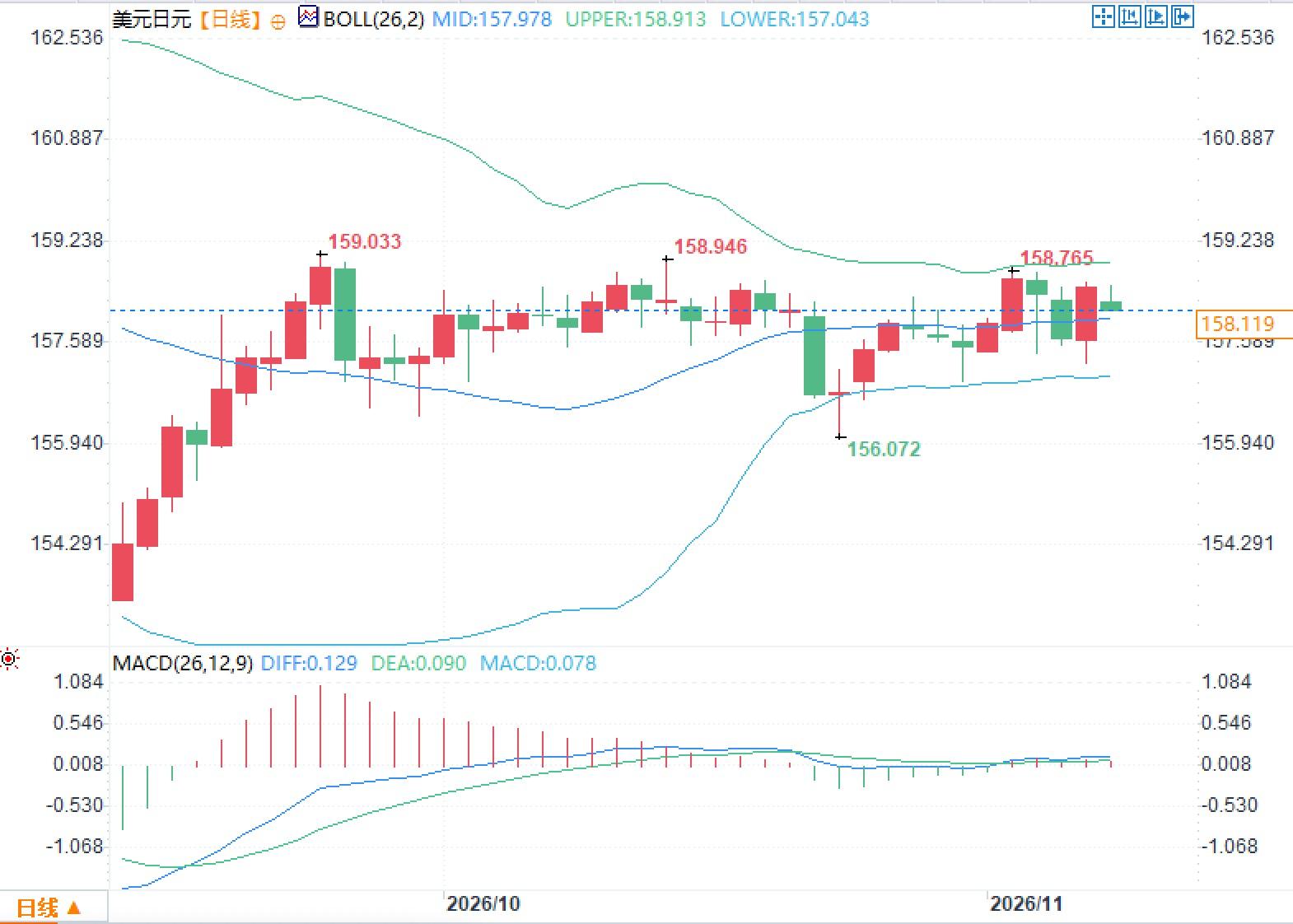
The USD/JPY exchange rate has recently fluctuated around 158. The daily chart shows the price approaching the middle Bollinger Band area, with the upper and lower bands at approximately 158.91 and 157.04 respectively. The bandwidth reflects recent volatility. The MACD indicator is in positive territory, with a small difference between the DIFF and DEA lines, and the histogram remaining positive but with limited amplitude, indicating a relatively stable momentum indicator. Exchange rate movements are influenced by the Bank of Japan's policy rate path, the external interest rate environment, trade and capital flows, and risk sentiment. The divergence between the leading index's decline and the coincident index's improvement, coupled with energy price and wage data, constitutes an important dimension for fundamental analysis. Market participants are focusing on the final value release, inflation readings, and central bank communications to assess the balance between growth and prices.Frequently Asked Questions
Question 1: What factors mainly reflect the decline in Japan's leading economic index to 116.4? Answer: The decline is mainly due to the lagged effects of natural disasters, cost pressures from high oil prices, and supply disruptions related to the Middle East conflict. Forward-looking indicators such as job seeking and consumer confidence are under pressure, and although government budget measures have partially buffered household burdens, price pressures persist. Question 2: How does the Bank of Japan view the current inflation and policy environment? Answer: After raising interest rates to 1.25% in September, the Bank of Japan kept them unchanged. Kazuo Ueda stated that core inflation has reached its target, but the duration is uncertain, and public expectations have not yet fully anchored. The policy emphasizes comprehensive data assessment, vigilance against overshooting risks, and continued monitoring of financial conditions.- Risk Warning and Disclaimer
- The market involves risk, and trading may not be suitable for all investors. This article is for reference only and does not constitute personal investment advice, nor does it take into account certain users’ specific investment objectives, financial situation, or other needs. Any investment decisions made based on this information are at your own risk.