













Eurozone expectations have fallen to a June low; what does the euro's technical structure reveal?
2026-11-09 19:00:28
On Monday, November 9th, the Eurozone investor confidence index further declined to 2.4, while the current conditions assessment remained at -3.3, and the economic expectations index fell to 8.3, the lowest since June. The euro traded around 1.119 against the dollar, with the market continuing to price in the weakening global growth momentum. The survey covered 1,025 investors, including 220 institutional investors, and the data collection window was from November 5th to 7th. This data reinforced the assessment of a Eurozone economic stagnation scenario, while the global composite index fell for the third consecutive month to 12.7, with the expectations sub-index dropping to 9.3. 
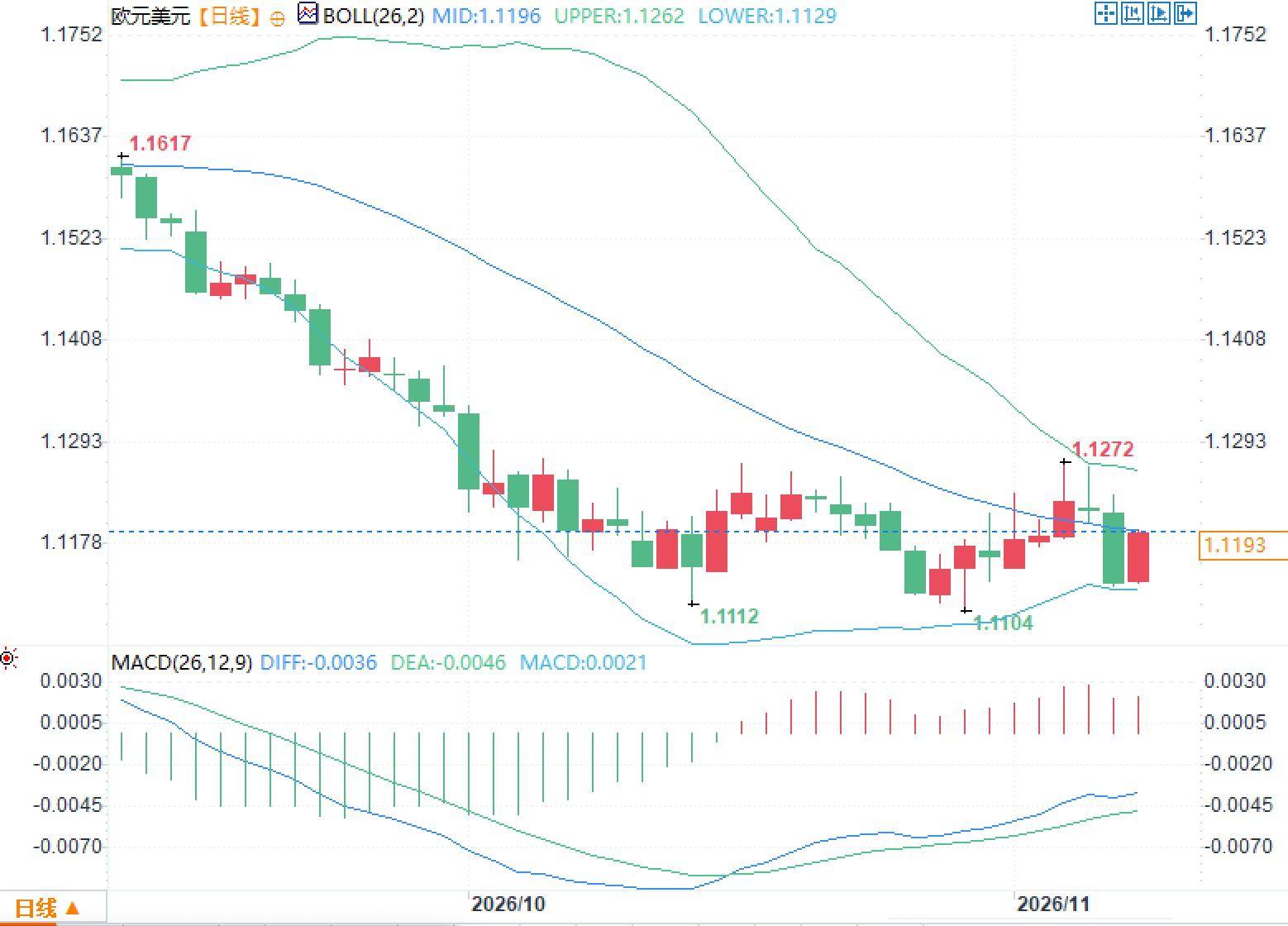 The price recently touched around 1.1272 before falling back, leaving a mark in the 1.1104 to 1.1112 range. The overall structure shows consolidation characteristics near the middle band, with the fluctuation range constrained by the upper and lower bands.
The core driver of the decline in the Eurozone confidence index
The Eurozone overall index fell 0.3 points to 2.4 from 2.7 in October, slightly above some market expectations, but the second consecutive month of decline clearly reflects a further weakening of recovery expectations. The current conditions sub-index remained stable at -3.3, indicating that economic activity has not yet escaped negative territory; the expectations sub-index, however, declined for the second consecutive month to 8.3, reaching its lowest point since June 2026. This divergence suggests that while investors' assessment of the current situation has not worsened further, doubts about the sustainability of future growth are accumulating. Key drags include persistently high interest rates, energy price pressures, and political uncertainty. These variables collectively suppress investment and consumption, making it difficult for the overall economy to escape stagnation. Following the data release, the euro's trading range against the US dollar did not widen significantly, reflecting that the market had already priced in similar signals, but the continued weakening of the expectations sub-index still constitutes a fundamental constraint.A comparison of signs of stabilization in Germany and expectations of a negative turn in the US.
The German sub-index rose slightly to -3.3, while the current conditions assessment improved for the fifth consecutive month to -14.0, reaching its highest level since May 2023. The expectations sub-index remained at 8.0. Officials pointed out that the German economy showed initial signs of stabilization, but a decisive breakthrough has not yet been achieved, with high costs and policy uncertainty remaining a fragile foundation. This improvement was limited and unlikely to reverse the overall stagnation assessment of the Eurozone. The US economic index fell 2.0 points to 13.1, the lowest since June 2026. The expectations sub-index declined 3.5 points to -2.5, entering negative territory for the first time since June, while the current conditions sub-index remained at 30.0. The survey indicated that changes in the political landscape of the US Congress may limit the scope for fiscal stimulus, and high financing costs and geopolitical risks have also exacerbated uncertainty. The widening gap between current conditions and expectations indicates that growth momentum is facing a test.Global momentum waning and changes in inflation policy expectations
The global composite index fell for the third consecutive month to 12.7, with the expectations sub-index also declining to 9.3, while the current conditions assessment remained relatively stable at 16.2. This trend, spanning major economies, indicates a broad weakening of growth momentum. The inflation-themed index improved from -29.25 to -22.5, and the central bank policy index rose from -21 to -12.75, reflecting investors' expectations of easing inflationary pressures and a slightly looser monetary policy environment, but this change is accompanied by a further weakening of the growth outlook. Interest rate paths and energy prices remain key variables. The policy stances of the European Central Bank and the Federal Reserve continue to influence financing conditions, while geopolitical conflict risks are creating additional disturbances to supply chain and price expectations. Overall, the data points to a degree of resilience in current conditions, but the continuous decline in forward-looking indicators has shifted market focus to the sustainability of growth.Technical Structure of EUR/USD
On the daily chart, the EUR/USD pair is trading near the middle Bollinger Band, which is around 1.1196, with the upper band at approximately 1.1262 and the lower band at around 1.1129. The current price level is close to the middle band, and the band width reflects recent converging volatility. The MACD indicator shows the DIFF at approximately -0.0036, the DEA at approximately -0.0046, and the histogram at approximately 0.0021. Both the fast and slow lines are below the zero line, and the histogram is in positive territory. The price recently touched around 1.1272 before falling back, leaving a mark in the 1.1104 to 1.1112 range. The overall structure shows consolidation characteristics near the middle band, with the fluctuation range constrained by the upper and lower bands.Frequently Asked Questions
Question 1: Does the decline in the Eurozone index mean the current economy has entered a recession? Answer: The current condition component remains at -3.3, while the overall index is still slightly above zero, indicating that activity has not yet contracted significantly. However, the continuous decline in expectations has reinforced the stagnation assessment. Question 2: Can the improvement in German data lead to a strengthening of the Eurozone as a whole? Answer: Germany's current condition has been improving, but the overall index remains negative, and Eurozone expectations are weakening in tandem. The improvement is insufficient to reverse the regional stagnation. Question 3: What impact will the negative turn in US expectations have on global indices? Answer: The first negative turn in US expectations, coupled with three consecutive months of decline in global indices, indicates that the forward momentum of major economies is weakening simultaneously, and growth prospects face broader constraints.- Risk Warning and Disclaimer
- The market involves risk, and trading may not be suitable for all investors. This article is for reference only and does not constitute personal investment advice, nor does it take into account certain users’ specific investment objectives, financial situation, or other needs. Any investment decisions made based on this information are at your own risk.

