













With the opening of the Strait of Hormuz still uncertain, is the pricing logic for crude oil risk changing?
2026-11-09 20:42:27
On Monday, November 9th, Brent crude oil futures entered a consolidation phase on the daily chart. Prices have retreated from near six-month highs in late October and are currently trading around $95 per barrel. Market focus is on the progress of negotiations between the US and Iran regarding nuclear program constraints and navigation arrangements in the Strait of Hormuz. US President Trump told the media that if sufficient progress is made on the nuclear program and reopening of the Strait, the possibility of further military action is low, but it still depends on the strength of the final agreement. US Secretary of State Rubio indicated limited progress in negotiations, with some Iranian demands being unacceptable, while emphasizing that diplomatic channels remain open. Unconfirmed reports of adjustments by Iran regarding Strait control and toll arrangements pushed prices further down, and the market awaits verifiable follow-up signals. 
 The market will continue to focus on the verifiability of the negotiation progress, actual data on cross-strait navigation, and cross-validation between inventory reports.
Geopolitical risk premium and the status of navigation in the Taiwan Strait
The Strait of Hormuz has long carried approximately one-fifth of the world's seaborne crude oil and liquefied natural gas trade. The ongoing conflict has reduced the strait's operational efficiency, limiting the capacity of alternative routes and thus maintaining a corresponding risk premium in the market. Current prices have retreated significantly from their highs, reflecting some participants' pricing adjustments based on the possibility that negotiations might alleviate supply disruption concerns. Meanwhile, limited military options remain, and such actions, if targeting nuclear facilities rather than energy infrastructure, would have a relatively limited direct impact on supply; the sustainability of the premium depends on how subsequent events unfold. The production adjustment capabilities and inventory levels of other global oil-producing countries provide some buffer, but in the short term, geopolitical factors still carry more weight in pricing than pure fundamental equilibrium.Considerations of supply balance and inventory dynamics
Against a geopolitical backdrop, changes in commercial inventories and strategic reserves remain closely monitored. The extent of the recovery in cross-strait navigation directly impacts the pace of Middle Eastern exports, which in turn affects global available supply. The stability of production in other regions and refinery operating rates determine the price's sensitivity to unexpected news. Currently, the market is awaiting clear diplomatic signals, and volatility remains at a high level. On the demand side, the pace of overall economic activity is affected, and cross-validation of inventory reports and export data becomes an important basis for observing the actual extent of supply recovery. Price reactions to unconfirmed news have shown that the market has a high demand for verifiable progress.Technical Pattern Observation
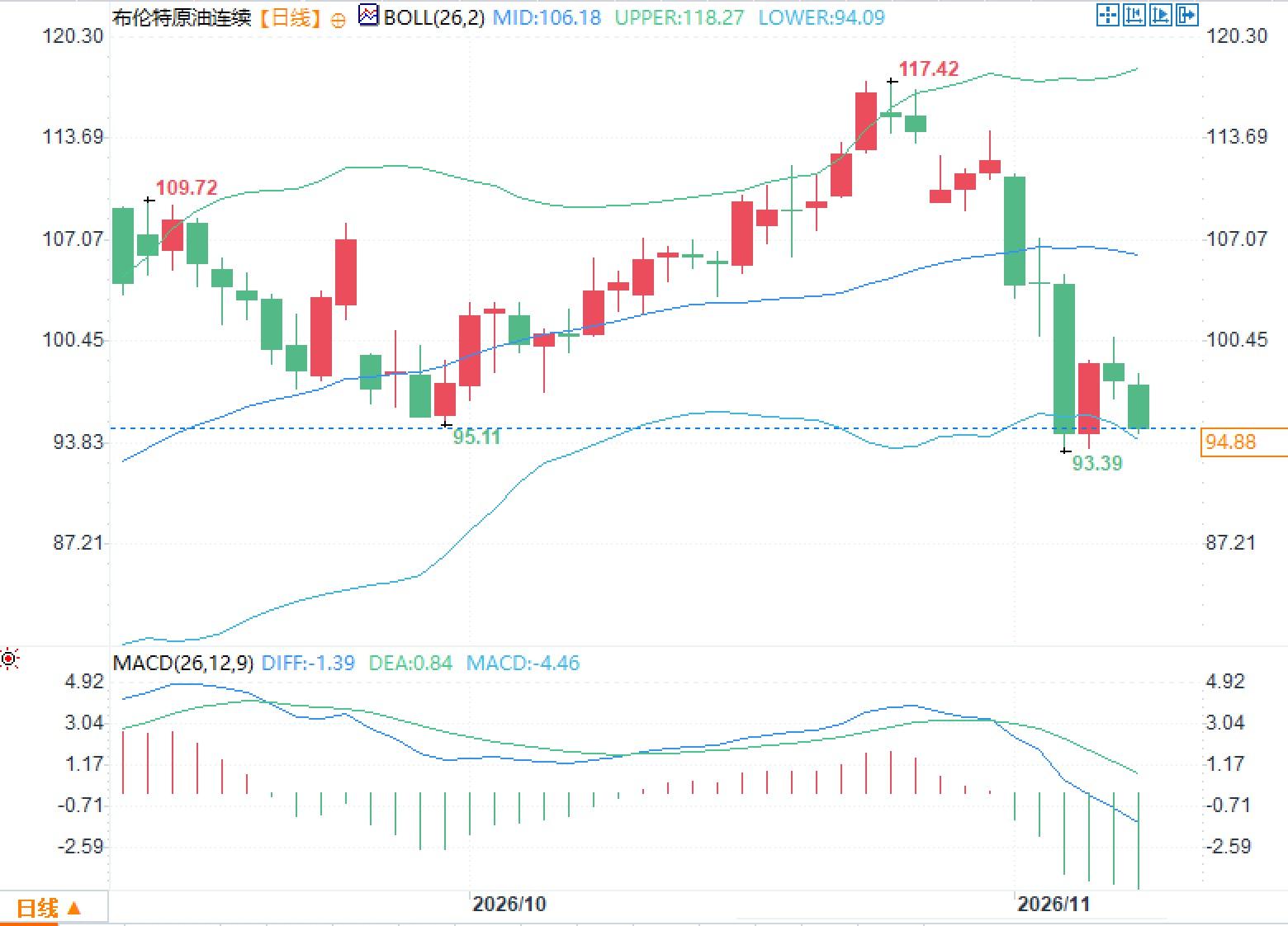
The daily chart shows that Brent crude oil futures are currently trading near the lower Bollinger Band, with the middle band around $106/barrel, the upper band around $118, and the lower band around $94. Prices have retreated from the high of around $117 at the end of October, and recent candlestick patterns show consolidation. The MACD indicator shows the DIFF line is negative, and the histogram is below the zero line, reflecting the current state of momentum. Trading has been primarily concentrated between $93 and $100/barrel, with trading volume converging after significant fluctuations. The market will continue to focus on the verifiability of the negotiation progress, actual data on cross-strait navigation, and cross-validation between inventory reports.Frequently Asked Questions
Question 1: What are the main drivers behind the current decline in Brent crude oil prices? Answer: The price decline from the late October high primarily reflects market adjustments to expectations that progress in US-Iran negotiations could reduce the risk of supply disruptions through the Strait of Hormuz. Unconfirmed concessions have further reinforced this dynamic, while Rubio's comments about limited progress have limited the extent of the decline. Question 2: Why is the Strait of Hormuz so crucial to global crude oil pricing? Answer: This strait handles approximately one-fifth of global seaborne crude oil trade. Any changes in navigation efficiency directly impact the availability of Middle Eastern exports, thereby altering expectations of global supply balance. The current risk premium is priced primarily in the uncertainty surrounding this passage, rather than simply production data. Question 3: How should we interpret the current consolidation characteristics shown by technical indicators? Answer: Prices are trading near the lower Bollinger Band, and the MACD histogram is below the zero line, indicating that recent momentum indicators are in a relatively weak range.- Risk Warning and Disclaimer
- The market involves risk, and trading may not be suitable for all investors. This article is for reference only and does not constitute personal investment advice, nor does it take into account certain users’ specific investment objectives, financial situation, or other needs. Any investment decisions made based on this information are at your own risk.

