A chart shows that the Baltic Dry Index rose, driven by increases in Capesize and Panamax freight rates.
2026-11-09 23:12:27
The latest data shows that the Baltic Dry Index (BDI) reached 2854 points on November 9, 2026, a new high since October 9, 2026, up 1.75% month-on-month, marking the fourth consecutive day of increase (including zero growth). Looking at the short-term charts, the recent 11 BDI data points show: 7 positive increases, 4 negative increases, and 0 zero increases. Specifically, the Panamax Freight Index (BPI) was 2037 points, up 1.70% from the previous value; the Capesize Freight Index (BCI) was 4459 points, up 2.65%; and the Supramax Freight Index (BSI) was 1810 points, down 0.28%. For detailed 720-day and 10-year trend charts of the Baltic Dry Index and its three main sub-indices, please refer to the charts specially created by FX678. 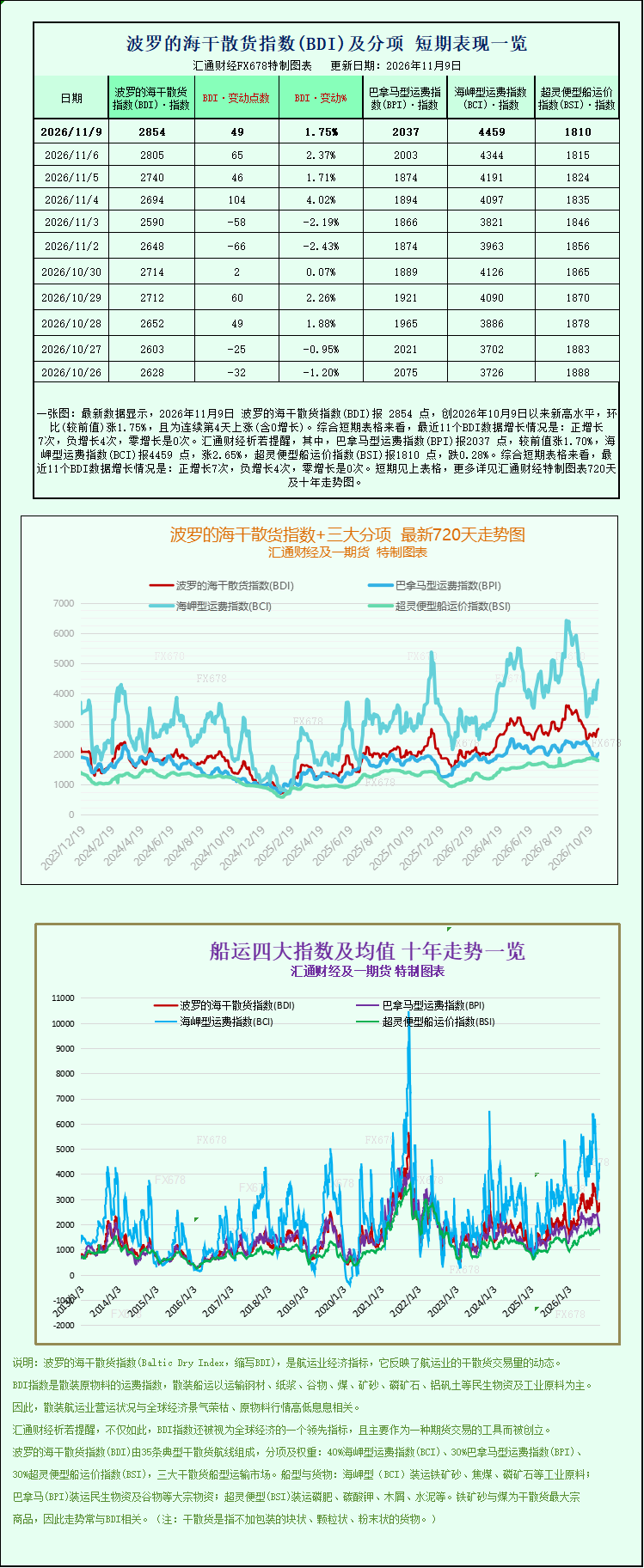 On November 9th, the Baltic Dry Index, which tracks freight rates for dry bulk commodities, rose on Monday, with significant increases in freight rates for Capesize and Panamax vessels driving the index's climb. The Baltic Dry Index, which tracks freight rates for Capesize, Panamax, and Supramax vessels, covers the three main types of dry bulk carriers. The index rose 49 points, or 1.8%, to close at 2854 points, a new high since October 9th. Dry bulk shipping indices are considered a crucial indicator of global commodity trade; fluctuations directly reflect changes in the supply and demand dynamics of the shipping market and indirectly reflect the trading activity of global industrial raw materials, food, and other commodities. This rebound breaks the previous period of weak and volatile trading, indicating a clear recovery in the dry bulk shipping market. Among the various ship types, the Capesize index performed the best, rising 115 points, or 2.7%, to 4459 points, reaching its highest level in over a month. Capesize vessels primarily transport bulk industrial raw materials such as iron ore and coal, with a single vessel carrying up to 150,000 tons, making them the mainstay of global iron ore transoceanic transportation. Data shows that the average daily earnings of this type of vessel increased by $1044, reaching $36936. The strong performance of the Capesize vessel market is closely related to changes in the fundamentals of the iron ore trade market. Last Friday, iron ore futures prices remained stable, achieving a second consecutive week of gains. The market generally expects a further decline in coking coal prices. Coking coal is an important raw material in steel production, and a price reduction in coking coal is expected to alleviate the production cost pressure on steel mills, boost their willingness to replenish raw material inventories, and thus drive the release of demand for seaborne iron ore procurement. The expected recovery in steel industry production directly transmits to the upstream shipping market, supporting the chartering demand for Capesize vessels and pushing up daily charter earnings. Panamax vessels also contributed significantly to the upward momentum, with the Panamax index rising 34 points, or 1.7%, to close at 2037 points, a new high since October 26. Panamax vessels, with a deadweight tonnage of 60,000 to 70,000 tons, primarily undertake ocean-going transport of coal and grain, playing a crucial role in global grain trade and the cross-border flow of thermal coal. Correspondingly, the average daily earnings of Panamax vessels increased by $300, reaching $18,330. The strengthening of Panamax freight rates stemmed from two main factors: firstly, demand for coal transportation in the Asia-Pacific region increased due to increased coal transport orders resulting from thermal power plant restocking; secondly, the global cross-regional flow of grain maintained a certain volume, with stable shipping orders from South American grain exports and Asian grain imports supporting charterer bids for Panamax vessels, thus driving up both freight rates and vessel profitability. However, not all ship types experienced a synchronized price increase. The small vessel sector showed divergence, with the Supramax index weakening slightly, falling 5 points, or 0.3%, to 1810 points, its lowest level since October 8th. Supramax vessels are more focused on short-haul, small-volume dry bulk shipping, with more fragmented trade cargo sources. This sector's decline reflects that market demand for small and medium-sized bulk carriers has not recovered in tandem with that of larger vessels. Large vessels primarily handle long-distance, large-volume intercontinental bulk freight orders, significantly driven by steel mill raw material procurement and large-scale grain export projects. Supramax vessels, on the other hand, primarily serve short-haul regional trade. Currently, regional demand for small-volume bulk cargo is weak, supply is insufficient, and competition in the charter market is intensifying, putting downward pressure on freight rates for this vessel type, a stark contrast to the booming market for large vessels. From a market perspective, the core driver of this round of Baltic Dry Index rebound is concentrated on large dry bulk carriers, with improved expectations on the industrial raw material side playing a dominant role. Improved iron ore demand expectations boosted the Capesize vessel market, while coal and grain trade supported the strength of Panamax vessels. These two major vessel types propelled the overall market index higher, but smaller vessels have not yet caught up with the recovery pace, resulting in a pronounced structural differentiation in the market. Industry analysts believe that the future trend of the dry bulk shipping market still requires close attention to two key variables. First, the actual production and raw material procurement pace of China's steel industry. Currently, the market only anticipates lower coking coal prices and steel mill resumption of production. If the actual operating rate of steel mills falls short of expectations, there is a risk of a decline in seaborne iron ore demand, making it difficult to sustain the high freight rates of Capesize vessels. Second, changes in the global export and import pace of grain and coal. With the Northern Hemisphere entering winter, demand for heating coal in some regions is expected to increase, potentially benefiting Panamax vessels. However, the uncertainties brought about by the global macroeconomic environment must also be considered. The pace of global economic recovery and the activity level of industrial production in various countries will indirectly affect the scale of commodity trade, thereby influencing the trend of dry bulk shipping freight rates. The current market sentiment is generally optimistic, but structural differentiation reminds market participants that this recovery lacks the foundation for a broad-based rally. The market is highly dependent on the realization of genuine demand from downstream industries, and a rise driven solely by market expectations carries the risk of a correction. Whether the Baltic Dry Index can break through further upwards will depend on continued monitoring of steel mill restocking progress, commodity export shipments, and shipping capacity deployment. It will also be important to observe whether the strong performance of large vessels can spread to the small and medium-sized vessel sector, achieving a synchronized recovery across the entire market.
- Risk Warning and Disclaimer
- The market involves risk, and trading may not be suitable for all investors. This article is for reference only and does not constitute personal investment advice, nor does it take into account certain users’ specific investment objectives, financial situation, or other needs. Any investment decisions made based on this information are at your own risk.