European central banks have moved gold reserves out of the United States, but their dollar reserves remain high.
2026-11-10 15:06:30
Since 2013, several central banks in the Eurozone, including the Netherlands, France, and Germany, have publicly announced the relocation of their gold reserves. Many countries have moved their gold out of overseas custody and reduced their dollar assets due to concerns about sanctions risks. However, Germany, France, and the Netherlands have not followed this model. Even after their gold was moved out of the United States, their dollar reserves still accounted for a high proportion.
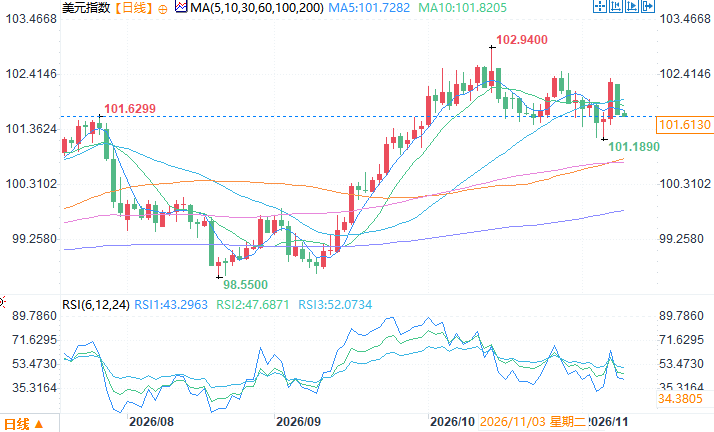 US Dollar Index Daily Chart Source: EFX At 15:04 Beijing time on November 10, the US Dollar Index was at 101.62.
The core significance of gold storage locations: circumventing sanctions and asset seizure.
One major advantage of gold as a reserve asset is its potential to circumvent financial sanctions and asset freezes imposed by other countries, a significant difference from foreign currency reserves. However, this is contingent on the gold not being stored within the territory of the country imposing sanctions. Central banks, concerned about this, typically choose to repatriate their gold reserves to their home countries; Russia and Turkey are typical examples. In the 2010s, Russia continuously increased its gold holdings and reduced its dollar holdings, storing all its gold domestically. In 2018, Turkey repatriated its gold reserves held in the US and UK, while simultaneously significantly reducing the proportion of dollars in its reserves, amidst heightened geopolitical tensions between Turkey and the US. Of course, the choice of custody location also considers other factors, such as proximity to international gold trading markets and ease of trading; sanctions risk is just one consideration.The first gold rush of the 2010s: Germany and the Netherlands, with dollar positions remaining largely unchanged.
Between 2013 and 2017, Germany repatriated one-fifth of its gold reserves held in the United States. During this period, the proportion of US dollars in Germany's foreign exchange reserves remained stable at around 90%, and currently remains above 80%, significantly higher than the global average. The Netherlands repatriated two-fifths of its gold reserves held in the United States in 2014. At that time, its US dollar reserves maintained a proportion of 83%, only briefly declining to nearly 50% in 2018 before quickly rebounding. This was a one-off fluctuation, not a long-term de-dollarization strategy.A new round of adjustments in the 2020s: France repatriates all its funds, the Netherlands transfers them to London, and the US dollar remains the dominant currency.
France plans to repatriate all of its gold reserves held in the United States between 2025 and early 2026. However, the proportion of its foreign exchange reserves held in US dollars will remain stable at 60%, indicating that it has not reduced its dollar assets in line with the global trend of declining dollar reserves. The Netherlands, on the other hand, will transfer two-fifths of its gold reserves, originally held in the United States, to London for safekeeping in 2026. During the same period, the proportion of its reserves held in US dollars will decrease by 10 percentage points, but this proportion will still be higher than the low point in 2018, and the US dollar will continue to dominate its reserve structure.The Eurozone central bank's underlying choice: prioritizing dollar asset returns and liquidity advantages.
A comparison of the actions of Russia and Turkey reveals a clear distinction: many countries are relocating their gold reserves overseas while simultaneously reducing their dollar holdings, essentially a dual hedging strategy against potential sanctions; however, the three Eurozone central banks—Germany, France, and the Netherlands—did not significantly diversify or strip away their dollar reserves after moving their gold out of the US. For them, the combined benefits and convenience of dollar assets, backed by the size of the US economy and the unparalleled depth and liquidity of its financial markets, outweigh the potential geopolitical risks. Adjustments to gold custody arrangements are more of an independent asset safekeeping arrangement and do not equate to a decline in confidence in dollar reserves.Conclusion
The continued relocation of gold reserves from the United States by major Eurozone countries could easily be interpreted as a signal of de-dollarization, but the data does not support this conclusion. Adjustments to the custody of gold reserves and the allocation of dollar assets are two independent decisions. As long as the liquidity advantage of the dollar market remains, the European Central Bank will not easily abandon its dollar reserves on a large scale. US Dollar Index Daily Chart Source: EFX At 15:04 Beijing time on November 10, the US Dollar Index was at 101.62.
- Risk Warning and Disclaimer
- The market involves risk, and trading may not be suitable for all investors. This article is for reference only and does not constitute personal investment advice, nor does it take into account certain users’ specific investment objectives, financial situation, or other needs. Any investment decisions made based on this information are at your own risk.