US-Iran-Russia-Ukraine negotiations strain oil prices; Hergésés faces impeachment.
2026-11-10 16:24:27
On Tuesday (November 10th) during the Asian and European sessions, international oil prices continued to decline following Monday night's sharp drop. Currently, the WTI crude oil futures contract is trading around 85.32, down 1.80%. Recently, oil prices have been continuously influenced by global geopolitical news. Last night, according to Saudi Arabia's Al Arabiya television, citing Arab sources, a proposal from Qatar and Pakistan reactivated substantive negotiations between the US and Iran. The two sides are expected to reach a preliminary agreement on the issue of Iranian uranium enrichment. Rumors involving a solution to the nuclear issue briefly caused Brent crude oil to plummet by over 5%, while spot gold and silver rose simultaneously, and the Nasdaq's gains expanded to 3%. However, US President Trump subsequently held an emergency meeting with the Qatari Prime Minister at the White House. After the meeting, Trump stated that Qatar and Saudi Arabia hoped for a peaceful resolution to the Iranian conflict, but the US was prepared to resume military strikes if necessary. Trump added that the two sides discussed Iranian-related issues in depth, and Qatar, Saudi Arabia, the UAE, Bahrain, Kuwait, and other countries preferred to maintain the status quo, that is, to continue implementing the "largest naval blockade in history," while indicating that the possibility of further large-scale strikes was low. Trump wanted to end the war amicably, but Iran did not comment and denied any nuclear negotiations. Meanwhile, negotiations between Russia and Ukraine are underway, which is expected to ease geopolitical tensions, causing oil prices to fall accordingly. 
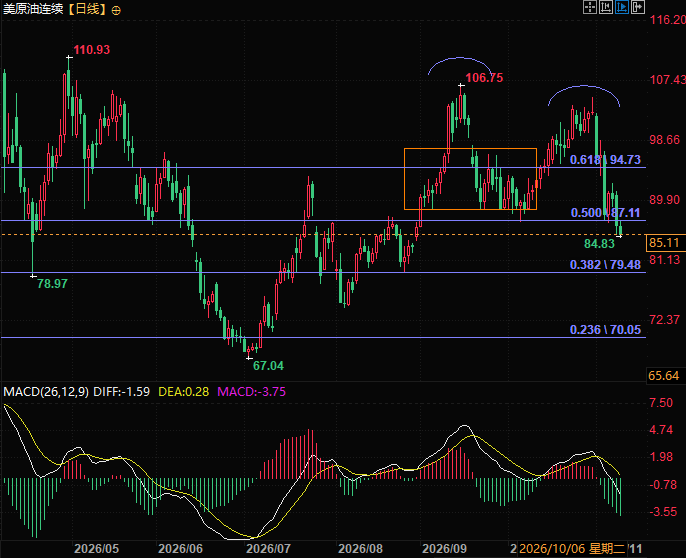 (WTI crude oil futures daily chart, source: EasyTrade) At 16:21 Beijing time, the WTI crude oil futures contract is currently trading at $85.10 per barrel.
The protracted negotiations between the US and Iran have stirred up new turmoil in US politics.
Qatar and Pakistan spearheaded a new proposal to bring the US and Iran back to the negotiating table. Reports indicated a preliminary agreement was drafted: the US would allow Iran to maintain its uranium enrichment level at 3.67%, Iran would agree to dilute its highly enriched uranium to 60%, and a third country would assist in disposing of its stockpile; IAEA inspectors would return to Iran, the Strait of Hormuz blockade would be lifted, and the US would release $6-9 billion in frozen Iranian assets. However, the negotiations immediately took a turn when Iran's top security official directly refuted the reports as fake news, demanding the US accept seven negotiating conditions and refusing to compromise under duress. Meanwhile, Trump publicly signaled de-escalation, stating in a press conference that the conflict with Iran would soon be over and that military action was unnecessary at this stage; he later added on social media that several Middle Eastern countries still supported maintaining the maritime blockade and advancing "Operation Iron Gate," that there was no room for negotiation on Iran's nuclear program, and that the US military could intervene at any time should the situation change. Iranian officials also simultaneously stated that the Supreme Leader had ordered an end to the "neither war nor peace" state and was willing to begin negotiations, but would not accept the bullying terms offered by the United States. There were also reports that Iran had made concessions on the conditions for navigation in the Strait of Hormuz. Meanwhile, political changes occurred in the United States, with members of the House of Representatives formally submitting a resolution to initiate impeachment proceedings against Defense Secretary Hergsays. External military actions coupled with internal political strife further increased the uncertainty of US Middle East policy. Affected by the continued escalation of the Iranian military threat, the US military again scaled back its forces, withdrawing aerial refueling tankers from RAF Mildenhall in the UK for the second time and transferring them to bases in Germany; previously, the Pentagon had already withdrawn B-1 bombers stationed in the UK to mitigate the risk of Iranian drone attacks.Shipping in the Strait of Hormuz continues to recover, but the risks to navigation remain high.
Although geopolitical tensions have not subsided, crude oil and LNG shipments through the Strait of Hormuz have steadily recovered. Saudi shipping company Bahri, coordinated by the United States, dispatched four oil tankers through the strait that day, steadily resuming crude oil exports and gradually bringing shipments back to pre-conflict levels. Ship tracking data shows that 31 LNG carriers passed through the Strait of Hormuz in October, a new monthly high since the outbreak of the conflict. Qatari exports recovered to more than 30% of pre-war levels, and UAE transit volumes have fully returned to pre-conflict levels. However, navigational safety risks have not been eliminated; attacks on ships in the strait remain frequent, and the maritime blockade has not been completely lifted. The Houthi rebels along the Red Sea continue to coordinate the situation, using the Bab el-Mandeb Strait to disrupt shipping and repeatedly clashing with the Saudi-led coalition. Both key shipping routes are under pressure simultaneously, global oil shipping costs remain high, and the shipping market continues to be shrouded in geopolitical risks.Institutional View: Short-term premium has declined, but medium- to long-term oil price risks remain on the rise.
Analysts believe that the current Middle East situation will likely see little compromise between the two US parties on Iran's core demands, resulting in a situation where "conflict escalation is manageable, but negotiations remain deadlocked." On one hand, congressional budget constraints and voter aversion to war will limit Trump's potential expansion of the conflict; on the other hand, Iran's core strategic demands are unlikely to be accepted by the US, making a diplomatic breakthrough extremely difficult. Goldman Sachs cautions traders against excessive optimism, noting that while short-term negotiation news has mitigated some extreme risk premiums, the safety of shipping in the Strait of Hormuz remains fragile until a formal written agreement is reached. The bank has raised its medium- to long-term oil price forecasts, increasing its Brent crude oil target to $105/barrel and WTI crude oil target to $94/barrel by the end of 2026; its 2027 average Brent price forecast is raised to $88/barrel and WTI to $78/barrel, with geopolitical supply risks remaining the core driver of oil price support.Summary and Technical Analysis:
Short-term oil prices are entirely driven by geopolitical news. Positive progress in US-Iran and Russia-Ukraine talks will quickly suppress oil prices, while a breakdown in negotiations and escalating hardline stances will immediately lead to a rebound. However, unlike in the past, Trump has lost both parties, and his Secretary of Defense is undergoing impeachment proceedings, making the continuation of the war uncertain. Military spending is unlikely to be approved, so the focus is on whether the US can achieve a breakthrough in negotiations quickly. From a shipping perspective, the continued recovery in shipping volume in the Strait of Hormuz supports spot supply, but Iran and the Houthis could resume attacks on ships at any time, and the risk of shipping disruption remains. The supply premium brought about by geopolitical conflicts has not completely subsided. Even if short-term setbacks in negotiations lead to a price rebound, the start of Russia-Ukraine negotiations and the change of power in the US Congress will limit the overall ceiling for oil prices. Future trading will require close monitoring of the details of US-Iran diplomacy and Russia-Ukraine negotiations, as well as continuous tracking of tanker traffic in the Strait of Hormuz and the movements of the Houthi rebels in the Red Sea. Technical Analysis: The neckline of the double-top pattern in WTI crude oil futures has been broken. If oil prices cannot quickly recover the losses around 87-88 in the short term, there is a risk of falling to around 70. (WTI crude oil futures daily chart, source: EasyTrade) At 16:21 Beijing time, the WTI crude oil futures contract is currently trading at $85.10 per barrel.
- Risk Warning and Disclaimer
- The market involves risk, and trading may not be suitable for all investors. This article is for reference only and does not constitute personal investment advice, nor does it take into account certain users’ specific investment objectives, financial situation, or other needs. Any investment decisions made based on this information are at your own risk.