The dollar's strength remains intact; how far can the euro's rebound go?
2026-11-10 16:18:30
The euro edged higher against the dollar on Tuesday (November 10), holding onto gains from Monday's strong rally, as traders held firm ahead of the release of U.S. CPI data later in the day. The euro traded slightly below 1.1230 at the start of the European session, having rebounded from a low of 1.1137 on Monday. 
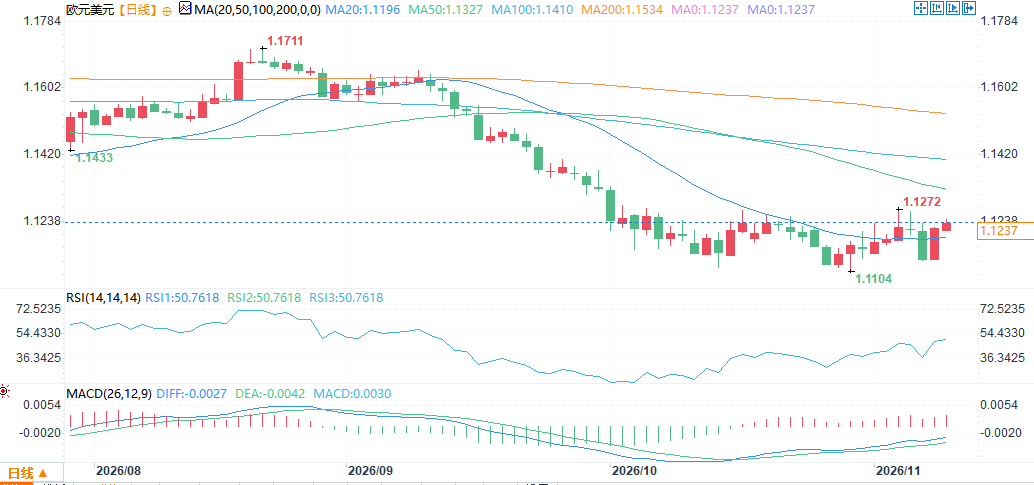 (Euro/USD daily chart, source: FX678) At 16:11 Beijing time, the euro was trading at 1.1237/38 against the US dollar.
Oil price easing: Falling oil prices provide support for eurozone importing economies.
The euro found support at the start of the week in risk appetite as reports of progress in diplomatic efforts to resolve the Middle East conflict pushed oil prices to a two-month low. Furthermore, President Trump's decision to rule out an attack on Iran during ongoing negotiations helped improve market sentiment. Against this backdrop, Brent crude fell more than 20% in a week, providing significant relief to the eurozone's oil-importing economies. The decline in oil prices directly improved the eurozone's terms of trade and inflation outlook—lower energy import costs supported growth and eased inflationary pressures on the European Central Bank, forming the fundamental basis for the euro's recent rebound.Market sentiment: Volatility slows as investors are reluctant to short the dollar ahead of CPI data.
However, market volatility subsided on Tuesday as investors prepared for the release of US CPI data. This report will lack year-over-year data due to the 2025 federal government shutdown, and monthly data is expected to show easing price pressures. The euro's rise was more a result of "the dollar not being shorted" than "the euro being actively long"—investors chose to hold dollars rather than sell them ahead of the CPI, which limited the euro's rise to dollar-driven pricing rather than its own momentum.US Context: Strong employment and GDP provide an ideal scenario for further tightening by the Federal Reserve.
These data follow Friday's strong U.S. labor market report, which showed a significant increase in net jobs in October. Prior to this, GDP data showed the economy grew at an annualized rate of 3.4% in the third quarter. Overall, this is an ideal scenario for the Federal Reserve to further tighten monetary policy in the coming months. The strength of the U.S. economy provides a data basis for the Fed's hawkish stance, thus keeping interest rate differentials favorable to the dollar—the euro's rise requires a weakening dollar, not an improvement in its own interest rate differentials.Institutional View: The US dollar slightly retraced its gains from the non-farm payrolls report, but the overall outlook remains constructive.
Some institutional strategists observed that the dollar "gave back some of the gains from Friday's strong October nonfarm payroll data," although they noted that the broader context remains constructive for the dollar, as "strong U.S. economic activity, favorable labor market conditions, and persistent underlying inflation support the Fed's hawkish stance, keeping interest rate differentials in support of the dollar." The dollar's pullback is technical and limited in magnitude, rather than a trend reversal—the combination of interest rate differentials and fundamentals remains favorable for the dollar, thus limiting the euro's upside potential to this structural factor.in conclusion
The euro edged higher against the dollar on Tuesday, reaching around 1.1230 and holding above Monday's low of 1.1137. Support came from a pullback in oil prices – Brent crude fell more than 20% in a week, with Middle East diplomatic developments and Trump's decision to rule out attacking Iran pushing prices to a two-month low, providing significant relief to oil-importing economies in the eurozone and improving terms of trade and inflation prospects. However, market volatility eased ahead of the CPI, with investors reluctant to short the dollar; the October CPI will not show a year-on-year comparison, and monthly data is expected to show easing price pressures. Strong US employment and GDP provide an ideal scenario for further tightening by the Federal Reserve. Analysts point to strong US economic activity, a favorable labor market, and persistent underlying inflation, supporting a hawkish stance and continued favorable interest rate differentials for the dollar. The euro's upside is therefore constrained by the dollar's pricing – the short-term direction depends on the CPI: a weaker CPI could see the euro test above 1.1230, while a meeting of expectations would limit dollar retracement and allow the euro to consolidate at higher levels. (Euro/USD daily chart, source: FX678) At 16:11 Beijing time, the euro was trading at 1.1237/38 against the US dollar.
- Risk Warning and Disclaimer
- The market involves risk, and trading may not be suitable for all investors. This article is for reference only and does not constitute personal investment advice, nor does it take into account certain users’ specific investment objectives, financial situation, or other needs. Any investment decisions made based on this information are at your own risk.