A chart shows the Baltic Dry Index rising to a one-month high, boosted by Panamax freight rates.
2026-11-10 23:38:27
The latest data shows that the Baltic Dry Index (BDI) reached 2862 points on November 10, 2026, a new high since October 9, 2026, up 0.28% month-on-month, marking the fifth consecutive day of increase (including zero growth). Looking at the short-term charts, the recent 11 BDI data points show: 8 positive increases, 3 negative increases, and 0 zero increases. Specifically, the Panamax Freight Index (BPI) was 2075 points, up 1.87% from the previous value; the Capesize Freight Index (BCI) was 4457 points, down 0.04%; and the Supramax Freight Index (BSI) was 1806 points, down 0.22%. For detailed 720-day and 10-year trend charts of the Baltic Dry Index and its three main sub-indices, please refer to the charts specially created by FX678. 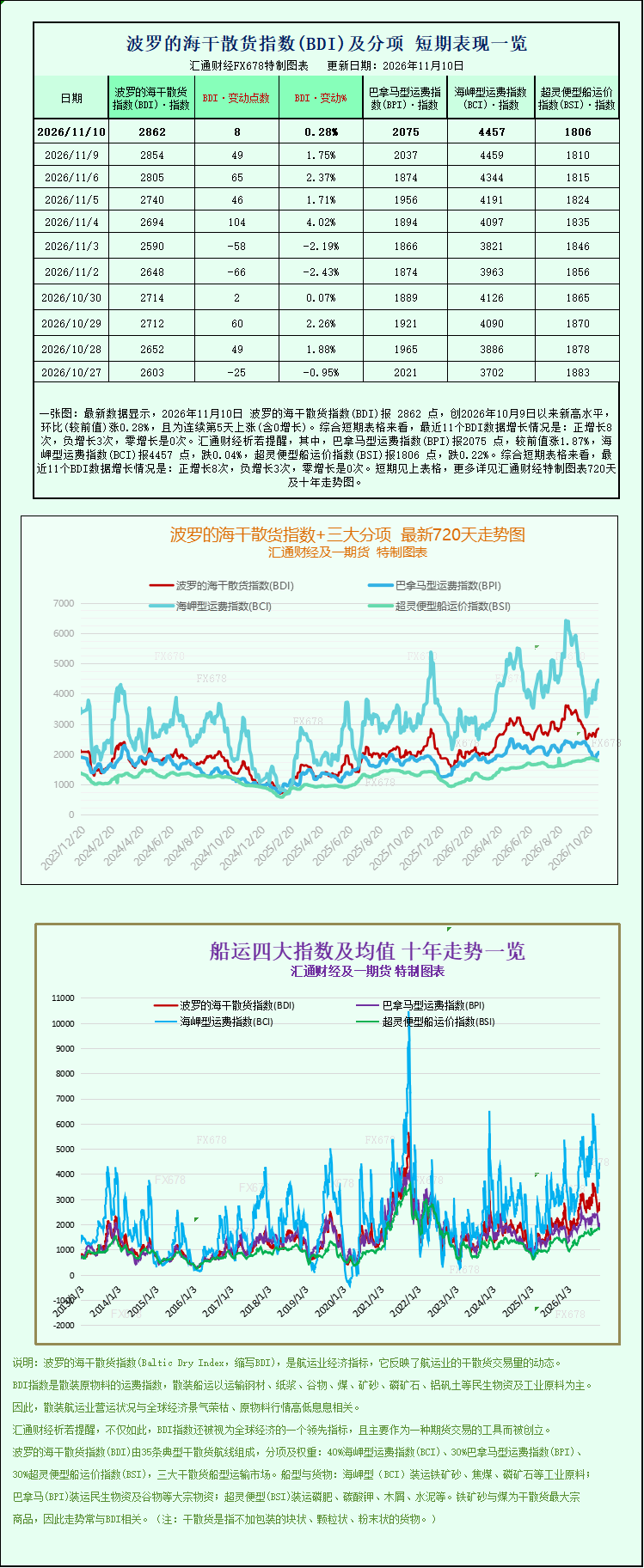 The Baltic Dry Index (BDI), a key indicator of global dry bulk shipping rates, rose slightly on Tuesday, reaching a near one-month high. This increase was primarily driven by stronger Panamax vessel rates. The BDI, which covers Capesize, Panamax, and Supramax dry bulk carriers, rose 8 points, or 0.3%, to close at 2862 points, a new high since October 9th. This index is one of the most important indicators of the global commodity shipping market, used by market participants, traders, miners, grain traders, and shipping capital to assess the global physical flow of goods. A rising index typically indicates a recovery in global dry bulk shipping demand and increased bargaining power for shipowners; a falling index suggests insufficient cargo space, relative overcapacity, and pressure on the shipping market. Dry bulk shipping carries the transoceanic transport of basic industrial raw materials such as iron ore, coal, grain, cement, and fertilizer, as well as bulk agricultural products. Its freight rate fluctuations not only reflect global manufacturing, infrastructure activities, energy consumption, and food trade, but also conversely affect commodity trade costs, transmitting along the industrial chain to upstream resource-rich countries and downstream manufacturing economies. Looking at different vessel types, the trends show a clear divergence. The Capesize index remained flat at 4457 points on the day, having just reached a peak in over a month the previous trading day, entering a short-term consolidation phase. Capesize vessels are the largest and most important vessel type in the dry bulk fleet, with a standard deadweight of approximately 150,000 tons. They primarily transport iron ore and thermal coal, and their trade flows are highly tied to iron ore shipping routes from Australia and Brazil to China, as well as transoceanic coal trade between Indonesia and Australia. They are a leading indicator for observing the raw material procurement pace of China's steel industry. Data shows that the average daily earnings of Capesize vessels fell by $19 on the day, to $36,917. Despite stabilizing freight rates at high levels, per-vessel earnings have slightly declined, reflecting a slowdown in the upward momentum of the Capesize market. The previous surge in Capesize freight rates was mainly driven by temporary disruptions in iron ore shipment schedules and a concentrated release of cargoes due to steel mill restocking. With the earlier peak arrival window closed, coupled with continued profit constraints on domestic steel mills and limited willingness to actively replenish inventory, Capesize freight rates lost their support for sustained upward movement and instead traded sideways at high levels. Iron ore futures maintained a narrow trading range on Tuesday, with the balance of power between bulls and bears approaching equilibrium. On the one hand, a decline in global iron ore shipments and a significant drop in arrivals at major Chinese ports provided support for prices due to supply contraction. On the other hand, persistently high port iron ore inventories, coupled with weak end-user demand from domestic steel mills, suppressed upward price potential. These two factors offset each other, making it difficult for iron ore to break out of a one-sided trend. The demand for iron ore is fundamentally based on steel production, which in turn is linked to end-user industries such as real estate, infrastructure, and machinery manufacturing. The recovery of downstream orders is currently slow, and steel mills are maintaining a cautious production stance, primarily purchasing raw materials on an as-needed basis rather than stockpiling on a large scale. This has limited the enthusiasm of upstream iron ore traders to continue chartering and securing shipments, indirectly dragging down Capesize freight rates. This supply-demand tug-of-war has also deprived the Capesize shipping sector of its independent upward momentum, leading to consolidation after reaching a recent high. Panamax vessels became the biggest highlight of the day. The Panamax index rose 38 points, or 1.9%, to close at 2075 points, returning to the level of October 26th. Panamax vessels typically have a deadweight tonnage of 60,000 to 70,000 tons, with core cargoes being coal and grain. Their routes cover multiple grain export routes in the Atlantic and Pacific Oceans, as well as coal trade in the Asia-Pacific region. Compared to Capesize, the market structure is more diversified and more susceptible to changes in grain exports from various countries and coal demand for thermal power generation. Panamax vessels saw a significant surge in daily earnings of $342 to $18,672, outpacing the Baltic Dry Index and serving as the core driver of the Baltic Dry Index's rise. This round of strong Panamax freight rates is supported by multiple real-world factors. Entering the fourth quarter, the Northern Hemisphere enters winter, leading to increased electricity demand for heating in some countries and boosting thermal coal trade. Simultaneously, North and South America and the Black Sea region enter their traditional shipping window, resulting in a concentrated release of ocean-going export cargoes for corn, soybeans, and wheat, continuously consuming available Panamax capacity. The simultaneous increase in grain and coal cargoes, coupled with temporary tightening of capacity on some regional routes, has strengthened shipowners' pricing confidence, pushing up freight rates for this vessel type. Unlike Capesize vessels, which heavily rely on Chinese iron ore demand, the Panamax market has more diversified demand sources. In addition to Asian coal imports, Black Sea grain exports and Gulf Coast grain shipments to Europe and the Middle East can provide additional cargo volume. This makes it easier for structural market trends to emerge when single-demand demand weakens. The weakness in the small vessel sector offset some of the gains brought by Panamax vessels. The Supramax index fell 4 points, or 0.2%, to close at 1806, its lowest level since October 7. Supramax vessels are smaller and have more flexible routes, handling not only coal and grain but also fertilizers, building materials, and small-volume ore shipments, serving a large volume of short-haul and feeder trade. The weakening freight rates for this vessel type reflect relatively weak small-to-medium-sized bulk cargo trade and regional feeder flows, highlighting a highly segmented market demand. The divergence in market performance among large, medium, and small vessels indicates that the current global dry bulk market is not experiencing a full recovery but rather a structural differentiation: the recovery in Panamax vessel demand is driven by grain and winter heating coal, but demand for general bulk cargo and small-volume raw materials has not kept pace, making the overall recovery foundation still unstable. Overall, the current rebound in the Baltic Dry Index is a structural market trend, not a full-blown bull market. Capesize vessels are fluctuating at high levels due to the constraints of a weak Chinese steel industry chain; Panamax vessels are benefiting from the peak season for grain exports and a phased recovery in winter coal demand; Supramax vessels continue to weaken due to sluggish general cargo demand. The future market trend will require continuous monitoring of several key variables: the pace of recovery in iron ore shipments from Brazil and Australia, the willingness of domestic steel mills to replenish raw materials, the progress of grain export shipments from the Black Sea and the Americas, the increase in coal consumption for thermal power generation in the Asia-Pacific region during winter, and the medium- to long-term supply pressure from new ship deliveries. If the phased cargo gains in grain and coal fade, and iron ore demand does not improve significantly, the upside potential of this index rebound may be limited; conversely, if downstream manufacturing and infrastructure demand recovers more than expected, driving a sustained increase in iron ore and coal purchases, the dry bulk shipping market is expected to see an overall strengthening.
- Risk Warning and Disclaimer
- The market involves risk, and trading may not be suitable for all investors. This article is for reference only and does not constitute personal investment advice, nor does it take into account certain users’ specific investment objectives, financial situation, or other needs. Any investment decisions made based on this information are at your own risk.