













Geopolitical premium recedes! The Fed's independence strengthens and turns hawkish, but gold prices still have room to rise.
2026-11-11 18:10:28
Gold prices saw a weak rebound during the Asian and European sessions on Wednesday (November 11), currently trading around 4050. Before the US election results, the core conflict in the gold market was the ongoing US-Iran conflict and concerns about stagflation stemming from rising oil prices. Funds were simultaneously betting on geopolitical safe-haven buying and fearing that rising energy prices would force the Federal Reserve to continue tightening monetary policy. This created a two-way pull on gold prices. However, with the White House losing both houses of Congress and the US president's power being limited, the Federal Reserve may adopt a more hawkish stance that aligns with market data. 
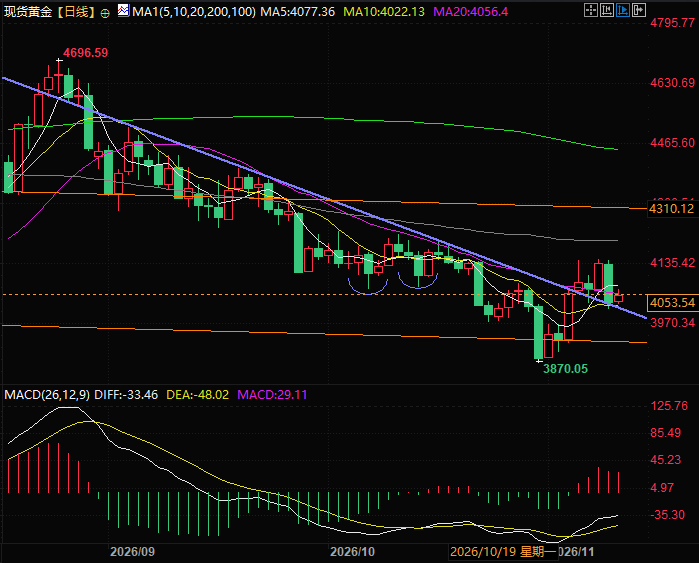 (Spot gold daily chart, source: EasyTrade) At 18:07 Beijing time, spot gold is currently trading at $4055 per ounce.
Gold price drivers shift: Geopolitical advantages fade, Fed policy returns to center stage
With the White House losing bipartisan support, the ceiling for escalating the US-Iran conflict has become apparent, the marginal increase in geopolitical premiums has disappeared, and the dominant variable for gold prices has once again been handed back to the Federal Reserve's monetary policy. The White House's limited political power has objectively amplified the Fed's policy independence. In the past, the White House had a strong incentive to intervene in monetary policy and pressure for interest rate cuts; now, with the president's policy space shrinking, the Fed can more purely focus on its dual mandate and need not consider short-term political demands as much. Coupled with the latest data—non-farm payrolls and the unemployment rate performing better than expected, showing no signs of weakening in the labor market, but core inflation rebounding more than expected—this creates ample policy ground for the Fed to shift towards a hawkish stance. Even if a large part of this round of inflation originates from energy supply shocks, the Fed has sufficient reason to prioritize curbing the spread of inflation.Divergent Interest Rate Hike Expectations: Benchmark 25bp Implemented, Beware of Data-Driven Further Acceleration Risks
The market has already priced in a 100% probability of a December rate hike, but the disagreement centers on the magnitude of the increase. The baseline scenario remains 25 basis points, with a 50 basis point hike being a tail risk and unlikely. However, Waller's recent remarks have provided a clear warning signal: if subsequent data continues to show "unresilient employment and persistently rising inflation," the Fed may consider further tightening, meaning the 50 basis point figure increases the likelihood of continued rate hikes. The core logic here is very clear: the Fed's primary responsibility is price stability, and without a deterioration in employment, it has no reason to tolerate inflation consistently exceeding its target. Supply shocks themselves cannot be improved through rate hikes, but the transmission of energy price increases to the service sector and wages, creating endogenous inflation, is a risk the Fed must prevent and will not allow simply because inflation originates from oil prices.Macroeconomic constraints: Difficult to initiate a sustained tightening cycle; AI support gradually weakens.
We also need to recognize the constraints of the macroeconomic environment; the Federal Reserve will not initiate an unrestrained and continuous tightening. Moody's latest macroeconomic outlook indicates that global economic growth will stabilize in 2027, and oil prices are expected to gradually decline after the middle of next year. Central banks are likely to choose limited interest rate hikes rather than initiating a sustained tightening cycle. Meanwhile, while AI capital expenditures remain high, their growth rate will slow significantly, weakening their support for GDP and limiting the Fed's room for prolonged aggressive tightening. This means that this round of tightening is more of a preventative rate hike than a Volcker-style aggressive anti-inflation cycle. After all, with a weakening global economy, if the Fed raises rates with a hawkish stance, most business owners will not expand their production lines, significantly impacting employment demand beyond AI and negatively affecting the US stock market.Market signals: The rebound is weak, and institutions are warning of downside risks.
From a technical perspective, gold prices saw a technical correction on Wednesday, with spot gold briefly rebounding above $4060. This was driven by bargain hunting and profit-taking after the previous day's nearly 3% drop, and does not indicate a resumption of the bullish trend. DBS Group points out that gold prices are likely to remain range-bound in the short term, and the conditions for sustained gains are not yet in place, with expectations of Fed tightening being a clear upward constraint. TD Securities, however, warns that a strengthening US Treasury yield, a stronger dollar, and liquidity risks could lead to a test of support around $3900 for gold prices.Bottom support: Central bank gold purchases provide a degree of resilience, but are unlikely to drive a sustained surge.
In the medium to long term, continued central bank gold purchases remain a crucial support for gold prices. China has increased its gold reserves for two consecutive years, buying another 26 tons in October. Central banks in the Czech Republic, Uzbekistan, and Poland have also increased their purchases. Global central bank gold purchases surged 42% year-on-year in the third quarter. However, the World Gold Council also noted that central bank purchases are highly sensitive to price fluctuations. While official buying can provide resilience to gold prices, this force alone is unlikely to change the fundamental operating logic of gold.Summary and Technical Analysis
In summary, gold prices are currently entering a period of logical shift: the influence of geopolitical factors is weakening, and interest rate expectations are becoming the main pricing driver. In the short term, under pressure from hawkish expectations from the Federal Reserve, the upside potential is limited, and the weak, volatile pattern is unlikely to change. Going forward, the focus will be on core inflation and non-farm payroll data. If inflation remains stubborn and expectations of further tightening by the Fed intensify, gold prices will face a stronger impact. Only when inflation confirms a decline or the job market shrinks, and the market reprices the interest rate cut cycle, will gold open up sustained upward potential. Technically, if gold prices do not rebound significantly by the close today, it indicates a weak rebound, and the price is near the neckline of the recent breakout. 3990 is a key observation point; if the 4000 level is easily breached, the upside potential will be very limited. If international gold prices rebound significantly by the close, even exceeding 4080 (the level indicated by the CPI release), the market will also perceive the Fed's hawkish turn as a paper tiger. (Spot gold daily chart, source: EasyTrade) At 18:07 Beijing time, spot gold is currently trading at $4055 per ounce.
- Risk Warning and Disclaimer
- The market involves risk, and trading may not be suitable for all investors. This article is for reference only and does not constitute personal investment advice, nor does it take into account certain users’ specific investment objectives, financial situation, or other needs. Any investment decisions made based on this information are at your own risk.

